




It is with profound sadness that the Texas technology community and the broader business world mourn the loss of Joshua Baer, a pioneering figure whose life was tragically cut short. On Tuesday night, June 17, 2026, a private jet carrying six individuals crashed on a highway in Laredo, Texas, near the Mexican border. Among the victims was Baer, the founder and CEO of the influential venture capital firm Capital Factory. The company confirmed his passing, paying tribute to him as a “visionary force, mentor, and champion for the Texas technology and startup ecosystem.” Known widely as the “Godfather” of Austin’s tech scene, Baer was instrumental in cultivating the city’s reputation as a major hub for innovation and entrepreneurship, making his loss a devastating blow to countless founders and colleagues who saw him as a guiding light.
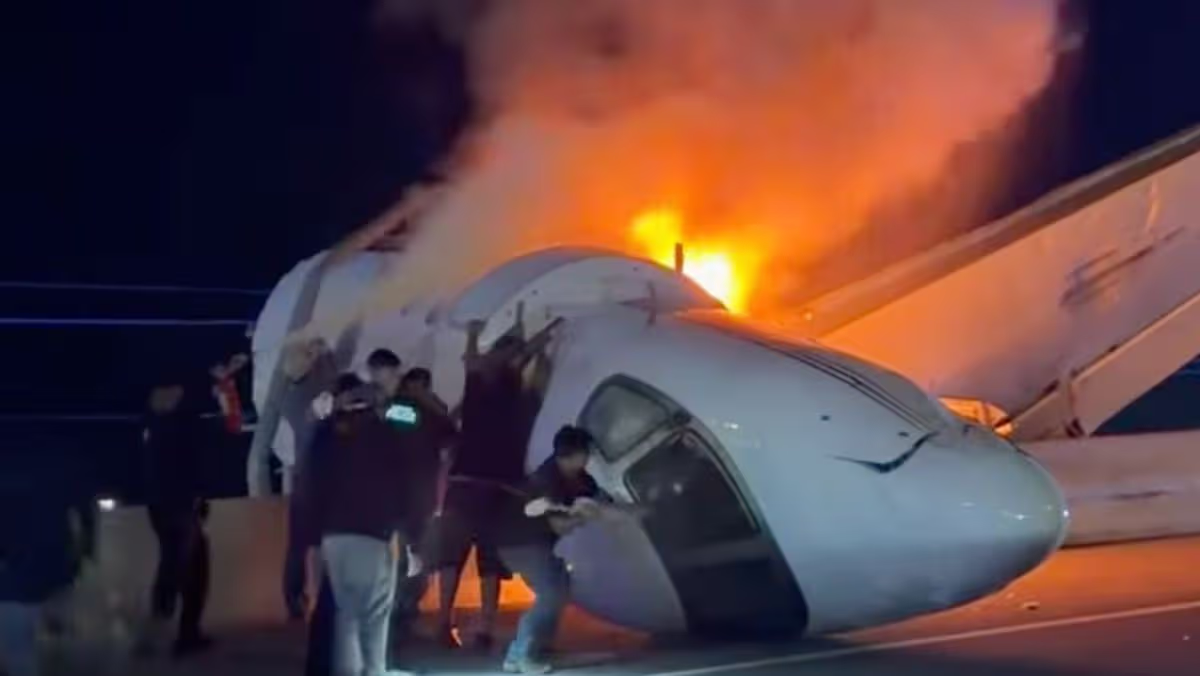
The flight, operated by NetJets, had originated from Los Cabos International Airport in Mexico and was en route to Austin-Bergstrom International Airport when catastrophe struck. According to authorities, the pilot contacted air traffic control reporting a dire situation involving both low fuel and a power outage, requesting an emergency landing at Laredo International Airport. Tragically, the aircraft never made it. Just before 10 p.m., the Cessna Citation Latitude twin jet descended onto Texas State Highway Loop 20, clipping a vehicle and sending that motorist to the hospital in stable condition before careening down the roadway, knocking down a light post, and finally coming to a rest on its side, its tail section severed from the burning fuselage.
What followed was a scene of both horror and remarkable heroism, captured on the cellphones of stunned witnesses. As dark smoke poured from the wreckage, ordinary motorists immediately stopped their cars and rushed toward the danger to aid the passengers and crew trapped inside. One individual was seen swinging a sledgehammer against the cockpit glass in a desperate attempt to gain entry, while others worked together to pry open the aircraft’s door using makeshift tools. Zayra Garza, a witness who filmed the scene, described it as surreal, “like part of a movie.” She watched as her husband and others ran to help, seeing three individuals who appeared to be teenagers escape from the opened door, followed by a pilot and another crew member who were attempting to extract an unconscious passenger.
The rescue efforts were fraught with extreme peril. Police officers arrived and helped prop open the door, but they, along with the civilian rescuers, were met with intense, billowing smoke. Five officers would later be treated at a hospital for smoke inhalation. A firefighter courageously climbed into the burning cabin to reach the remaining passenger. Garza recalled the overwhelming fear that the aircraft might explode at any moment, a fear that underscored the incredible bravery of those who ignored their own safety. Despite these valiant efforts, the toll was severe. Police initially confirmed one fatality at the scene, which was later confirmed to be Joshua Baer, though the full accounting of all six souls on board remained under investigation in the immediate aftermath.
This accident marked a somber point in a tragic series of aviation incidents across the United States that week, highlighting the inherent risks of flight even with advanced technology and training. Just days prior, a B-52 bomber crash during a test flight in California claimed eight lives, and a skydiving plane crash in Missouri killed twelve people. The National Transportation Safety Board and the Federal Aviation Administration launched a full investigation into the causes of the Laredo crash, with NetJets pledging full cooperation. The preliminary focus on the pilot’s reports of mechanical failure and low fuel would form the core of a complex inquiry into this heartbreaking event.
Joshua Baer’s legacy, however, extends far beyond the circumstances of his untimely death. His work through Capital Factory provided not just funding but a foundational support system for startups, embodying the collaborative spirit of Austin itself. He built more than a company; he fostered a community, mentoring a generation of entrepreneurs and connecting them with the resources needed to thrive. As the technology world grapples with this immense loss, the images of strangers risking everything to save lives on a Texas highway serve as a powerful, parallel testament to human courage and interconnectedness—the very principles Baer championed in business. He will be remembered not only as a visionary leader but as a man whose impact ignited countless innovations, a flame that will continue to burn brightly in the ecosystem he so passionately built.