
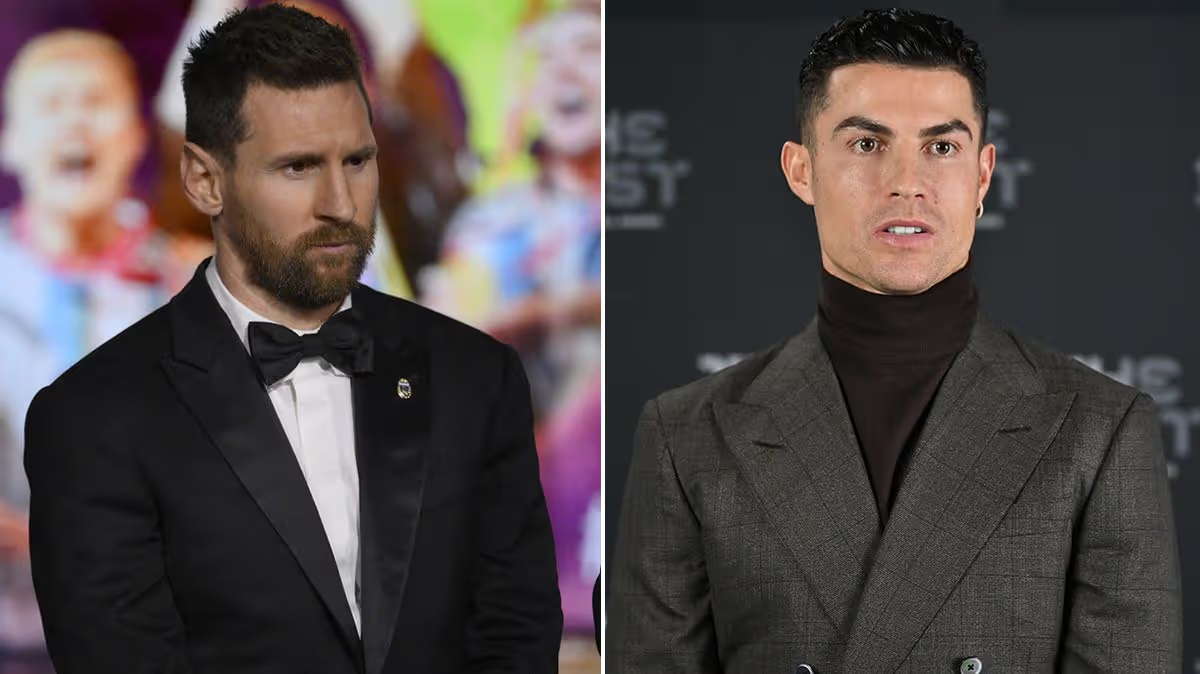



In the glittering world of professional football, the names Cristiano Ronaldo and Lionel Messi are synonymous not only with unparalleled talent but also with astronomical wealth. Their careers, built on staggering weekly salaries and a galaxy of lucrative endorsements, have propelled them into the rarefied air of billionaire status. Ronaldo’s current contract with Al-Nassr in Saudi Arabia reportedly earns him an astonishing £3.42 million per week, while Messi’s deal with Inter Miami is valued at over £20 million annually. Yet, despite these figures that dwarf the earnings of virtually every other athlete, these two legends of the sport do not hold the title of the world’s richest footballer. That crown belongs to a far less famous name: Faiq Bolkiah.
The extraordinary wealth of Faiq Bolkiah stems not from football contracts or sponsorship deals, but from his birthright. At 28 years old, Bolkiah is a member of Brunei’s royal family, the son of Prince Jefri Bolkiah and nephew of the Sultan of Brunei, Hassanal Bolkiah. His personal net worth is estimated at around £15.7 billion, a fortune that places him in a financial stratosphere entirely separate from the game’s superstars. To contextualize this staggering sum, Ronaldo’s estimated net worth of £908 million and Messi’s £833 million combined are still seven times smaller than Bolkiah’s individual wealth. In fact, Bolkiah’s resources are so vast that he could theoretically purchase the Dallas Cowboys—the world’s most valuable sports franchise at £10.2 billion—and still retain a residual fortune of approximately £5 billion.
Bolkiah’s path to professional football, however, has been markedly different from his journey to immense wealth. Born in Los Angeles and of Bruneian descent, he was once a promising academy prospect in England. He was first spotted by Southampton at age 13 and later joined Chelsea’s youth system, where he played alongside future stars like Tammy Abraham and Fikayo Tomori. Despite a memorable personal performance in a heavy defeat to Chelsea’s dominant youth side, Bolkiah struggled to cement his place at Cobham. He moved to Leicester City in 2015, describing his time there as “amazing,” but ultimately failed to make a senior appearance for the Foxes.
His subsequent move to Portuguese club Maritimo in 2020 proved to be a regretful chapter. Bolkiah has since expressed frustration, feeling the club’s motivations for signing him were not entirely football-related and that promises of playing time were not honored. This experience, marked by what he perceived as political machinations within the club, led to a significant reassessment of his career path. Determined not to waste further years at clubs where he might not play, Bolkiah made a conscious decision to shift his focus to Asia, a region he had never previously considered for his football development.
Today, Bolkiah plays for Ratchaburi in Thailand’s League 1. His on-field impact has been minimal; in the 2025/26 season, he made only two appearances out of a possible thirty for a team that struggles in the league. While his professional career has not reached the heights he perhaps envisioned as a youth player in England, and while he has no prospect of playing in a World Cup, Bolkiah appears content with his current path. The move to Asia was a calculated decision to prioritize playing football, however modest the stage, over being sidelined at a more prestigious European club.
Thus, the narrative of Faiq Bolkiah presents a fascinating paradox in the football world. On one hand, he exists as the sport’s ultimate financial outlier, a man whose inherited wealth eclipses the earned fortunes of its most iconic and successful practitioners. On the other, he is a journeyman footballer, navigating the lower tiers of the sport with a quiet persistence, far removed from the bright lights of elite competition. His story underscores that wealth and footballing success are not always aligned, and that the title of “richest footballer” belongs not to a global icon, but to a royal heir pursuing his passion on the fringes of the game, a title that even Cristiano Ronaldo and Lionel Messi cannot claim.