

In a poignant reminder of how seemingly minor gestures can carry profound symbolic weight, Ukrainian President Volodymyr Zelensky has expressed hope that several Reform-led local councils in Britain will reverse their recent decision to remove Ukrainian flags from civic buildings. These flags were originally raised in a powerful show of solidarity following Russia’s full-scale invasion in 2022, standing alongside local banners and the Union Jack. Addressing the move in an interview with The Guardian, President Zelensky, with a blend of diplomacy and sober caution, remarked, “I hope they will put it back.” He framed the issue not as a political demand but as a matter of sensitive international fellowship, noting, “the world is so sensitive today. Sometimes little, small mistakes can break big friendship or huge contacts.” His appeal was for dialogue and understanding, urging those involved to “come back to the table, let’s speak, let’s understand each other.” This episode highlights how, in a time of war, the physical symbols of support are deeply felt and closely watched, serving as a barometer of unwavering alliance.
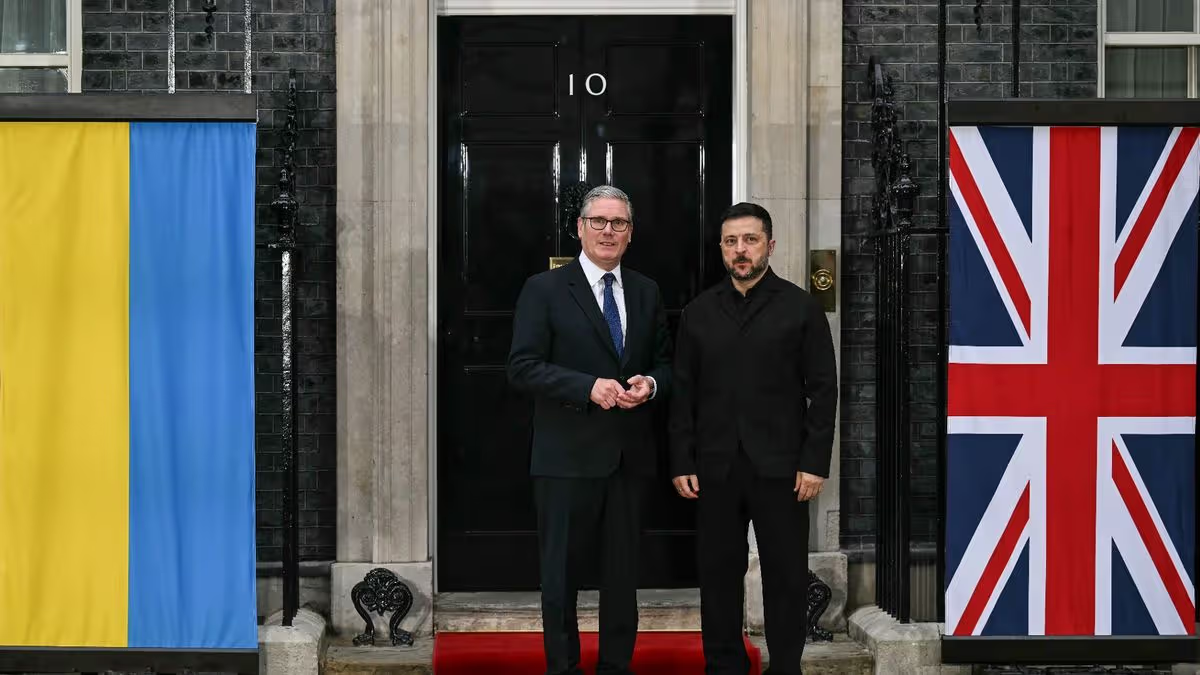
The context for Zelensky’s remarks underscores the high stakes of continued British solidarity. His comments followed a significant meeting at 10 Downing Street with Prime Minister Sir Keir Starmer and the political leaders of France and Germany, Emmanuel Macron and Friedrich Merz, emphasizing Europe’s unified front. In the same interview, Zelensky stressed the mutual necessity of the UK-Ukraine relationship, stating, “British people helped us from the very beginning of this war, it’s true. It’s because of security, not only values… But it’s about security in Europe. It’s in the interests of the UK.” This reinforces the idea that support for Ukraine is not merely an act of charity but a crucial investment in continental and, by extension, British security. The removal of flags, however localized, introduces a discordant note into this narrative of steadfast partnership at a time when public displays of unity are more critical than ever.
Beyond the immediate symbolism, President Zelensky’s visit to London served to deepen personal and diplomatic ties, most notably with the British monarchy. He revealed plans to invite King Charles for a state visit to Ukraine as early as this year, building on the King’s demonstrated support. This followed a private audience between the two, and comes in the wake of King Charles’s pointed show of solidarity last year after former U.S. President Donald Trump’s harsh criticism of Zelensky. A royal visit would represent an unparalleled gesture of moral and symbolic support, elevating the bilateral relationship and showcasing the UK’s commitment on the world stage. It signifies a continuity of support that transcends electoral politics and government changes, rooting the alliance in enduring institutions.
In a separate, revealing interview with Sky News, President Zelensky peeled back a curtain on the shadowy, back-channel diplomacy that has occasionally punctuated the war. He disclosed that Roman Abramovich, the sanctioned former owner of Chelsea Football Club, has acted as an intermediary between Kyiv and Moscow. According to Zelensky, Abramovich met with him in Kyiv, conveying a message from Russian officials and offering to personally deliver Ukraine’s reply directly to Vladimir Putin. Zelensky recounted his firm response: “I said the question is not about us. You are fighting against us on our territory… we will not give you a victory.” He stated he told Abramovich to inform Putin that he was willing to meet “any time from tomorrow” anywhere except Russia or Belarus, potentially with other international leaders. This account, reportedly from a meeting in late May, illustrates Ukraine’s openness to diplomacy while maintaining an uncompromising position on its territorial integrity and the unacceptability of Russian aggression.
These diplomatic revelations and symbolic discussions unfolded against a backdrop of continued and escalating violence. On the very day European leaders were meeting in London, a Russian drone strike killed three civilians waiting at a bus stop in southeastern Ukraine. In a separate, particularly alarming attack, a storage centre for spent nuclear fuel, located just nine miles from the decommissioned Chernobyl power plant, was damaged. While officials assured the public that radiation levels remained within safe limits, the strike evoked chilling memories of nuclear catastrophe and demonstrated the reckless dangers inherent in Russia’s campaign. These attacks precipitated a strong joint statement from Starmer, Macron, and Merz, who condemned Russia’s “large-scale missile and drone attacks” and called on President Putin to agree to “an immediate and complete ceasefire.” The stark contrast between high-level diplomacy and the brutal reality on the ground could not be more pronounced.
Ultimately, President Zelensky’s appeals—from the subtle request to restore flags on town halls to the direct account of secret diplomatic exchanges—paint a picture of a nation engaged in a multi-front struggle. It is a fight not only on the battlefields of Donbas but also for the consistent, visible support of its allies, and for a just diplomatic resolution that preserves sovereignty. The removal of a flag may seem a small local matter, but in the grand, painful narrative of this war, every symbol of solidarity is a thread in a larger tapestry of resistance. Zelensky’s message is clear: in times of protracted conflict, vigilance, unity, and the maintenance of moral clarity are paramount. The strength of the friendship between nations is often tested not in grand declarations, but in the preservation of these small, steady tokens of shared resolve.