

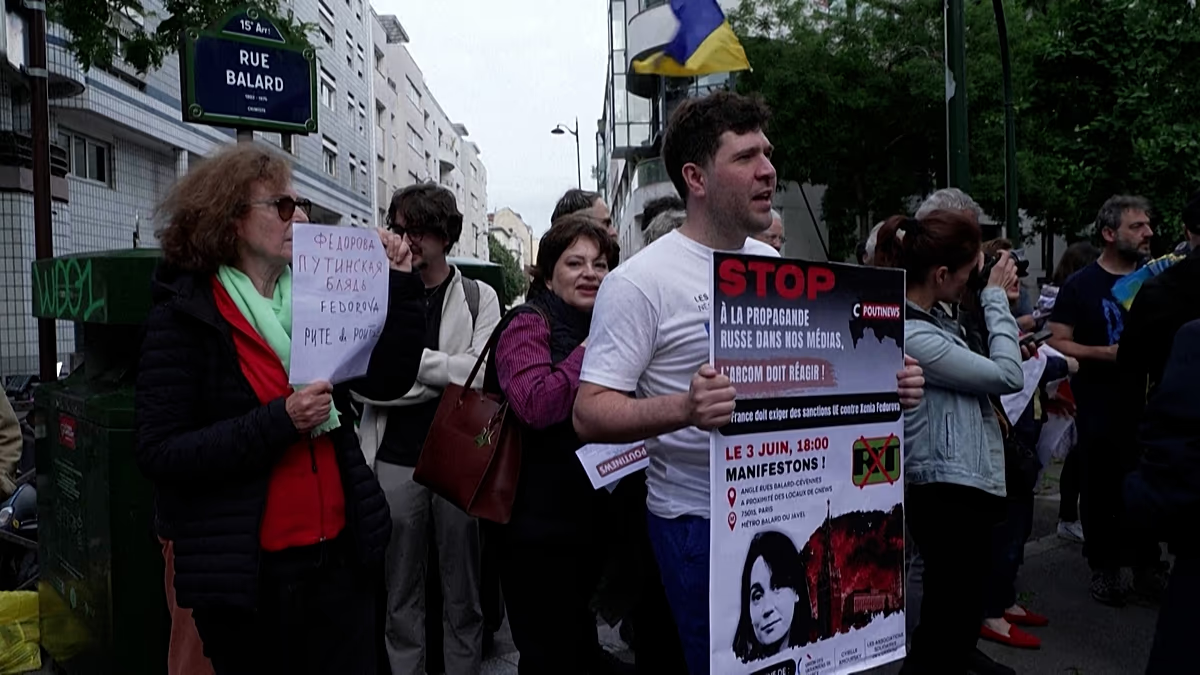
In a recent and telling episode in Paris, a public demonstration unfolded that speaks volumes about the contemporary tensions simmering within French media and politics. Protesters gathered to voice sharp criticism against commentator Nadezhda Fedorova, who they accuse of being a conduit for Kremlin-aligned narratives. Their specific grievance lies with the platforms that amplify her voice: media outlets owned by influential French entrepreneur Vincent Bolloré, namely the news channel CNews, the radio station Europe 1, and the weekly newspaper Le Journal du Dimanche. The demonstrators, carrying signs denouncing what they labeled as war propaganda, called upon French authorities and media regulatory bodies to exercise greater scrutiny. The presence of several elected officials and journalists at the rally underscored that this was more than a casual public grievance; it was a pointed political statement. Their central argument posited that Fedorova’s rising profile is not merely a media issue but a potential national security concern, one that demands attention as the country looks ahead to the high-stakes 2027 presidential election. This protest, therefore, was not just about one commentator but about the perceived health of the French information ecosystem at a precarious geopolitical moment.
The roots of this controversy are deeply entangled with the aftermath of Russia’s full-scale invasion of Ukraine in February 2022. Prior to that, Fedorova was a figure associated with RT France, the French-language arm of the Russian state-controlled network RT. Following the invasion, the European Union enacted sanctions that forced RT France to cease its operations. For critics, Fedorova’s subsequent migration to prominent mainstream French outlets represents a troubling phenomenon: the seamless transplantation of perspectives they see as aligned with Moscow’s interests into the heart of the domestic media landscape. The core accusation is that this provides a continued, and arguably more legitimized, platform for narratives that seek to justify Russian actions or sow discord within Western democracies. The protest in Paris was a physical manifestation of the demand for regulators and policymakers to formally examine this pathway and the influence it may wield, questioning whether the boundaries of acceptable commentary have been transgressed.
Naturally, this demand collides with one of democracy’s most cherished principles: freedom of the press. Defenders of this freedom, and of the media outlets in question, offer a counter-argument that is foundational to liberal societies. They contend that in a free democracy, editorial teams must retain the autonomy to choose their contributors and present a range of viewpoints, even controversial ones. To institute special scrutiny or bans based on a commentator’s past affiliations or perceived biases, they warn, sets a dangerous precedent that could be used to silence a wide spectrum of dissent. The Bolloré-owned outlets themselves would likely argue they are simply offering diverse commentary in a competitive media market. This creates a fundamental clash of values—between the imperative to protect public discourse from foreign manipulation and the imperative to protect it from state overreach and censorship.
The French state finds itself navigating this treacherous fault line. Authorities have publicly acknowledged the genuine and growing concerns about foreign influence operations targeting the French public. Yet, their response is characteristically measured, emphasizing that in a democratic system governed by the rule of law, there are clear legal limits to state intervention in media content. Existing laws against hate speech, defamation, and the direct incitement of violence provide a framework, but the subtler realm of geopolitical narrative-shaping often operates in the grey areas between these clear lines. The government’s stance, therefore, is one of cautious vigilance, insisting that any action must be precisely calibrated to fit within strict legal boundaries. This careful dance highlights the immense difficulty of the task: how to legally and effectively counter sophisticated disinformation without eroding the very democratic liberties that define the nation.
This Parisian protest is, in reality, a microcosm of a profound and pervasive challenge facing not just France, but all of Europe. The digital age has collapsed informational borders, making every nation’s public sphere a potential battlefield for influence. The balancing act is extraordinarily delicate. On one side of the scale lies the open society—committed to free debate, robust journalistic inquiry, and the messy but vital exchange of ideas. On the other side rests national security and democratic integrity, threatened by adversarial states that weaponize information to destabilize, polarize, and undermine trust in institutions. Countries are scrambling to develop tools—from media literacy initiatives and transparency laws about ownership to more robust regulatory oversight—that can add weight to the security side of the scale without tipping the entire balance over. The French debate over a single commentator’s media presence is a live experiment in where that equilibrium point might lie.
Ultimately, the significance of this event extends beyond the career of Nadezhda Fedorova or the editorial policies of Vincent Bolloré’s media empire. It is a symptom of a collective anxiety in an era of hybrid warfare, where tanks are accompanied by tweets, and invasions are preceded by years of narrative seeding. As France marches toward 2027, the election will not be contested only by candidates on the stump, but within the countless commentaries, talk shows, and newspaper columns that shape public perception. The protesters in Paris are sounding an alarm, fearing that this invisible contest is already being unfairly influenced. Their action forces a critical public question: In the name of free speech, what kinds of speech, and sponsored by which actors, can a society tolerate when that very tolerance might be exploited as a weapon? The search for an answer to that question, one that safeguards both liberty and security, remains the defining media and political dilemma of our time.