


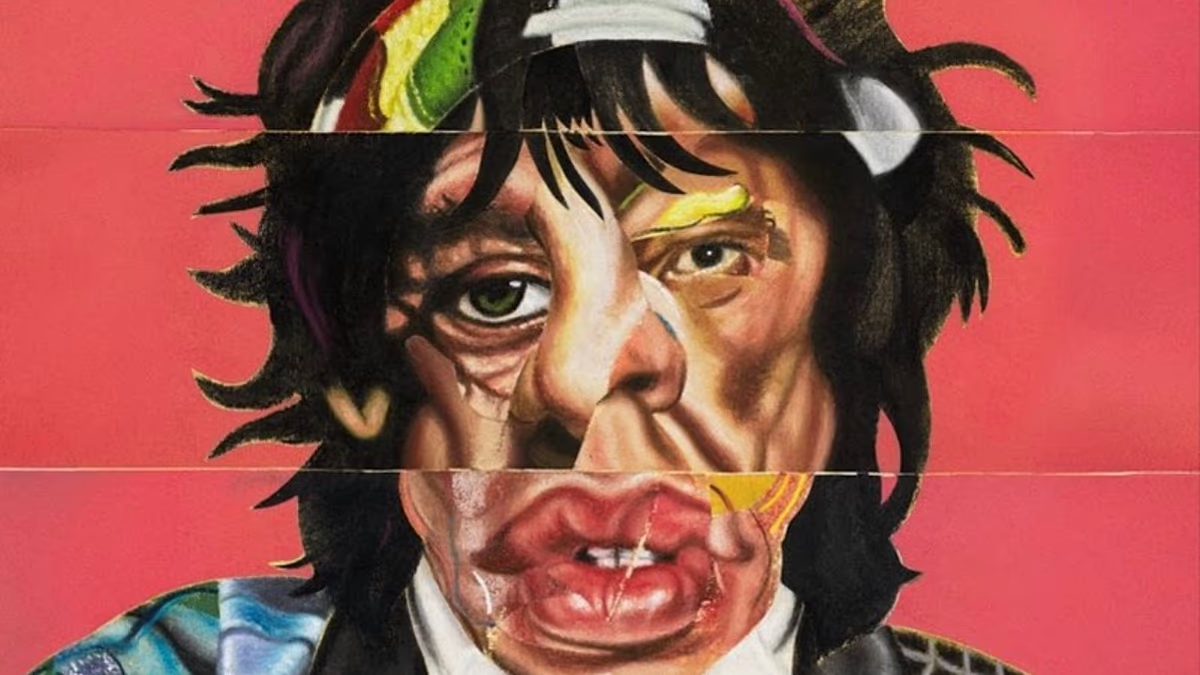
In a world that often feels fragmented, there is something profoundly comforting about the enduring rumble of The Rolling Stones. The legendary rockers have announced that their 25th studio album, ‘Foreign Tongues,’ will arrive on July 10th, serving as a swift follow-up to 2023’s acclaimed ‘Hackney Diamonds.’ The record promises a potent dose of the band’s signature energy, teased by two initial singles: the raucous ‘Rough and Twisted’ and the more melodic ‘In The Stars.’ Adding to the intrigue are star-studded guest appearances from icons Paul McCartney and The Cure’s Robert Smith, suggesting a collaborative spirit fueling this new chapter. However, amidst the excitement for the music, a single, jarring visual has sparked a widespread conversation – the album’s artwork, a bizarre cartoonish collage of Mick Jagger, Keith Richards, and Ronnie Wood’s features arranged like a police sketch or a scrambled slide puzzle.
This reaction highlights the strange and significant alchemy of album art. It is the visual handshake, the first impression that can elevate a collection of songs into a cultural artifact or, conversely, become a distracting curiosity. One can imagine the creative process: months of perfecting lyrics, honing guitar tones, and building harmonies, all leading to this crucial final step of presentation. For a band like The Stones, with a legacy of iconic sleeves like ‘Sticky Fingers’ and ‘Exile on Main St.,’ the oddity of the ‘Foreign Tongues’ cover feels particularly pronounced. It is, admittedly, a subjective reaction to a piece of art, and the music itself remains promising. Yet, it invites us to reflect on how a cover can frame our listening experience, for better or worse.
In fact, the Stones’ new artwork is a gentle spring breeze compared to the howling hurricanes of aesthetic misfortune found in music history. A survey of truly perplexing album covers reveals a fascinating spectrum of misjudgment, from the innocently dated to the psychologically unsettling. The 1960s offered Paddy Roberts’ ‘Songs For Gay Dogs,’ a title and image whose context has radically shifted, and the terrifyingly intense stare of German singer Heino on ‘Liebe Mutter,’ which feels less like a tribute to mother and more like a portrait of a stalker. The 1970s gave us Robert Wotherspoon’s ‘Music to Massage Your Mate By,’ where the promise of easy listening is undermined by the couple’s expression of profound despair, and the Scorpions’ ‘Lovedrive,’ a rare miss from design legend Storm Thorgerson featuring a woman and a man in a bizarre, waxy limousine scenario.
The journey into the surreal accelerates from the 1980s onward. This era brought us Ringo Starr’s ‘Stop and Smell The Roses,’ where his floating head beside a giant, grasping hand ventures into the uncanny valley, and Crosby, Stills & Nash’s ‘Live It Up,’ a baffling lunar landscape adorned with floating hot dogs. The dawn of the new millennium saw Limp Bizkit’s deliberately grotesque ‘Chocolate St★rfish and the Hot Dog Flavored Water,’ an accurate visual metaphor for their nu-metal sound, and William Hung’s ‘Hung For The Holidays,’ a cover whose sheer, unironic joy is somehow haunting. Then there are the covers that seem to actively challenge the viewer, like the Yeah Yeah Yeahs’ ‘Mosquito,’ featuring a giant insect menacing a baby, or Green Day’s ‘Father Of All Motherfuckers,’ a garish, vomiting-unicorn sticker that perfectly mirrored the album’s critical reception.
Some misfires stem from over-literal interpretation, like Maroon 5’s ‘Overexposed,’ or from puzzlingly low-effort execution, exemplified by Eric Clapton’s ‘Old Sock,’ which resembles a blurry vacation selfie. Others are memorable for their sheer, unadulterated oddity, such as Kevo Muney’s ‘Baby G.O.A.T.,’ a surreal tableau of a screaming goat giving birth to a full-grown man. Even legends are not immune, as seen in the posthumous release of David Bowie’s ‘Toy,’ which awkwardly superimposes his face onto a child’s body, a disservice to the music within. These covers, whether hilarious, horrifying, or simply confusing, remind us that the line between iconic and infamous is often very thin, paved with the best of intentions and the oddest of artistic choices.
So, while the internet collectively raises an eyebrow at the disjointed faces on ‘Foreign Tongues,’ history provides a gentle consolation. The Rolling Stones’ latest cover may be a curious choice, but it exists within a rich and riotous tradition of aesthetic adventures gone awry. It is unlikely to haunt our dreams like Heino’s stare or confuse our senses like lunar wieners. Ultimately, it is a momentary talking point on the path to the music itself. When July 10th arrives, the conversation will rightly return to the chords, the lyrics, and the timeless swagger that has defined the band for over six decades. The cover will become a footnote, a quirky thumbnail on a streaming platform, as the sounds of Jagger, Richards, Wood, and their illustrious guests take center stage once more, proving that while eyes may wander, it is the ears that have the final say.