



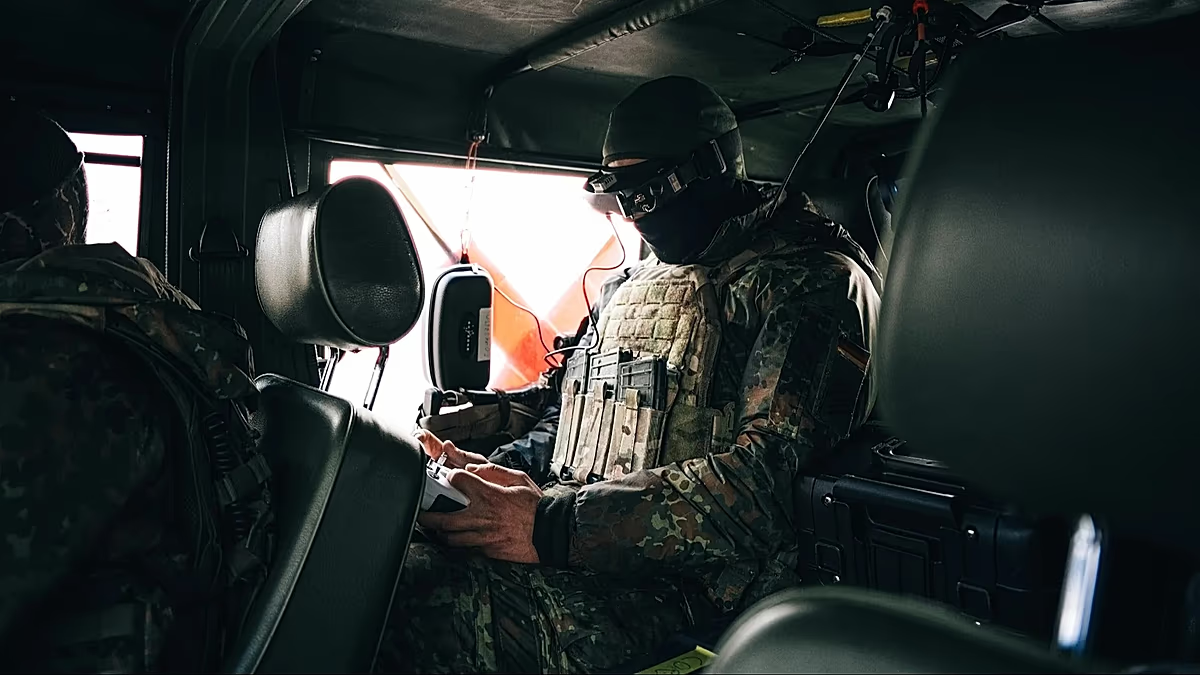
The nature of military power is undergoing a profound transformation, and a recent multinational exercise in Germany offers a vivid glimpse into this new reality. During Grand Quadriga 2026, soldiers at the Seedorf training grounds were engaged in an activity that would have been unthinkable a generation ago: they were building their own weapons. Instead of solely conducting traditional live-fire drills, troops from Airborne Engineer Company 270 and Paratrooper Regiment 31 collaborated with the Bundeswehr’s Cyber Innovation Hub (CIHBw) to construct, test, and refine first-person view (FPV) drones. These small, agile unmanned aircraft, piloted remotely with an onboard camera providing a live feed, were then used to identify and engage targets within seconds. This initiative, part of the “Spark Cells” programme—decentralised innovation units embedded within the forces—signals a radical departure from the past. The goal is not merely to use technology, but to master it to the point where soldiers can adapt, repair, and even create tools independently, fostering a new level of self-reliance and tactical agility.
This shift is driven by urgent lessons from contemporary battlefields, which have starkly demonstrated that warfare is now fundamentally digital and unmanned. The conflicts in Ukraine and the Middle East have proven drones to be not merely supplemental tools, but structurally defining elements of modern combat. They have collapsed the timeline between identifying a target and striking it, transforming reconnaissance, firepower, and command decisions. As a spokesperson for the CIHBw explained, controlling the tactical airspace now confers strategic advantages in speed, transparency, and precision. Lieutenant General Dr. Christian Freuding, the Army Chief of Staff, encapsulated this new paradigm by declaring data “a form of ammunition.” His logic is compelling: supremacy now belongs to those who can see more, process information faster, build a clearer picture of the battlefield, and act with decisive precision. In essence, the flow and application of data has become the critical path to victory.
Consequently, the very role of the soldier is being redefined. The modern warfighter is no longer just a user of issued equipment but must evolve into a technologically literate problem-solver. As the CIHBw spokesperson noted, skills like improvisation, networked thinking, and the ability to understand and question complex systems are now as vital as traditional martial prowess. The soldier is becoming a co-developer. This cultural change was embodied in the Seedorf exercise, where troops applied their frontline experience to assemble drone prototypes using 3D printers and commercial components, testing them in simulators and real-world conditions. This hands-on process embodies a powerful new mantra: “The future doesn’t wait for authorisation.” When a problem arises in the field, the soldiers who face it are often best positioned to find the fastest, most direct solution. Empowering them to prototype and experiment creates unmatched speed and operational relevance.
This grassroots innovation, however, is not intended to replace traditional defence industry procurement but to create a vital hybrid model. The Bundeswehr envisions a force that adeptly combines centrally acquired, complex platforms with decentralised, in-house adaptation and rapid prototyping. This approach aims to reduce dependencies, increase flexibility, and ensure that formal procurement is informed by real, frontline experience. The CIHBw and its Spark Cells act as essential bridges, connecting the practical needs of troops with innovative start-ups and technology, and helping to turn field ideas into workable solutions. The key question, as the spokesperson stated, is no longer whether soldiers should develop solutions, but how to effectively organise and harness this creativity. The objective is to build an adaptive and resilient armed force where innovation flows both from the top down and, crucially, from the bottom up.
Of course, this new model operates within necessary boundaries. For highly sensitive or exceptionally complex systems, formal development and procurement channels remain essential. The Spark Cell initiative is not a call for chaos, but for structured empowerment. The challenge is to integrate this agile, feedback-driven innovation into the broader military framework, ensuring that successful soldier-driven developments are fed back into the official system. It represents a balanced approach: granting troops greater autonomy to innovate within a defined space, while maintaining rigorous standards for security and integration. This balance seeks to capture the agility of a startup mentality within the disciplined structure of a military institution.
Ultimately, the scene in Seedorf is a microcosm of a much larger evolution. It reflects a military coming to terms with a world where technological change is relentless and adversaries move quickly. By transforming soldiers from passive operators into active designers and problem-solvers, the Bundeswehr is attempting to build a deeper, more organic form of resilience. It is a recognition that in the age of data-as-ammunition, the most potent resource may not just be the technology itself, but the human capacity to understand, adapt, and reinvent it under pressure. The future of military effectiveness may well depend on this fusion of human ingenuity and technological tools, fostered from the ground level of the force itself.