




The long-held view of Parkinson’s disease as a single, uniform neurological disorder is being fundamentally challenged by groundbreaking research. A new study, published from the laboratories of the VIB-KU Leuven Center for Brain & Disease Research in Belgium, suggests that what we call Parkinson’s may, in fact, be several biologically distinct conditions masquerading under one name. This revelation emerges not from observing human patients directly, but from an innovative approach using the humble fruit fly and sophisticated machine learning. The implications are profound, pointing toward a future where diagnosis and treatment are no longer one-size-fits-all but are precisely tailored to the unique biological drivers of an individual’s illness. This shift in understanding is urgently needed; the World Health Organization has noted a rapid increase in disability and death from Parkinson’s, estimating over 8.5 million individuals living with the disorder in 2019, a number that underscores the critical need for more effective therapeutic strategies.
The core problem that motivated this research is a paradox familiar to both scientists and clinicians: while patients present with a unifying set of clinical symptoms—such as tremors, stiffness, and progressive movement difficulties—the disease can be triggered by mutations in dozens of different genes. Each of these genetic errors is thought to disrupt the brain’s intricate machinery in subtly different ways. This biological diversity has been a major roadblock in developing effective drugs. A treatment designed to correct a specific molecular pathway might help a subset of patients but show little to no effect in others, leading to repeated clinical trial failures and a lack of disease-modifying therapies. As Professor Patrik Verstreken, head of the research group, explains, viewing the disease only through the lens of symptoms creates a false unity. “But when you look under the hood at the molecular level,” he says, “then you see that they fall into subcategories. And that’s important because one drug to target the different molecular dysfunctions in all Parkinson’s disease essentially doesn’t exist.”
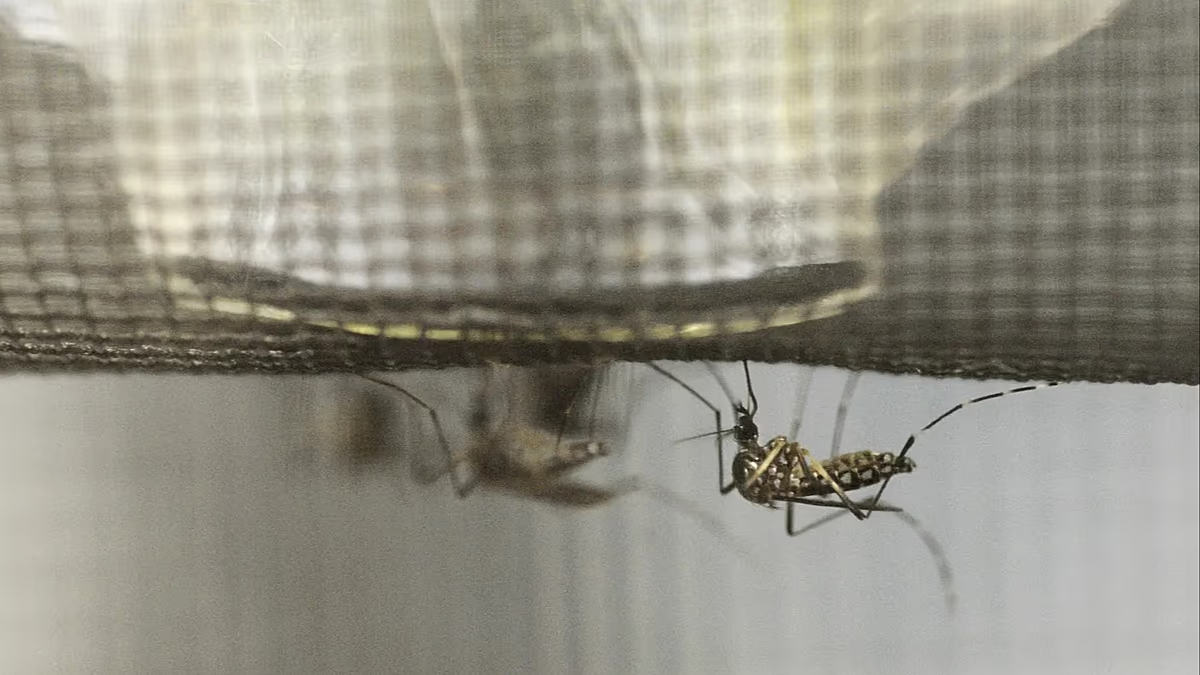
To systematically map this molecular diversity, the researchers took a uniquely unbiased approach. They engineered fruit flies to carry mutations in 24 different genes known to be linked to Parkinson’s disease in humans. Rather than testing preconceived ideas about each mutation, they simply observed the flies’ behavior over time—monitoring movement, activity, and other traits—and fed this vast dataset into machine learning algorithms. As first author Natalie Kaempf describes, “We came in without any preconceived notions… We just monitored their behaviour over periods of time.” The computer analysis revealed clear, natural patterns. The flies, and by implication the genetic forms of Parkinson’s they model, did not behave as one chaotic mass; they clustered into two main groups and, more precisely, five distinct subgroups. This suggests that despite the variety of genetic causes, they converge onto a limited number of specific biological dysfunction pathways.
This classification is far more than an academic exercise; it is a practical roadmap for future medicine. By clearly defining these subgroups, researchers can now hunt for “biomarkers”—unique biological signatures in blood or cerebrospinal fluid—specific to each category. This could one day allow doctors to diagnose not just “Parkinson’s disease,” but a particular biological subtype of it. Most importantly, it enables the development of precision treatments. “By having these subcategories, we can now go and look within that group of patients with those particular mutations, search specific biomarkers, and develop drugs tailored to each group,” Verstreken emphasizes. The team demonstrated this principle directly in their flies. They found that a compound that successfully alleviated Parkinson’s-like symptoms in one genetic subgroup had no therapeutic effect in another. This concrete evidence underscores that subgroup-specific drugs are not just a theory but a achievable necessity.
It is crucial to temper excitement with the acknowledgment that this research, while promising, is in its early stages. The work was conducted in fruit fly models, not human patients. Flies offer a powerful genetic and screening tool, but translating these findings into human clinics will require extensive validation in human cells and, eventually, carefully stratified clinical trials. However, the study powerfully points the compass toward a new direction for neurology: a future where Parkinson’s treatment is matched to the biological root cause of a person’s disease. Furthermore, the researchers believe the methodological breakthrough has wider implications. The same approach of using behavioral or molecular profiling combined with machine learning to classify subtypes could be applied to other complex disorders like Alzheimer’s disease, various forms of autism, or psychiatric conditions, which are also likely umbrella terms for multiple biologically distinct illnesses.
In summary, this research reframes Parkinson’s disease from a singular entity to a collection of related but distinct disorders. By moving the focus from the common symptomatic endpoint to the diverse molecular starting points, it offers a path out of the therapeutic stagnation that has long plagued the field. The vision it presents is one of precision neurology—where a diagnosis reveals not just the name of the disease, but its specific biological passport, guiding the way to a treatment with the highest chance of success. While the journey from fruit flies to pharmacy shelves will be long, this study provides a crucial and hopeful new map for that journey, promising a more personalized and effective future for the millions living with Parkinson’s disease worldwide.