

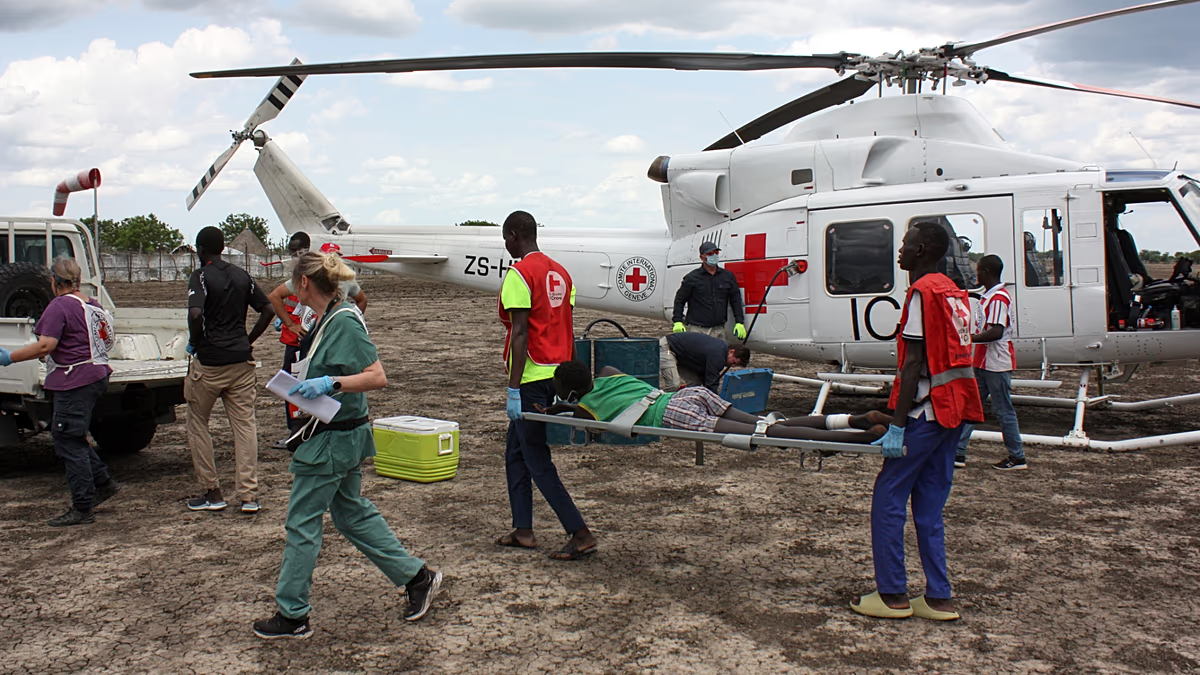
In a rare and powerful display of unity, the heads of the world’s most prominent humanitarian medical organizations—the International Committee of the Red Cross, the World Health Organization, and Médecins Sans Frontières (Doctors Without Borders)—have issued a joint and desperate plea to global leaders. Their message is stark: the political leadership required to protect healthcare in war zones is absent, and the international community is witnessing a profound moral failure. A decade ago, there was hope. In 2016, the UN Security Council unanimously adopted Resolution 2286, a landmark commitment by over 80 nations to shield medical personnel, hospitals, and ambulances from the horrors of conflict. The leaders now state plainly that this resolution is not a milestone to celebrate, but a promise that has been shattered. The harm it sought to prevent has not diminished; it has escalated. They frame the crisis in the most human terms possible: when a hospital is bombed or a doctor is killed, it is more than a breach of protocol—it is a crisis of our shared humanity. The sanctity of healthcare, they argue, is the bedrock of civilized conduct in war, and its erosion signals a catastrophic breakdown of the very rules designed to limit suffering.
The grim statistics and geography of this crisis paint a picture of relentless, widespread violence. Over the last ten years, no conflict zone has been spared. The world has watched in horror as hospitals in Syria and Yemen have been leveled by airstrikes, as maternity wards in Ukraine and Gaza have been shelled, and as clearly marked ambulances in Cameroon, Haiti, and Lebanon have been targeted. The World Health Organization’s data for 2025 alone recorded 1,348 separate attacks on healthcare, claiming 1,981 lives. The human cost is concentrated in places like Sudan, where 1,620 people were killed in such attacks, followed by Myanmar, Palestine, Syria, and Ukraine. The trajectory is moving in the wrong direction, with 2026 already seeing hundreds of attacks across 13 countries. Particularly alarming is the situation in Ukraine, where attacks on healthcare have risen by nearly 20% since 2024. Since the full-scale invasion began, over 2,800 documented assaults have damaged everything from rural clinics to medical supply warehouses, creating a landscape where seeking help is itself a life-threatening gamble.
This is not, the organizations insist, a failure of international law. The rules are clear and have been agreed upon. The failure is one of political will and enforcement. The mechanisms for accountability are weak, and the commitment to uphold the principles enshrined in Resolution 2286 has faded in the face of geopolitical interests and battlefield expediency. When hospitals are struck, the aftermath is not just physical rubble but a collapse of trust. Communities lose their last sanctuaries, and healthcare workers—who take an oath to treat all—are forced to operate in terror. The joint letter emphasizes that these are not abstract violations but daily realities witnessed by their teams on the front lines. They see the pediatrician killed by shrapnel, the dialysis patient who cannot reach treatment, and the surgeon operating by flashlight in a basement. Each attack creates a ripple effect, paralyzing entire health systems and ensuring that civilians suffer long after the bombs have fallen, from preventable diseases and untreated wounds.
The consequences of this war on healthcare are profound and multigenerational. Destroying a hospital is an act with a long half-life of suffering. It means vaccinations stop, disease surveillance collapses, and chronic conditions like diabetes or heart disease go unmanaged. It means women give birth without skilled attendants, and cancer patients lose access to chemotherapy. In conflict zones like Gaza, Sudan, and Myanmar, the dismantling of health infrastructure has paved the way for deadly outbreaks of cholera, measles, and malnutrition. The psychological trauma inflicted on surviving medical staff and a population that can find no safe haven is immeasurable. The organizations argue that attacking healthcare is a strategy that weaponizes public health, using the suffering of civilians as a tool of war. It creates a vicious cycle where conflict breeds disease and injury, and the destruction of the medical system ensures that those ailments become death sentences, thereby deepening the humanitarian catastrophe.
What, then, is the path forward? The humanitarian leaders call for more than just renewed verbal commitments. They demand concrete, courageous political action. This includes sustained diplomatic pressure on all parties to conflict to respect international humanitarian law, and a rejection of the rhetoric that justifies attacks on medical facilities as collateral damage or as responses to legitimate military threats. There must be robust, independent investigations into every attack, followed by meaningful accountability for perpetrators to break the cycle of impunity. Nations that are signatories to Resolution 2286 must be held to their promises, using their political and economic influence to uphold these rules. Furthermore, support must be given to local health workers who are the first and last responders in these crises, providing them with the resources and protection they desperately need to continue their lifesaving work.
In conclusion, this unprecedented joint appeal is a sobering alarm bell for our global conscience. It moves beyond policy briefs to articulate a fundamental truth: the protection of healthcare in war is the minimum standard of human decency. When we allow hospitals to become battlefields, we lose more than buildings and lives; we surrender a core principle of our civilization. The letter from the ICRC, WHO, and MSF is ultimately a challenge to everyone who holds power. It asks world leaders to look beyond immediate political and military objectives and see the doctor, the nurse, the newborn, and the grieving parent. Ending violence against healthcare is not a peripheral humanitarian issue; it is the foundational step toward preserving humanity itself amid the chaos of war. The world has the laws and the knowledge to stop this. What it lacks, and what these brave humanitarians are begging for, is the unwavering will to make “never again” a reality for the most vulnerable.