

Dave Fishwick, the Burnley businessman whose spirited crusade to launch a community bank became the heartwarming Netflix film ‘Bank of Dave,’ found himself in the role of an accidental news correspondent on Thursday. Piloting his helicopter over his beloved hometown, he was met with a scene of alarming scale: a colossal plume of black smoke rising into the sky. Reacting with the instinctive concern of a local champion, he immediately began filming, sharing the unfolding emergency in real-time with his followers. His voice, familiar for its no-nonsense Lancashire cadence, was etched with a mix of shock and urgent responsibility, marking a stark departure from his usual messages of community enterprise.
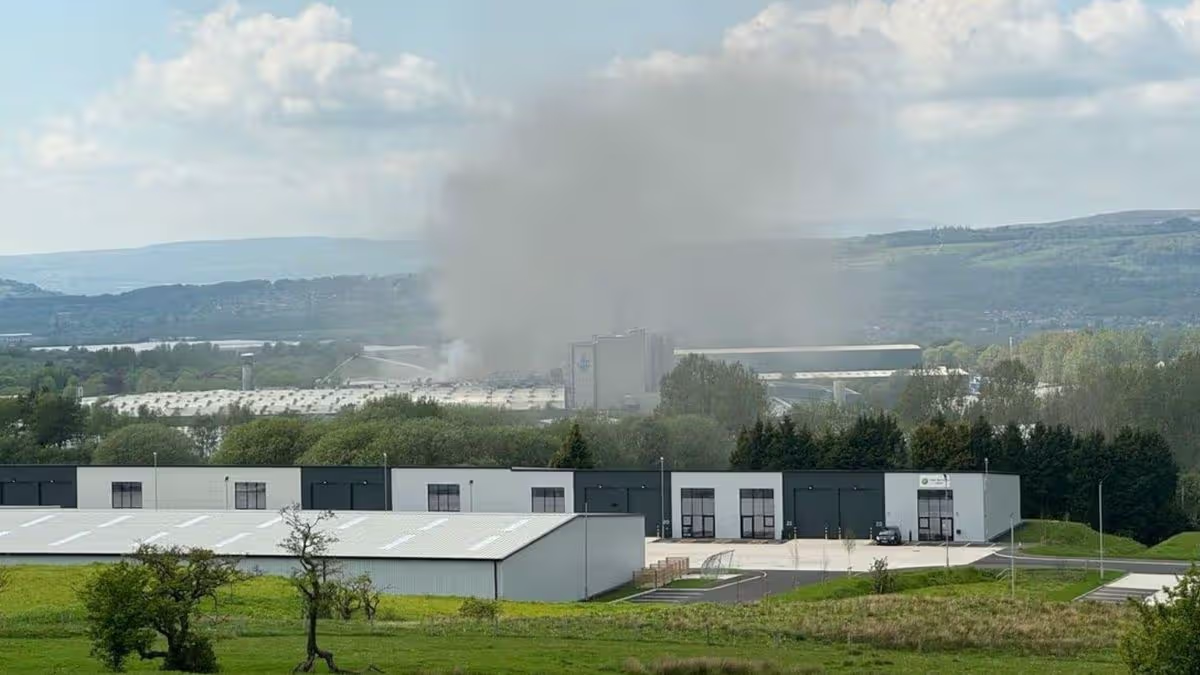
In the video, broadcast directly from the cockpit, Fishwick’s commentary was unvarnished and gripping. “I am just above Burnley, just flying over. I hope everybody is okay,” he began, his words immediately establishing the human stakes. The camera then panned to reveal the source of his anxiety. “There is a huge fire. It is unbelievable how big the fire is, it is unbelievable how big it is,” he repeated, the redundancy underscoring his genuine astonishment. The vantage point from the air provided a terrifying perspective on the inferno’s magnitude, making the distant emergency viscerally real for those watching on their screens. He quickly identified the apparent epicenter, noting, “It looks like the factory roof is going up at the Warburton’s factory,” connecting the abstract blaze to a well-known local landmark.
True to his character—a man who built his reputation on direct action and community support—Fishwick’s next move was pragmatic and civic-minded. “We are just going to ring the fire brigade, and I hope everything is okay,” he stated, transitioning from observer to active participant. Even amidst the chaos, he offered a vivid description of the environmental impact, observing, “The smoke is going up to the clouds,” a simple yet powerful image that conveyed the sheer volume of the combustion. His historical frame of reference added weight to the event; this was no minor incident. “I have not seen a fire like that for a long, long time,” he remarked, drawing on a lifetime of local knowledge to contextualize the disaster’s severity.
Having taken personal responsibility to alert the authorities, Fishwick then provided a crucial update, offering reassurance to a worried community. “We have called the fire brigade, and they are en route,” he confirmed. This action completed a loop of real-time civic engagement: seeing a crisis, reporting it, and mobilizing help, all while keeping the public informed. It was a modern-day example of community watchfulness, enabled by technology but driven by old-fashioned neighbourly concern. His presence in the sky became an asset, providing early confirmation and assessment long before traditional ground-based reporting could arrive.
In a moment that perfectly encapsulated his deep-seated pride in Burnley and its people, Fishwick concluded his impromptu broadcast with heartfelt praise for the emergency services. “A fantastic police and fire brigade service we have in Burnley,” he affirmed. This wasn’t merely a sign-off; it was a testament to his faith in the town’s infrastructure and the individuals who protect it. Even while documenting a potential tragedy, his instinct was to champion his community’s heroes, reinforcing the very spirit of collective resilience that his ‘Bank of Dave’ story celebrated. It was a reminder that behind the media persona and the cinematic portrayal lies a man whose first thoughts in a crisis are for the safety of his neighbours and the effectiveness of their public servants.
Ultimately, this brief helicopter video captures more than just the visual drama of a major factory fire. It presents a poignant snapshot of Dave Fishwick in his essential element: a connected, proactive, and deeply concerned citizen of Burnley. The incident temporarily recast the self-made millionaire and financial activist into the role of a frontline witness, using his platform and resources not for profit or promotion, but for public awareness and swift action. In doing so, he seamlessly blended the digital age’s immediacy with a timeless sense of local duty, proving that the ethos of community support he famously advocates for extends far beyond the walls of a bank.