


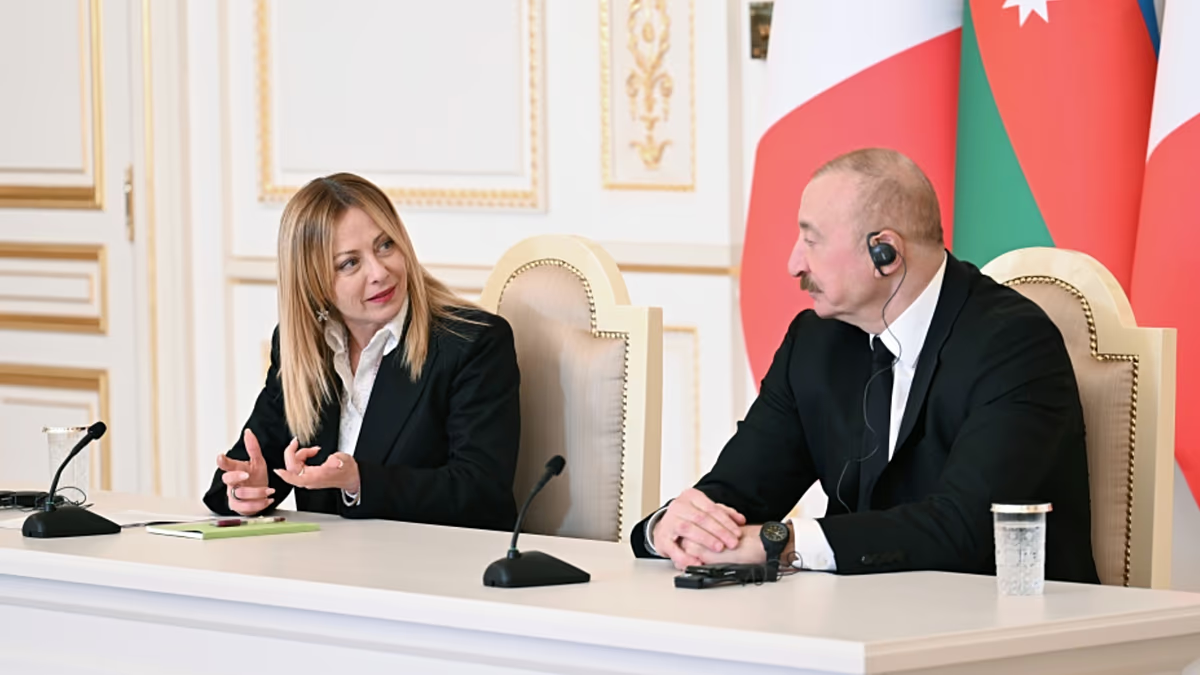
In a significant diplomatic move underscoring the search for stability and energy security, Italian Prime Minister Giorgia Meloni arrived in Baku, marking the first visit by an Italian premier to Azerbaijan in thirteen years. Speaking at a joint press conference with President Ilham Aliyev, Meloni framed the relationship as a vital anchor in turbulent times. “The more instability grows around us, the more important it is to strengthen the certainties we have,” she stated, positioning the Italian-Azerbaijani partnership as a reliable foundation amid spreading Middle Eastern conflicts. This sentiment set the tone for discussions that were intensely pragmatic, focusing on tangible economic and strategic ties rather than abstract diplomacy, reflecting a Europe urgently recalibrating its foreign relationships in a post-Ukraine-invasion world.
The core of the dialogue was undeniably energy. Since Russia’s full-scale invasion of Ukraine in 2022, Italy, as the European Union’s largest importer of Azerbaijani energy, has leaned heavily on Baku to replace lost Russian gas. President Aliyev provided concrete figures, noting that of the 25 billion cubic meters of natural gas Azerbaijan exported last year, 7.5 billion cubic meters were destined for Italy—a market he described as being of “primary importance.” The conversation naturally progressed to how to increase these volumes. The key lies in expanding the capacity of the Trans-Adriatic Pipeline (TAP), the final segment of the Southern Gas Corridor, which transports gas from Azerbaijan through Turkey, Greece, and Albania into southern Italy. Both leaders confirmed that work on this expansion is already underway, a necessary step to solidify Azerbaijan’s role as a critical energy hub for Europe.
The operational success of this energy partnership was detailed by TAP managing director Luca Schieppati. Since its launch, TAP has delivered 47.5 billion cubic meters of gas to Italy, with recent annual deliveries consistently hovering around 9.5 billion cubic meters—covering roughly 16% of Italy’s total gas demand and about a quarter of its pipeline imports, excluding LNG. The pipeline has maintained perfect operational availability, and recent technical upgrades in Greece have already added 1.2 billion cubic meters of annual capacity. This infrastructure is not merely a pipeline but a geopolitical lifeline, allowing Italy to diversify its supply routes away from the volatile Strait of Hormuz and ensuring a steady flow of energy that Meloni described as having been “decisive for the energy security” of her nation.
Beyond energy, the bilateral economic relationship is robust and expanding. Two-way trade reached €10.2 billion last year, cementing Italy’s position as Azerbaijan’s largest commercial partner, while Azerbaijani investments in Italy total €2.5 billion. The cooperation extends into reconstruction and development, with around thirty Italian companies operating in Azerbaijan and twenty-three projects currently underway in the Karabakh region. To further catalyze this economic synergy, both sides announced plans for a major Business Forum in Baku in the latter half of 2026. Meloni emphasized that Italian firms are keen to participate in Azerbaijan’s “360-degree modernisation,” not just domestically but in third-country projects, positioning Italy as “the privileged gateway to the European market” for Azerbaijan’s ambitions as a bridge between Europe and Asia.
The discussions also touched upon broader regional security and diplomacy. Prime Minister Meloni expressed Italy’s support for the normalization process between Armenia and Azerbaijan, suggesting that 2026 could be a “potentially crucial year” for unlocking the South Caucasus’s full economic potential. Furthermore, she revealed a poignant example of behind-the-scenes cooperation: following the outbreak of conflict in Iran in February, Azerbaijan provided crucial support for Italy to evacuate its citizens from Iran, even hosting the temporary relocation of the Italian embassy from Tehran to Baku. Meloni offered explicit thanks for this assistance, highlighting how the strategic partnership extends into crisis management, providing logistical and diplomatic shelter in a neighboring region fraught with danger.
This high-level visit, following closely on the heels of European Council President Antonio Costa’s trip to Baku, sends a clear signal of the EU’s and Italy’s concerted efforts to deepen ties with reliable partners on the bloc’s periphery. It underscores a European strategy where energy security is a fundamental pillar of foreign policy. For Azerbaijan, the engagement with a major EU founding member like Italy reinforces its strategic value beyond being an energy supplier, casting it as a stable, cooperative nexus between continents. For Italy, the partnership provides energy certainty, economic opportunity, and a stable ally in a volatile region—a multifaceted relationship where, as Meloni asserted, the mutual certainty forged between Baku and Rome becomes ever more invaluable as the world around them grows increasingly unstable.