


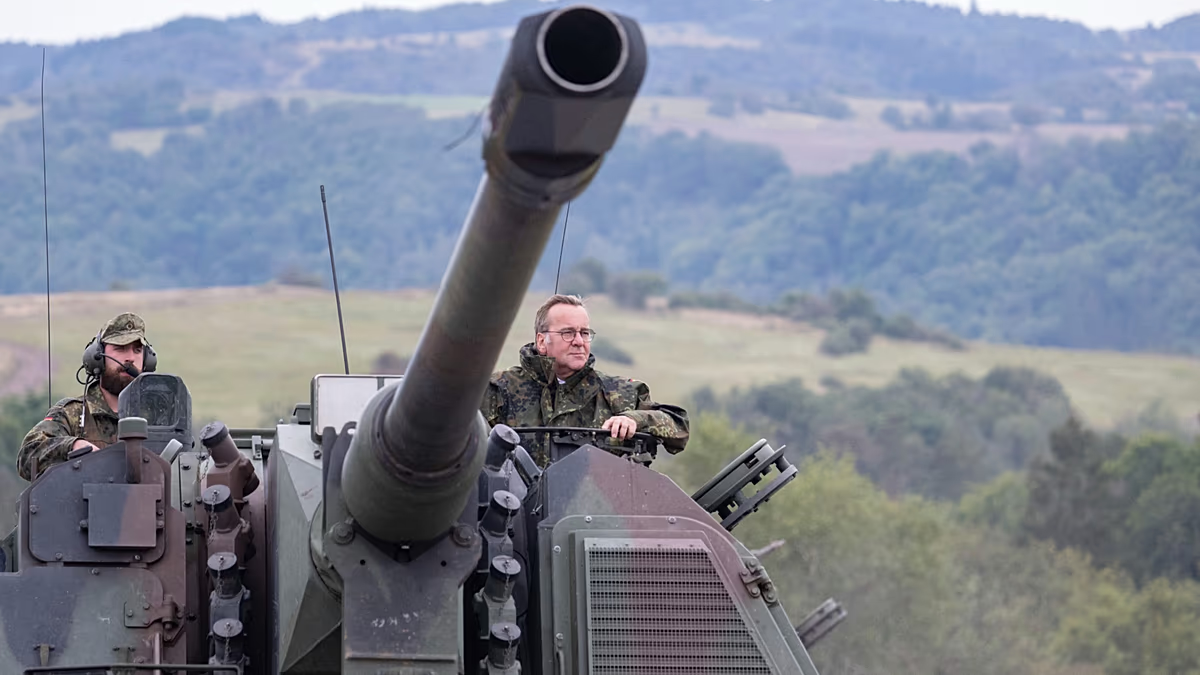
In a significant shift for a nation long defined by post-war pacifism, German Defence Minister Boris Pistorius has unveiled a comprehensive new military strategy, fundamentally reorienting the Bundeswehr to face what he describes as a “more unpredictable and, yes, more dangerous” world. Driven primarily by Russia’s full-scale invasion of Ukraine, the strategy represents Germany’s formal articulation of its own national defence priorities for the first time, moving beyond a planning model historically shaped almost entirely by NATO requirements. While experts like security analyst Dr. Christian Mölling caution that this is an “important first step” and not an overnight transformation, the document marks a pivotal moment. It establishes a framework where Germany defines its own military objectives and capabilities, which it can then bring to the alliance table, signaling a new era of German strategic responsibility within European security.
At the heart of this new approach is a fundamental philosophical rethink: a move away from rigidly counting tanks, ships, and aircraft toward a focus on tangible military capabilities and the actual impact forces can achieve. As Pistorius stated, “It’s not about the exact number… what matters is what the forces can actually do.” This capability-centric model, echoed by Armed Forces Inspector General Carsten Breuer, prioritizes outcomes over specific platforms. It calls for investing in critical areas like integrated air defence, advanced long-range strike systems, and the capacity for data-driven, networked warfare. This shift acknowledges the lessons from Ukraine, where adaptability, technological edge, and specific capabilities have proven more decisive than mere troop numbers, paving the way for a more agile and technologically integrated Bundeswehr.
A cornerstone of these new capabilities is the development of a robust “deep strike” capacity—the ability to precisely hit enemy command centres, supply routes, and critical infrastructure far behind front lines. Recognizing the strategic advantage this has provided in contemporary conflicts, Germany aims to move beyond its current limited capability, which rests largely on the Taurus cruise missile with a 500km range. The future vision includes equipping its new fleet of F-35 fighter jets with advanced munitions like the JASSM-ER cruise missile, extending its reach to approximately 1,000km. This enhancement is not about aggression but about deterrence and defence, aiming to degrade an adversary’s ability to sustain a conflict from the outset and thereby protect German and allied forces. Notably, Pistorius has kept specific operational scenarios and deployment plans secret, quipping that public details would be akin to adding Vladimir Putin to an email distribution list.
This strategic overhaul is matched by an ambitious plan to significantly grow the Bundeswehr itself, targeting a total strength of 460,000 personnel through a combination of active troops and a revitalized reserve force. With current active numbers at around 184,300, this expansion will be phased, first focusing on rapid readiness improvements by 2029, followed by the development of new capabilities to match incoming weapon systems. To meet these ambitious recruitment goals, the ministry is adopting a pragmatic “overbooking” policy, accepting more applicants than there are immediate posts. This growth is deemed essential, as new high-tech capabilities are meaningless without sufficient, well-trained personnel to operate and sustain them over the long term.
Crucially, the strategy redefines the role of reservists, transforming them from a peripheral backup force into an integral, co-equal pillar of national defence. “We explicitly see the new reserve on an equal footing with active troops,” Pistorius emphasized. In a crisis, Germany envisions itself as the central logistical hub for European defence, requiring the protection of critical infrastructure, supply lines, and troop movements on home soil. This vast homeland security and support mission will fall largely to reservists, making them, in Pistorius’s words, “the hinge between the military and civilian society.” This integration ensures that civilian expertise and local knowledge become a core asset of national defence, strengthening societal resilience.
Finally, the strategy acknowledges that a modern military cannot be hamstrung by outdated processes. A parallel push for internal agility aims to slash bureaucracy, digitize paper-based systems, and leverage artificial intelligence to streamline operations. “Reporting obligations will only remain where they add real value,” Pistorius asserted. Importantly, the document is conceived not as a static decree but as a living framework, to be regularly updated as threats evolve and new technologies emerge. In totality, this new German military strategy is more than a procurement list; it is a cultural and operational blueprint for a nation stepping decisively into its role as a cornerstone of European security, prepared for the challenges of a contested century.