


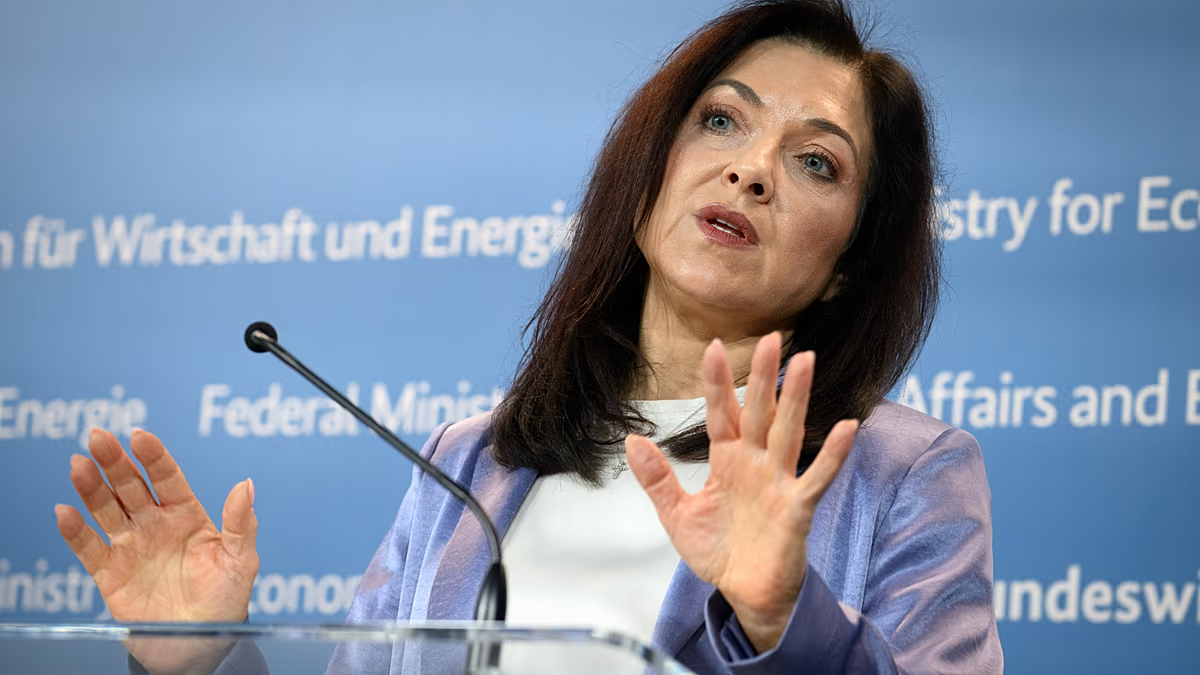
In a sobering announcement, German officials confirmed on Wednesday what many market analysts had feared for weeks: the economic engine of Europe is stalling out. German Economic Affairs and Energy Minister, Katherina Reiche, sharply reduced the nation’s 2026 growth target to a mere 0.5%, a significant cut from the 1% projection made just months prior in January. This news, far more than a simple statistical adjustment, signals a period of profound stagnation for Europe’s largest and most vital economy. Adding to the grim picture, the outlook for 2027 was also darkened, with forecasts revised down to 0.9% from 1.3%. This official confirmation punctured any remaining optimism about the resilience of Germany’s famed industrial model, highlighting its vulnerability to external shocks.
The primary culprit behind this sudden economic contraction is a geopolitical crisis raging far from German soil: the ongoing war in Iran. German officials stated plainly that the downward revision was unavoidable, citing the conflict as the catalyst for a continent-wide energy shock. As a manufacturing powerhouse, Germany’s economic health is intimately tied to the cost and flow of oil and natural gas, both of which have seen prices skyrocket since the outbreak of hostilities. The disruption is multifaceted; government reports detail how the “Iran war fallout” has snarled international supply chains and inflated the cost of raw materials, undercutting the competitiveness of German exports that are the lifeblood of the nation’s prosperity.
Beyond direct supply and cost issues, the war has instilled a deep sense of caution that is now paralyzing economic activity. The pervasive uncertainty has led to a pronounced “wait and see” attitude among private investors and business leaders. Fearing that the conflict could escalate regionally and unleash even greater market chaos, many firms have shelved major expansion projects and capital investments. This freeze in private spending, combined with the painful squeeze on household budgets as energy bills soar, is creating a devastating pincer movement on the German economy. Stagnant investment meets reduced consumer spending, leaving little room for growth or dynamism.
Germany’s troubles are not an isolated incident but part of a troubling pattern emerging across Europe. On the very same day, the Italian government followed suit, announcing its own fiscal recalibration in response to the turbulent times. Italy trimmed its own 2026 GDP growth estimate to 0.6%, a slight but symbolic reduction from 0.7%. Italian Economy Minister Giancarlo Giorgetti was unequivocal about the cause, stating that the “Iran war weighs heavily” on the nation’s fiscal planning for a country already highly sensitive to energy price swings. He framed the situation as one of “totally exceptional” circumstances and warned that the already-dim numbers would likely need further, downward “reviewing, adjusting and updating” in the coming weeks.
The economic downgrade comes with tangible fiscal consequences for Italy, further complicating its relationship with European Union financial rules. Minister Giorgetti revealed that the expected budget deficit for the year has worsened, now seen at 2.9% of GDP instead of 2.8%. The hope for improvement in 2027 has also dimmed. This news was compounded by a sobering confirmation from Italy’s statistics bureau that the country ended 2025 with a deficit of 3.1% of GDP. That figure dashes Rome’s hopes of escaping an EU disciplinary procedure for running an “excessive” deficit this year, adding a layer of bureaucratic pressure to an already dire economic outlook.
The synchronized announcements from Berlin and Rome paint an unmistakable portrait of a Eurozone under severe systemic stress. As energy-intensive industries—the backbone of Europe’s industrial core—struggle to adapt to a volatile new geopolitical reality driven by distant conflict, the collective aspiration for a swift economic rebound is fading. The simultaneous downgrades reveal a bloc whose foundational economies are being buffeted by the same external storm, with limited short-term defenses. The promise of stability and growth that has long defined the European project now feels distant, replaced by the immediate struggle to manage stagnation and navigate the uncertain fallout from a war that has reshaped the continent’s economic landscape overnight.