The European Battery Race: Current Leaders and Future Ambitions
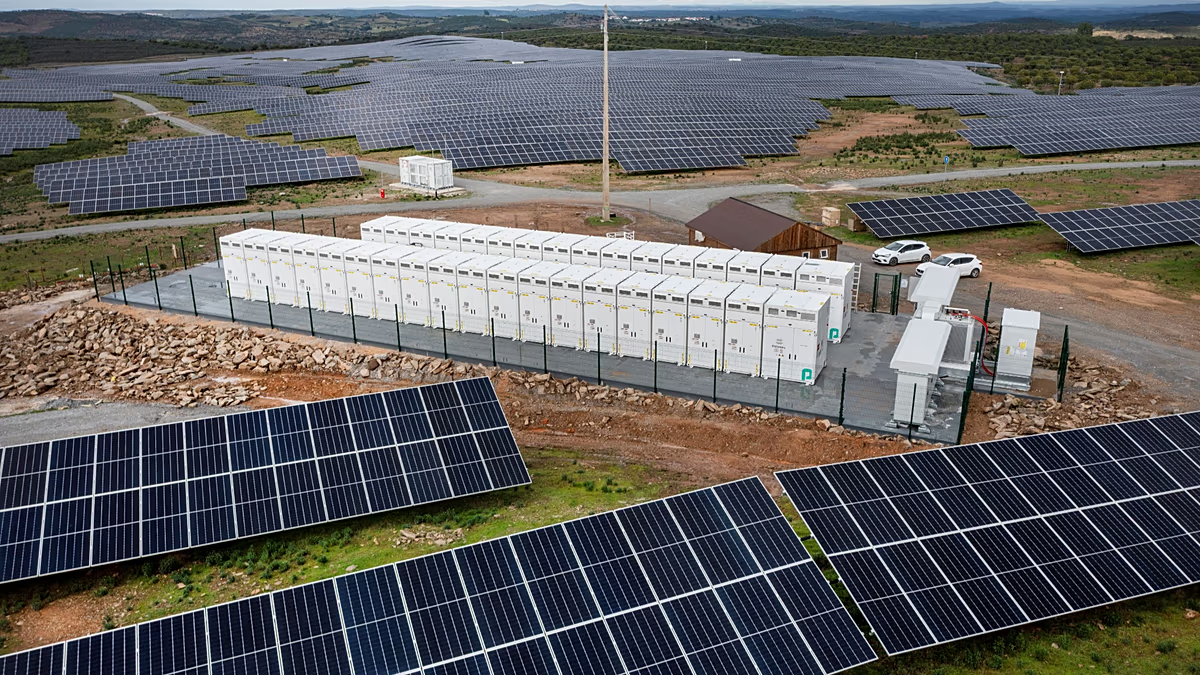
The global transition to renewable energy is fundamentally reshaping how nations power their economies. At the heart of this shift lies a critical, often unsung hero: the battery. As countries strive to wean themselves off fossil fuels and harness the power of the sun and wind, large-scale battery storage systems have become indispensable. They are the linchpin that allows for a stable and reliable electricity grid, storing surplus green energy when production is high and feeding it back into the system when demand peaks or generation falls. This technological capability is not just about innovation; it’s about energy security and independence. Across Europe, nations are now engaged in a strategic race to deploy these systems, racing to build the infrastructure that will underpin their clean energy futures. The landscape of this race, however, presents a fascinating picture of current leaders, ambitious newcomers, and the powerful role of policy in determining success.
Currently, the league table of operational grid-scale battery capacity reveals a clear frontrunner. According to Ember’s comprehensive 2026 reviews, Germany stands as the established champion of Europe, with a substantial 2.8 gigawatts (GW) of battery capacity already integrated into its power network. Italy follows in second place with 2 GW, showcasing its own significant commitment. A middle tier of nations, including Ireland (0.92 GW), Sweden (0.75 GW), Bulgaria (0.56 GW), and France (0.52 GW), have begun their journeys in earnest, each possessing between half a gigawatt and a full gigawatt of live capacity. The rankings then taper off with countries like Romania, Belgium, Finland, the Netherlands, and Türkiye, all operating under 0.5 GW. This snapshot shows a continent in the early stages of adoption, with a handful of nations pulling ahead in turning plans into concrete, functioning infrastructure.
However, a seismic shift in this hierarchy emerges when we look beyond what is already built to what is planned. Including the vast pipeline of projects—those under construction, permitted, or merely announced—paints a dramatically different and more dynamic portrait of Europe’s energy future. In this view, Türkiye emerges not just as a participant, but as the continent’s most ambitious visionary. With a staggering project pipeline totaling 32.8 GW, Türkiye’s planned expansion dwarfs that of its nearest European rivals more than threefold. Germany (10.5 GW), Poland (10.4 GW), and Italy (10.2 GW), while maintaining robust plans, find their ambitions eclipsed by this single nation’s staggering commitment. This surge, as explained by Ufuk Alparslan of Ember, was catalyzed by a pivotal policy decision: opening unlimited grid capacity for renewable projects that incorporate storage. This single move unleashed a flood of investor interest, positioning storage not as an afterthought, but as a gateway to grid connection for new wind and solar farms.
The driving force behind this continent-wide battery boom is, in large part, a story of rapidly improving economics. Dr. Beatrice Petrovich, a senior energy analyst at Ember, highlights that record-low costs are making large-scale storage projects financially viable like never before. Grid-scale battery costs plummeted by 45% in 2025 alone, continuing a decade-long trend of roughly 20% annual reductions. This means projects are increasingly standing on their own feet, profitable without the need for government subsidies. Yet, economics alone is not the sole dictator of pace. Petrovich emphasizes that “stable policy frameworks unlock battery potential.” Countries like Bulgaria, Italy, and Spain demonstrate how clear, supportive regulations can accelerate deployment by giving investors predictable revenue streams. Conversely, policy uncertainty can act as a powerful brake, as seen in Germany where proposed preferences for gas power and potential changes to grid fees have risked undermining the very investor confidence needed to build.
This context makes the position of a nation like France particularly noteworthy. Even if its entire project pipeline is realized, France’s total battery capacity would only reach 1.12 GW, leaving it near the bottom of the European rankings. This relative reluctance can be understood through the lens of its unique energy identity. Nuclear power, which provides a steady, constant baseload of electricity, constitutes nearly 70% of France’s power generation. This existing infrastructure reduces the immediate, perceived urgency for large-scale storage to balance the variable output of renewables, a challenge more acute in nations with higher penetrations of solar and wind. France’s path highlights that there is no one-size-fits-all approach to the energy transition; each country’s strategy is shaped by its existing resources and energy mix.
The monumental scale of Türkiye’s ambitions naturally leads to the pivotal question: can this vast pipeline actually be built? Alparslan cautions that securing grid capacity, while a major hurdle, is not a guarantee of completion. The realization of these plans now hinges on government decisions regarding construction timelines and extensions. The stakes are incredibly high. Türkiye’s 33 GW battery pipeline equates to a staggering 83% of its entire existing wind and solar capacity. Furthermore, the report notes a potential limitation: while global battery projects often provide 2.5 hours or more of storage, most planned projects in Türkiye are for shorter durations of around one hour, designed more for rapid grid services than for long-duration energy shifting. The outcome will be decisive. If these storage projects falter, they risk becoming “grid blockers,” occupying connection capacity that could have been used for new renewable installations. Thus, Türkiye’s bold gamble represents a critical test case for Europe, demonstrating how aggressive policy can ignite investment, but also underscoring that the final step—from blueprint to reality—is where the true challenge, and opportunity, lies for shaping the continent’s energy destiny.