


The 2026 FIFA World Cup, sprawling across North America, promised a festival of football on an unprecedented scale. Yet, even amidst this grand backdrop, one figure has consistently commanded a gravitational pull strong enough to bend the entire tournament’s narrative toward him: Lionel Messi. As the reigning champions, Argentina, began their final preparations in Kansas City, the world’s focus was not merely on the team, but intensely on its talisman. Research from Searchbloom, analyzing Google Trends data over the prior 24 months, quantified this phenomenon with startling clarity. The term “Messi World Cup” scored a peak relative interest index of 100 in both the United States and global markets—the absolute maximum. This metric established Messi as the benchmark against which all other player interest was measured, a testament to his unique status as the tournament’s central orbiting star.
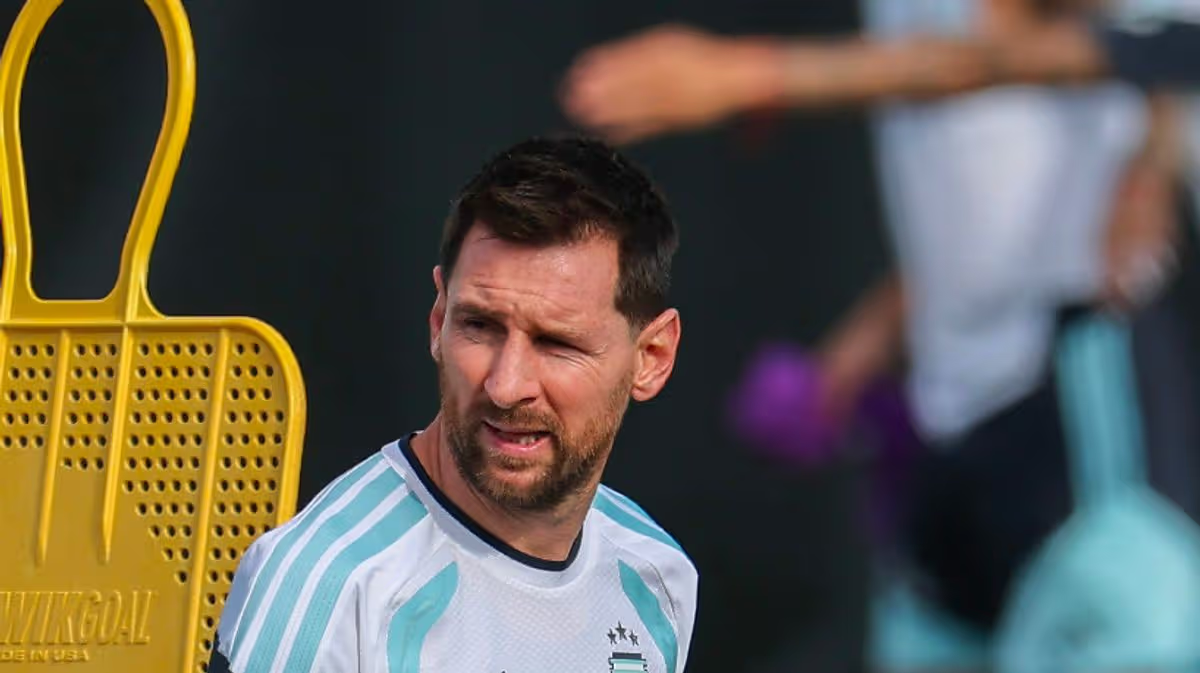
In the simmering heat of a Kansas City afternoon, with storms looming on the horizon, Messi’s demeanor contrasted sharply with the frenetic energy surrounding him. Training with his Argentine teammates, he moved with an economy of effort that belied his 38 years, breaking into a laugh during a game of head tennis and executing a playful shimmy that sent a defender scrambling. England legend Paul Gascoigne, observing from afar, marvelled not just at the skill but at the longevity. “I cannot believe he is about to play at his sixth World Cup. That is amazing,” Gascoigne noted, highlighting the dedication required to maintain such a level. For the hundreds of media representatives and the expected 700,000 fans descending on Kansas, Messi remained the star attraction, a living legend preparing to write what many assumed would be the final chapter of his World Cup saga.
The data from Searchbloom’s study painted a stark picture of this dominance. Every other global superstar existed in Messi’s shadow. French captain Kylian Mbappé, often framed as the heir to Messi’s throne, peaked at an index of 72, largely driven by an injury scare earlier in the year. Cristiano Ronaldo, confirming his inclusion in Portugal’s squad at 41 years old for his last World Cup, reached a peak of 65. The scale of the gap was further emphasized by the figures for home-nation heroes; Christian Pulisic, the captain and heart of the United States team, registered a peak index of just four. Cody C. Jensen, CEO of Searchbloom, emphasized the reliability of the data: “The index does not lie.” He pointed out the fascinating pattern of Messi’s digital footprint: “He does not have a steady baseline. He has valleys and spikes, and the spikes track news cycles with mechanical precision.”
This immense interest necessitates an equally immense security operation, transforming the Argentine camp’s movements into a logistical spectacle. Their team bus travels through Kansas City flanked by a cavalcade of police outriders, a motor patrol dedicated solely to safeguarding the world champions and their prized asset. Media personnel covering training sessions are required to park their vehicles nearly a mile from the team’s state-of-the-art training base, completing their journey via a designated yellow school bus. “It is a lot of work,” admitted one security official, underscoring the monumental effort required to manage the circus that follows Messi. This tight bubble of protection exists to allow the team a semblance of normalcy amidst the global frenzy, a necessary shield against the overwhelming wave of attention.
The narrative surrounding Messi is layered with a profound sense of legacy. Having finally secured his maiden World Cup trophy in Qatar 2022, his participation in 2026 is seen as a victory lap, a chance to cement his immortality in the sport on the world’s biggest stage. Yet, it is also a compelling competitive story—can the aging maestro, now playing in the demanding Major League Soccer, summon one more superlative campaign to defy time and lead Argentina to back-to-back titles? This duality—the celebratory farewell tour versus the relentless pursuit of more glory—fuels the public and media fascination that the data so clearly captures. He is no longer the young prodigy chasing his dream, but the accomplished king defending his crown, a nuance that adds depth to his every touch of the ball.
As the tournament’s opening whistle approaches, the story of the 2026 World Cup is, in many ways, already being written through the lens of Lionel Messi. The data proves his unrivalled draw; the scenes in Kansas City demonstrate the material reality of that fame; and the security protocols acknowledge the challenges it presents. While the beautiful game will showcase 31 other nations and hundreds of other magnificent athletes, the spotlight remains stubbornly fixed on one man from Rosario. His journey—from a galactically-hyped teenager to a serene, history-laden veteran—reaches its probable conclusion on North American soil, ensuring that every match he plays is not just a sporting contest, but a chapter in a defining footballing epic.