

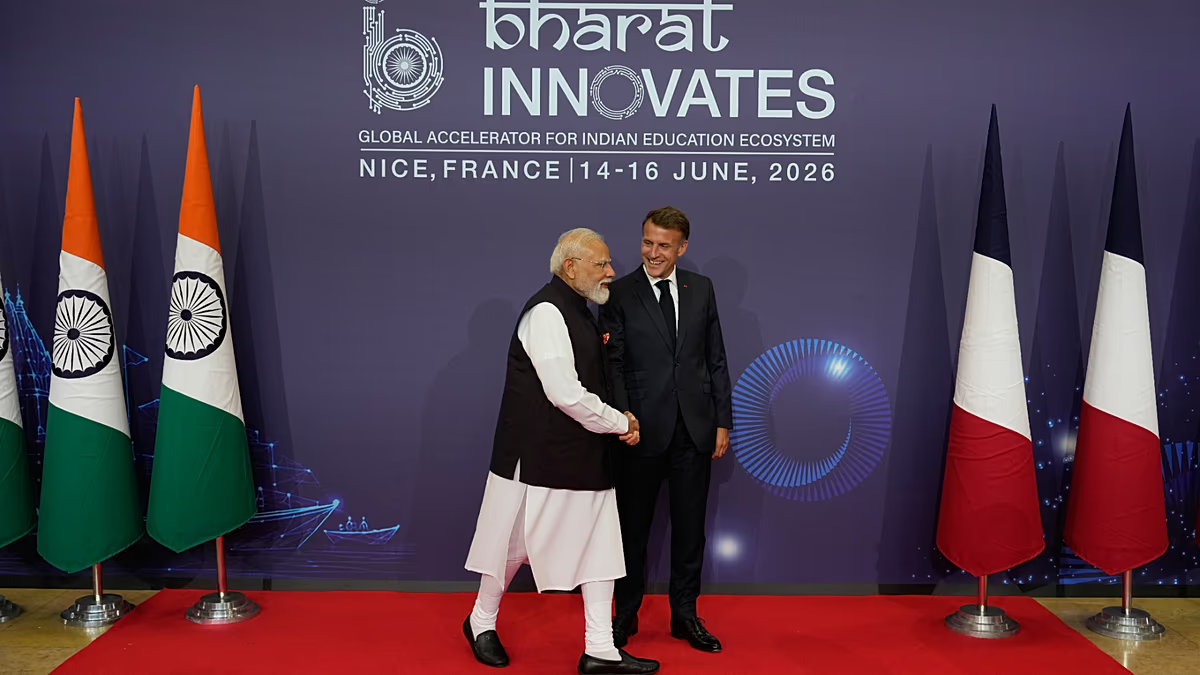
The meeting between French President Emmanuel Macron and Indian Prime Minister Narendra Modi on a Sunday in Nice was far more than a routine diplomatic engagement; it was a powerful and symbolic gesture of a deepening strategic partnership. The occasion was the grand opening of “Bharat Innovates,” a landmark Indian deep-tech showcase being held outside of India for the very first time. With 120 startups, 15 premier educational institutions, and a host of global investors gathered under one roof, the event represented a bold statement of India’s arrival as a global innovation powerhouse. By choosing France as the stage for this debut, Modi signaled a clear preference for a European partner, while Macron’s enthusiastic presence confirmed France’s eagerness to be that chosen ally. This convergence of ambition was the real headline, framed against the glamorous backdrop of the French Riviera, turning a tech exhibition into a significant chapter in bilateral relations.
President Macron, addressing the gathered innovators and investors, did not hold back in his praise, explicitly naming India as a “major innovation nation.” However, his speech quickly pivoted to a compelling sales pitch for France’s own technological credentials. He pointedly highlighted France’s leading position within the European Union in job creation for artificial intelligence, citing a study that reported nearly 20,000 AI-related roles generated in Paris since 2023. This was not merely boasting; it was a strategic argument. Macron was essentially outlining the contours of a perfect partnership: a massive, talent-rich India brimming with disruptive ideas and entrepreneurial energy, and a France offering a mature, investment-friendly gateway to the European market with a robust industrial and research base. The subtext was clear: together, they could build a formidable counterweight in the global tech landscape, reducing dependency on other dominant players.
For Prime Minister Modi, the visit was a continuation of a carefully cultivated dialogue, coming just months after Macron’s own trip to Mumbai. The welcome by Nice’s mayor, Éric Ciotti, who celebrated the city’s growing role in international innovation, underscored the localized economic benefits of this high-level friendship. But the true substance of the visit lay ahead, in the planned bilateral talks at the Villa Kérylos, a stunning mansion echoing Ancient Greek architecture. This secluded, intellectually evocative setting was ideal for conversations that undoubtedly stretched beyond technology. While “Bharat Innovates” showcased the exciting present, the leaders’ private discussions certainly touched on the critical future—collaboration in defense, space exploration, nuclear energy, and navigating the complex geopolitics of the Indo-Pacific. Their partnership, often called a “bridge between the West and the East,” is built on shared strategic autonomy and a multipolar worldview.
The timing of this meeting was particularly significant, occurring on the eve of the G7 summit in Évian-les-Bains. Modi’s attendance at the summit, as an invited guest, placed him at the heart of a critical Western forum. His consultations with Macron just beforehand suggest a coordinated approach, allowing both leaders to present united perspectives on global challenges like climate change, supply chain resilience, and global security. It provided Modi a trusted conduit into the G7’s inner circle and offered Macron a direct line to the voice of the Global South, represented by its most influential leader. This pre-summit rendezvous transformed their bilateral alliance into a force multiplier on the wider international stage, demonstrating how their synergy could shape agendas far beyond their national borders.
Stepping back, the imagery of the day—from the buzzing tech pavilions to the serene villa overlooking the Mediterranean—painted a holistic picture of a 21st-century alliance. It is no longer solely defined by historic treaties or arms deals, but by a shared hunger for the future. The collaboration is multidimensional: students and researchers exchange knowledge, startups and venture capitalists forge deals, and astronauts and engineers jointly design missions. This creates a deep, people-to-people web of connection that sustains the political relationship. In a world increasingly fragmented by trade wars and technological protectionism, the France-India partnership stands out as a deliberate, optimistic project to build interconnected, sovereign capabilities.
In conclusion, the day in Nice was a masterclass in modern diplomacy. It seamlessly wove together hard economics, soft power, and geopolitical strategy into a compelling narrative of mutual ambition. Macron and Modi moved from a vibrant exhibition hall celebrating Indian genius to intimate talks about shaping the world order, their itinerary itself telling the story of a partnership that is both granular and grand. They are not just leaders exchanging pleasantries; they are architects attempting to build a new axis of influence—one centered on technology, talent, and strategic trust. As the world’s attention shifted to the G7, the foundation for many of its most crucial conversations had already been laid on the shores of the French Riviera, between two partners cementing their role as pivotal players in the dawn of a new technological age.