


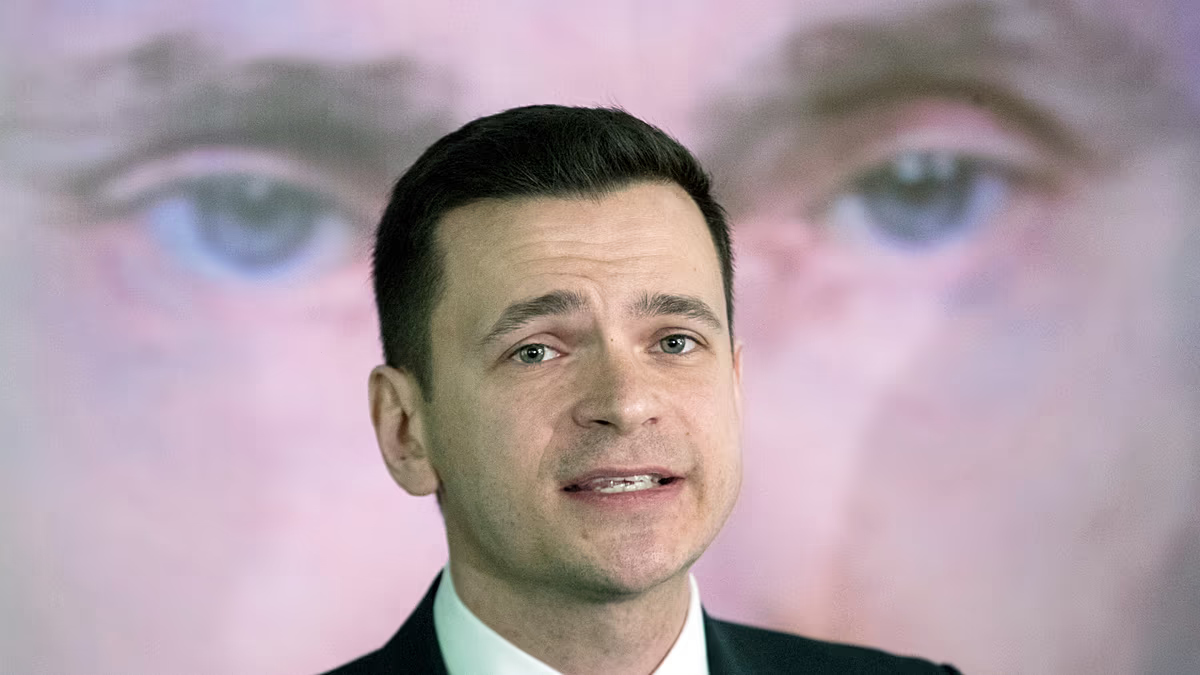
In the shadow of an increasingly repressive Russian state, a disparate array of opposition figures operating from exile faces a monumental, dual challenge: to remain relevant to a domestic population under tight control and heavy propaganda, and to construct a credible blueprint for a democratic future. The recent formation in Berlin of “The Peaceful Forces of Russia,” a party led by former political prisoner Ilya Yashin, epitomizes this effort. With the stark declaration, “Putin leads the party of war, and we lead the party of peace,” Yashin positions his movement as the moral and political antithesis to the Kremlin’s current path. Yet, this initiative unfolds against a complex backdrop where President Vladimir Putin maintains reportedly high approval ratings at home, and the opposition abroad is fractured, raising profound questions about its potential influence and its very readiness to govern.
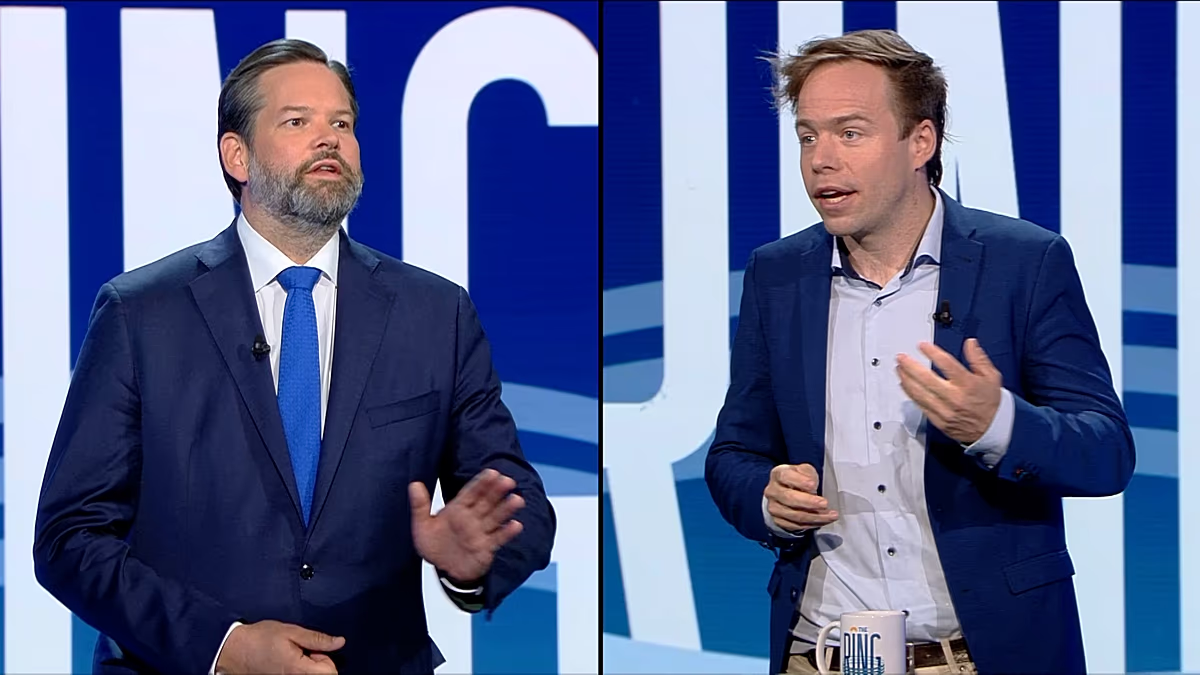
A central obstacle, as identified by Russia expert Professor Andreas Heinemann-Grüder, is a deeply ingrained culture of fragmentation and personal rivalry within the opposition, historically more akin to “a little Lenin” than a cohesive team. This legacy of centralized, top-down leadership models, ironically mirroring the “democratic centralism” of the system they oppose, is ill-suited for the necessary task. Heinemann-Grüder argues that the only viable structure is a broad, inclusive government-in-exile that reflects Russia’s vast diversity—ethnic, political, and geographical. Such a body would require a unifying figurehead, a single point of contact and symbolism. The expert points to Iran, where much of the opposition has rallied around Reza Pahlavi, and contrasts it with Russia’s plethora of voices—from Garry Kasparov to Mikhail Khodorkovsky to Yashin himself—asking pointedly if Yashin possesses the unifying potential of a Nelson Mandela to transcend these divisions.
This search for unity and identity is further complicated by the towering legacy of Alexei Navalny. Navalny mastered the power of a single, galvanizing issue—anti-corruption—to build a potent domestic movement. Today’s exiled opposition has similarly centered on ending the war in Ukraine, but Heinemann-Grüder cautions that this alone is insufficient; a war cannot be stopped from abroad, and a future political program must extend far beyond it. The opposition must now answer difficult questions it has largely neglected: What kind of Russia does it seek to build? A renewed federation, a decentralized state, a true multiethnic democracy? Learning from both the systemic politics of older parties like Yabloko and the populist appeal of Navalny, the new movement must articulate a comprehensive vision for the post-Putin era, or risk remaining perpetually on the sidelines.
Crucially, Heinemann-Grüder stresses that this vision must address foundational flaws that predate Putin, particularly the super-presidential system enshrined in the 1993 constitution, which enabled the extreme concentration of power. Therefore, the opposition must practice internally the democracy it preaches externally. For Yashin’s party, this means genuine internal ballots, term limits for its own leaders, and a commitment to pluralism—allowing other groups to compete in any future “parliament-in-exile.” This operational integrity is also a matter of security. Given the Kremlin’s record of targeting critics, from Boris Nemtsov to Alexei Navalny, infiltration and threat are real dangers. However, responding by becoming a secretive, closed society would betray the movement’s core values; it must navigate the perilous balance between security and the transparent openness it champions.
The path to any potential influence hinges on volatile dynamics within Russia itself. Heinemann-Grüder outlines two possible scenarios. The first is one of catastrophic escalation, further entrenching the “party of war.” The second, which he deems more likely, involves a eventual split within the ruling elite when factions recognize the war in Ukraine is unwinnable and seek an exit. It is in this latter scenario that a figure like Yashin might find an opening, potentially viewed by pragmatic oligarchs or security elements as a viable interlocutor or leader for a transitional period. The current Russian elite, Heinemann-Grüder notes, is largely opportunistic rather than ideologically driven; its loyalty to Putin is based on his power to reward and intimidate. Should that power wane, the support could evaporate rapidly.
Ultimately, the opposition’s fate may be decided by a fundamental shift in the Russian public’s consciousness. For years, Putin’s social contract traded prosperity for political silence. The war is breaking that contract, straining the economy and demanding sacrifices. Heinemann-Grüder uses a potent analogy: for now, “the television is beating the fridge”—state media narrative overwhelms material hardship. But he believes a threshold will eventually be crossed where “the fridge will beat the television,” where daily economic reality trumps propaganda. In that moment, as in 1917 when Lenin promised “bread and peace,” whoever can credibly offer those same necessities—security, stability, and an end to conflict—will have a historic chance. The task for Yashin and the exiled opposition is to build a legitimate, democratic, and unified alternative so that if that moment arrives, they are prepared not just to critique, but to lead.