



A New Chapter with Familiar Challenges: The EU’s Migration Pact Begins
The European Union’s long-anticipated Pact on Migration and Asylum officially takes effect, marking a significant milestone in the bloc’s turbulent history of migration management. Designed to replace a patchwork of national policies and emergency measures, the Pact aims to establish a unified, predictable system for all 27 member states. Its core promise is one of shared responsibility: to support nations bearing the brunt of migrant arrivals while ensuring orderly and humane procedures. The legislation introduces faster border assessments for asylum claims and a novel “mandatory solidarity” mechanism, theoretically obliging all countries to contribute support—whether by relocating asylum seekers, providing financial aid, or assisting with border operations. However, as the ink dries on this landmark agreement, a stark gap is emerging between its ambitious legal text and the political realities on the ground, casting doubt on its transformative potential from the very outset.
The Mechanics of “Mandatory” Solidarity: Ambition Versus Reality
At the heart of the new system is the “solidarity pool,” an annual plan where the European Commission calculates the needs of frontline states and assigns a “fair share” of contributions to other members based on their population and economic size. The regulation sets a baseline expectation: at least 30,000 relocations of asylum seekers and €600 million in financial contributions each year. In practice, however, this principle of mandatory solidarity has proven to be highly flexible, and many would argue, severely diluted. For the first operational cycle in 2026, the figures agreed upon by EU interior ministers have already shrunk dramatically to just 21,000 relocations and €420 million, citing that the rules will only be in effect for half the year. More critically, the final tally of tangible, new assistance is even smaller, revealing a system where legal loopholes and political reluctance are taking precedence over collective responsibility.
Reluctant Partners and Legal Loopholes Undermine the System
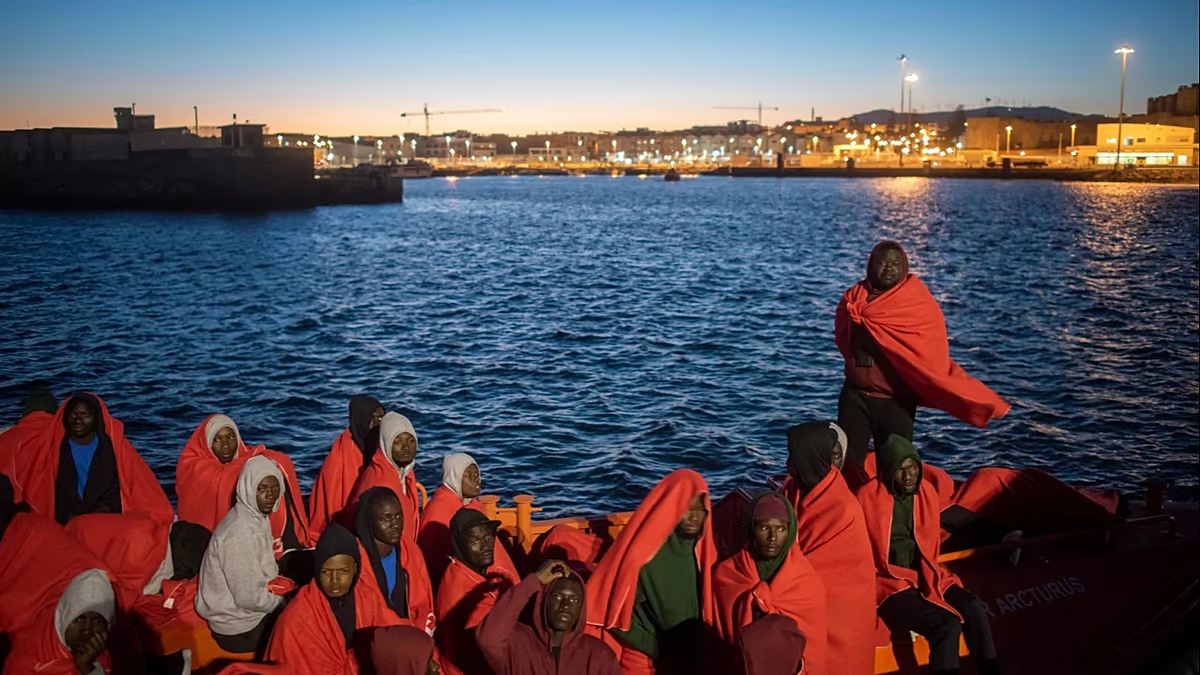
The implementation process has exposed significant resistance and strategic maneuvering by member states. Hungary and Slovakia have outright refused to participate in any form—neither accepting individuals nor providing funds—in a direct challenge to the Pact’s core tenet that has so far gone unpunished. Meanwhile, many other nations have chosen the path of least resistance: of the 19 countries obliged to contribute, only seven have agreed to accept relocations, with nine opting solely for financial payments. A further accounting trick reduces the real figures even more. The pledges include contributions from countries like Spain, which is itself classified as “under migratory pressure” and set to receive aid; its promised €42 million payment is therefore netted out, resulting in no new money entering the solidarity fund. When counting only genuine new commitments, the solidarity pool for 2026 collapses to fewer than 9,000 relocations and a mere €76 million—a fraction of the original threshold and a pittance compared to the nearly 670,000 asylum applications lodged in the EU last year.
The Illusion of Shared Burdens: “Responsibility Offsets” and Paper Promises
Beyond the overall reduction, member states are utilizing a specific provision within the Pact to minimize physical transfers of people. The “responsibility offset” allows a country to fulfill part of its relocation quota by taking responsibility for asylum seekers already within its borders who technically should have applied in their first EU country of arrival. Nations like Germany, France, and others are pursuing this option through bilateral deals, as it is politically easier than organizing high-profile transfers of new arrivals. The consequence is that the already meager figure of 8,878 relocations will be whittled down to fewer than 1,000 actual movements of people between states in 2026. As one diplomat starkly predicted, “We will see very few flights or buses carrying asylum seekers across Europe.” This strategic preference for offsets means the Pact’s vision of tangible burden-sharing is being replaced by an administrative exercise that does little to alleviate pressure on frontline states.
Frontline States Left Wanting and a Precedent of Insufficiency
The result of these maneuvers is that the four countries designated as under pressure for 2026—Spain, Italy, Greece, and Cyprus—will receive far less support than envisioned. Spain and Cyprus, in protest, abstained from the vote approving the solidarity pool, with Madrid formally condemning the “very insufficient” aid and warning that this first cycle sets a dangerous precedent of under-fulfillment. This sentiment is echoed by migration experts like Lukas Gehrke of the International Organization for Migration, who notes that the agreed numbers are “deliberately at the lower end.” While some EU officials, like Migration Commissioner Magnus Brunner, argue the level might be sufficient for the current moment, there is widespread concern that the mechanism has been intentionally weakened from its launch, failing its first test of providing meaningful, effective solidarity when it is most needed to build trust.
A Fragile Beginning for a Long-Sought Reform
The launch of the EU Migration Pact represents a hard-won political agreement, but its initial implementation reveals a system struggling under the weight of its own compromises. The phrase “mandatory but flexible solidarity” has, in practice, tilted overwhelmingly towards flexibility, allowing political reluctance to undermine collective action. The pact establishes a framework, but its success hinges on member states’ political will—a will that currently appears focused on minimizing commitments rather than solving a common challenge. As Swedish MEP Tomas Tobé conceded, the current numbers are an “acceptable beginning” but with “room for improvement.” The coming years will show if this framework can evolve into a tool of genuine burden-sharing, or if it will remain a symbol of the EU’s continued inability to forge a unified and compassionate response to migration. For now, the dream of tens of thousands of annual relocations as a norm remains firmly on hold, deferred by a present reality of symbolic gestures and diminished ambitions.