



A New Dawn: How a Groundbreaking Therapy Quieted a Raging Immune System
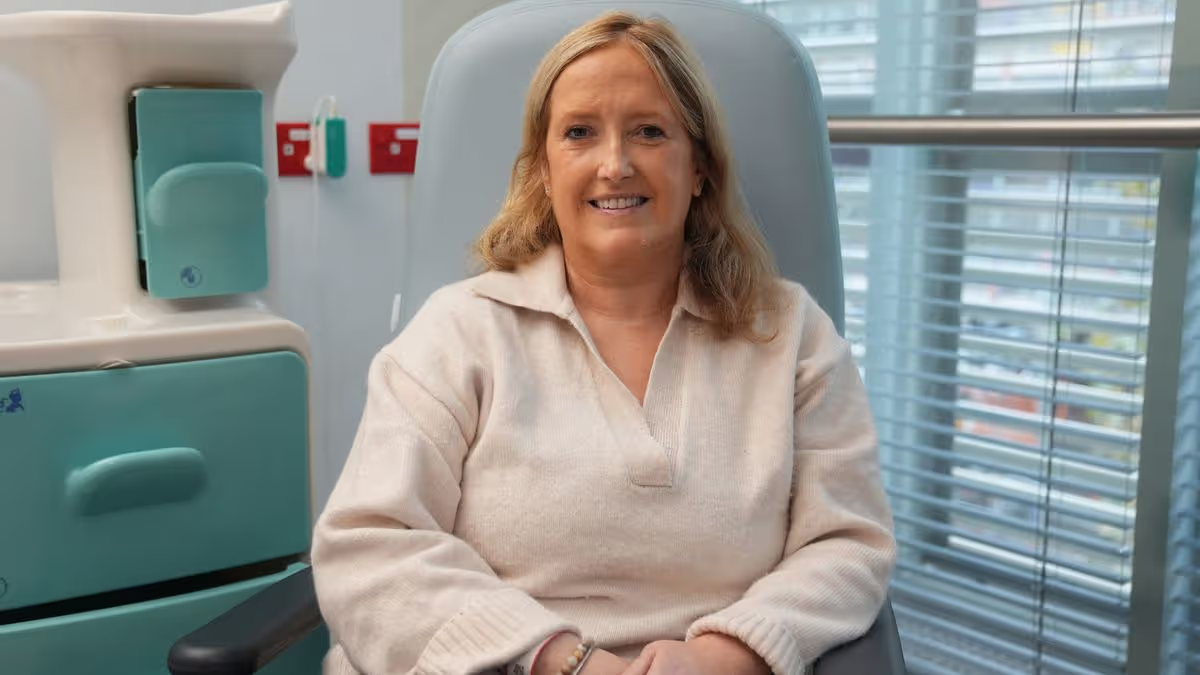
For Katie Tinkler, life had been defined by a relentless internal war. Diagnosed with severe systemic lupus erythematosus at the age of 20, her immune system had spent decades attacking her own body, treating her healthy tissues as enemies. Lupus, a chronic autoimmune disease affecting around 69,000 people in the UK, primarily women, had stolen the vibrant life of the former fitness instructor. It wasn’t just one ailment but a cascade of suffering: debilitating pain and fatigue locked her joints, swollen and stiff, sometimes making the simple act of walking or lifting a cup impossible. The disease ravaged her kidneys, pushing her to the brink of needing dialysis, while also scarring her lungs and heart. A heightened risk of blood clots, severe infections, and even episodes of sepsis and multi-organ failure that required intensive care and a medically induced coma marked the brutal trajectory of her illness. Forced to leave her career, her world had shrunk under the weight of a relentless condition and the powerful, lifelong medications that were her only defense.
This agonizing reality makes Katie’s description of her life today all the more powerful. “It’s like night and day,” she says, a simple phrase that captures a profound medical revolution. Katie is one of the first patients in the UK to receive an experimental treatment for lupus on the NHS, not with another immunosuppressant, but with a groundbreaking form of therapy called CAR T-cell treatment. Pioneered in the fight against certain cancers, this approach involves extracting a patient’s own T-cells—a key part of the immune system—and genetically re-engineering them in a laboratory. These “supercharged” cells are then infused back into the body, where they are programmed to seek out and destroy specific problem cells. In lupus, the target is the rogue B cells that produce the autoantibodies responsible for the body’s self-destructive attack.
The early results from this UK trial, led by University College London Hospitals NHS Foundation Trust and University College London, are nothing short of transformative. In the study, five out of six patients with severe, treatment-resistant lupus saw their disease go into remission within months of a single CAR T-cell infusion. For Katie, now 52 and from Guildford, Surrey, the change has been visceral and liberating. The joint pain that imprisoned her has melted away; the threat to her organs has receded. Most remarkably, she has been able to stop the complex cocktail of steroids and other powerful drugs that were merely managing, not curing, her condition. Today, she takes just two tablets daily for preventative care. “It’s miraculous for me,” she reflects. “My life two years ago versus now, it’s unrecognisable.”
The true impact, however, is measured not in lab results but in reclaimed moments. After a decade defined by limitation, Katie recently went on a ski trip—an activity once unthinkable. She danced with joy and without pain at her daughter’s wedding. Perhaps most poignantly, she notes that her youngest child, now twenty, has no memory of her participating fully in family life before this treatment. “My children can’t remember me participating in things before now,” she says, highlighting the years lost not just to her, but to her loved ones. CAR T-cell therapy has given her back her role as an active mother and an engaged participant in her own life.
Beyond the profound personal stories, scientists believe the therapy may be working through a mechanism far more sophisticated than simple suppression. Traditionally, lupus treatments work by broadly dampening the immune system, leaving patients vulnerable to infections. The trial data suggests that after CAR T-cells deplete the harmful B cells, these cells eventually begin to return, but they are predominantly naïve, early-stage cells. This indicates the treatment may be facilitating an “immune reset,” effectively rebooting the immune system to a state before it became autoreactive. Professor Karl Peggs of UCLH describes this as “truly groundbreaking,” offering the chance to break the endless cycle of autoimmune disease. “The possibility that CAR T-cell therapy could deliver an immune reset and potentially free patients from the cycle of chronic autoimmune disease marks a remarkable step forward,” he stated.
While cautious optimism is essential—larger and longer-term studies are needed to confirm these early results—the implications are vast. This trial offers a beacon of hope not just for the thousands living with the daily struggle of lupus, but for the future of treating autoimmune diseases more broadly. Experts believe similar approaches could be explored for conditions like multiple sclerosis. The vision Professor Peggs articulates is the most hopeful of all: “If these results are confirmed in larger studies, the prospect of a cure for lupus may no longer be out of reach.” For patients like Katie Tinkler, that prospect is already manifesting as a new reality, a life where dawn has finally broken after a very long and painful night.