

In a ruling that has reignited debates over presidential legacy and institutional independence, a US federal judge has firmly rejected an attempt to preserve President Donald Trump’s name on the iconic Kennedy Center for the Performing Arts. The board of trustees for the venue, a body stacked with Trump allies during his administration, alongside the Justice Department, had urgently appealed to Judge Christopher Cooper to stay his previous order demanding the removal. Their request was denied this past Friday, setting a clear deadline for the physical eradication of Trump’s name from the building’s façade. Judge Cooper’s reasoning was rooted in a principle of lawful governance, stating that the public interest is rarely served by perpetuating unlawful governmental action, a pointed rebuke of the renaming process.
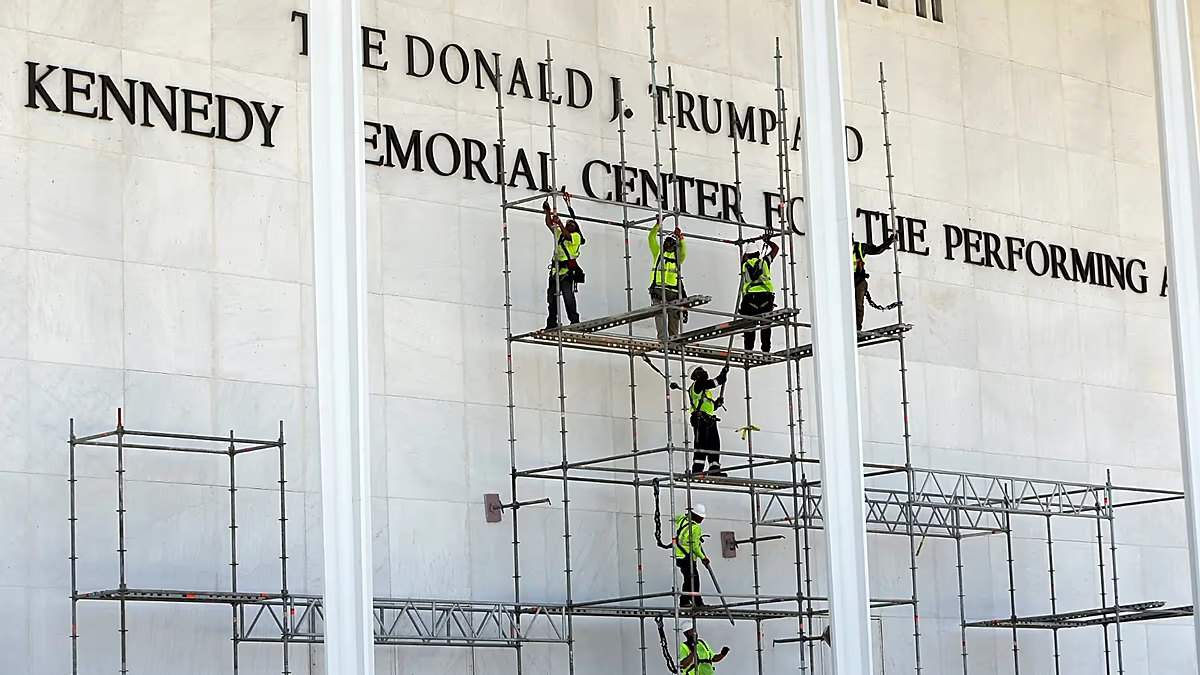
The core of Judge Cooper’s original ruling, issued on May 29th, was a finding that the renaming of the center was an illegal act. He determined that only Congress holds the statutory authority to change the name of the federally-funded institution, a power that the Trump administration bypassed. The sequence of events began last December when the Trump-loyalist board voted to rename the venue the “Trump Kennedy Center.” Subsequently, Trump’s name was installed in large letters above that of President John F. Kennedy on the building’s white marble exterior. Judge Cooper’s order gave the administration a strict 14-day window to remove the name not only from the building itself, but from all associated materials and documentation.
This legal pushback has prompted immediate, though incomplete, compliance. Earlier in the week, the Kennedy Center administration removed Trump’s name from its official website. However, as of the judge’s Friday decision, the physical letters remained on the building’s façade, awaiting the execution of the court’s order. The ruling also encompassed another contentious Trump initiative: a planned two-year closure of the center for renovations, set to begin in July. Judge Cooper temporarily blocked this closure, ensuring the venue’s doors would remain open to the public. This multi-faceted ruling sparked a furious reaction from Trump, who declared he was relinquishing control of the center—a control he had asserted at the start of his second term by naming himself chairman of the board.
The renaming controversy had already provoked significant backlash within the arts community, illustrating the cultural friction surrounding Trump’s actions. Following the board’s decision to append his name to the Kennedy Center, a number of artists and performers cancelled their scheduled engagements at the venue. This artistic boycott highlighted the profound symbolic weight of the Kennedy Center’s name, honoring a president associated with the support of arts and culture, and the perceived affront of altering it for what many saw as partisan self-aggrandizement. The judge’s ruling thus defended not only a legal procedure, but also a cultural institution’s historical identity against a unilateral overhaul.
The effort to imprint Trump’s name on the Kennedy Center is part of a broader pattern observed since his return to office: a concerted campaign to place his name and image prominently within official federal spaces, a notable departure from American political tradition. Similar actions include the renaming of the now-defunct U.S. Institute of Peace after Trump, and the installation of large banners bearing his portrait outside the Departments of Justice and Agriculture. Furthermore, his administration has pursued a plan to feature his image on a commemorative $250 bill for the nation’s 250th anniversary. These moves collectively represent a stark shift towards personalizing federal property and symbols, blurring the lines between state infrastructure and individual political branding.
Judge Cooper’s firm rejection of the stay application marks a pivotal moment in checking this trend, asserting the primacy of legal process over executive influence. By upholding the principle that only Congress can rename the Kennedy Center, the ruling reinforces institutional safeguards against unilateral action. It also ensures the center remains open and accessible, preserving its function as a public cultural resource. The ongoing removal of Trump’s name—from the website now, and soon from the marble façade—serves as a tangible correction, a reversal of an act deemed illegitimate. This episode stands as a significant case study in the ongoing tension between presidential ambition and the established norms and laws designed to govern enduring national institutions.