


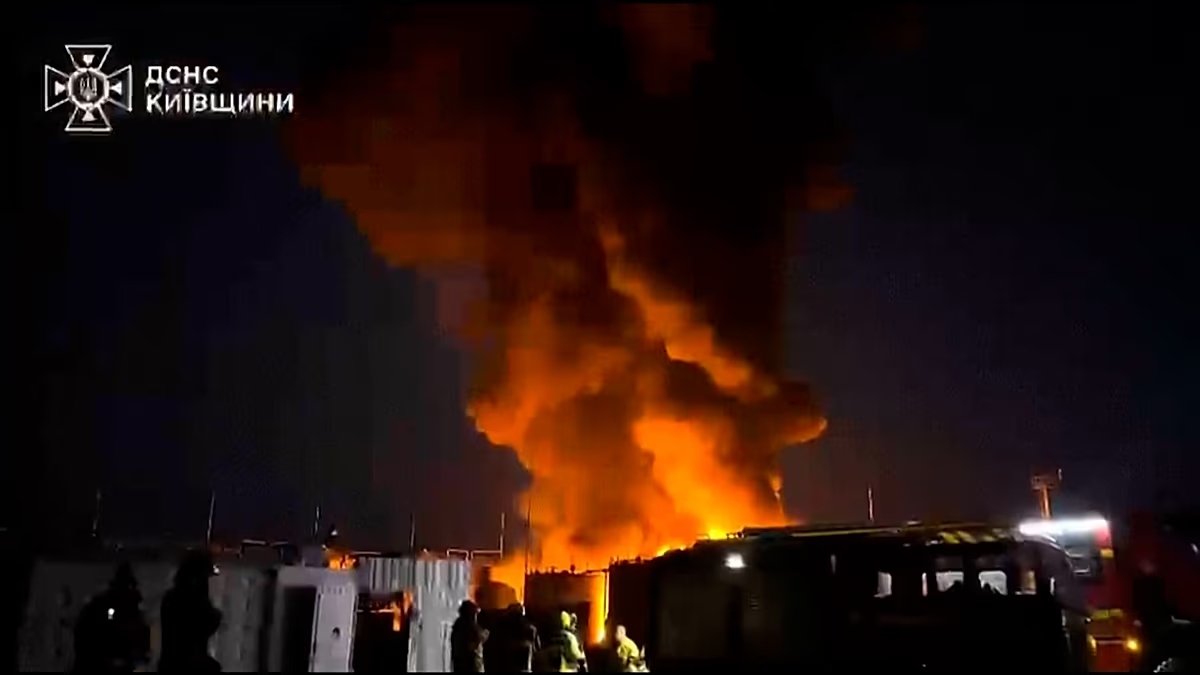
The war’s relentless, grinding nature was underscored by another night of aerial assault across Ukraine, with the most severe damage occurring in the Boryspil district, east of the capital, Kyiv. There, a drone strike ignited a major fire at a critical infrastructure facility, sending plumes of thick, dark smoke billowing into the sky. Emergency responders faced a formidable task, battling flames that engulfed approximately 2,000 square metres—an area equivalent to several large warehouses or industrial plots. Official images from the scene depicted firefighters in a determined struggle, deploying massive quantities of specialised foam to smother the intense blaze, a stark visual testament to the scale of the destruction. This attack on the outskirts of Kyiv served as a grim reminder that even regions surrounding the heavily defended capital remain vulnerable to the unpredictable reach of long-range drones.
Meanwhile, in the southern city of Mykolaiv, the human cost of these relentless attacks was felt directly. There, the night’s violence resulted in at least one civilian injury, a solitary number that belies the profound personal trauma and disruption behind it. Following the strike, emergency teams worked diligently to extinguish fires that had consumed vehicles, while also initiating thorough safety inspections. Notably, these procedures included radiation monitoring—a routine but chilling precaution that highlights the pervasive anxiety surrounding attacks on industrial or energy-related sites. This scene, repeated in various forms across the country, illustrates the complex aftermath of each strike: not merely putting out fires, but systematically ensuring the environment is safe for the community, a burdensome process that has become tragically routine.
The sheer volume of the aerial barrage is difficult to comprehend. According to statements from the Ukrainian Air Force, Russian forces launched an onslaught of 117 drones across the country in a single night. Ukrainian air defence units, operating under immense pressure, reported a significant success rate, claiming to have intercepted or otherwise neutralised 102 of these incoming threats before they could strike their intended targets. While these specific figures cannot be independently verified and are part of the informational fog of war, they underscore a critical, daily dynamic: a high-stakes battle between offensive drone swarms and defensive missile systems, a technologically intensive conflict waged in the darkness over Ukrainian towns and cities.
These latest attacks are not isolated events but part of a continuous campaign, now stretching into its fifth year since the full-scale invasion began, to systematically pressure Ukraine’s vital infrastructure. Beyond the immediate flames and explosions, the strategy aims to erode the nation’s economic resilience, disrupt energy supplies, and burden civilian life with constant uncertainty. As dawn broke after the attacks, emergency services remained deployed across multiple affected regions, their work transitioning from immediate response to meticulous damage assessment. Engineers and local authorities would have begun the painstaking evaluation of what was lost, a calculus that considers not just physical repair but the cascading impact on supply chains, heating, and power for countless households.
The narrative that emerges from nights like these is one of resilience shadowed by exhaustion. Behind the official statistics of square metres burned and drones shot down are the firefighters working successive shifts amid danger, the families in Mykolaiv waking to damaged property and injury, and the air defence soldiers spending another sleepless night staring at radar screens. The routine inclusion of radiation checks speaks to a profound and lingering dread that has been integrated into emergency protocol. The conflict has evolved into a war of attrition, where such attacks, though often not altering front lines, steadily drain resources, amplify fatigue, and test the endurance of the nation’s civilian and defensive infrastructure.
Ultimately, this episode encapsulates the current, protracted phase of the war. While global attention often focuses on dramatic frontline shifts, the reality for millions of Ukrainians is also defined by these sudden eruptions of fire in the night, the wail of sirens, and the morning-after reckoning of smouldering wreckage. The successful interception of many drones offers a measure of defence, but the ones that get through exact a tangible toll, underscoring the challenge of defending a vast country against a persistent and adapting threat. As cleanup and assessment continue, the events reiterate that the war’s impact is both concentrated in violent flashes and diffusely woven into the fabric of daily survival, a pressure maintained one night, and one drone, at a time.