

In 2025, the European Union embarked on a landmark journey into collective financial responsibility for its own security with the launch of the Security Action for Europe (SAFE) programme. This first-of-its-kind initiative allowed member states to access low-interest loans for defence investments, crucially outside the strict confines of the EU’s fiscal stability rules via a “national escape clause.” The primary aim was not to directly fill national arsenals, but to bolster a fragmented European defence industry plagued by inconsistent demand. One year into SAFE’s operation, the geopolitical landscape has only grown more urgent, propelling EU policymakers to actively plan a second edition. However, the path to “SAFE II” is fraught with complex political and financial questions that reveal deep divisions and shifting priorities among the 27 member states.
The most intense debate revolves around the fundamental structure of future funding. While there is unanimous agreement that ramping up defence spending is a geopolitical necessity—driven by Russia’s war in Ukraine and a perceived withdrawal of U.S. security commitments—many countries now argue that loans are no longer sufficient. Nations on the EU’s eastern flank, feeling the immediate brunt of hybrid threats like drone incursions, are leading the charge. Officials from Estonia and Latvia, which have already maxed out their borrowing capacity under current rules, voice a clear demand: “We don’t want loans anymore. We want grants.” They contend that further debt is unsustainable and that genuine solidarity requires direct financial transfers. This push for grants sets the stage for a major budgetary battle, as it would require richer member states to subsidize the defence of their eastern neighbours, testing the limits of European unity.
The immediate priority is concluding the first SAFE programme. Despite initial enthusiasm, with member states expressing willingness to borrow up to €188 billion, the final uptake is expected to be lower. Countries like Italy and Romania have scaled back requests, leaving an estimated €8 to €18 billion potentially unspent. This surplus is now in focus, as frontline states like Poland and Lithuania are anticipated to request second rounds of financing. EU officials are keenly aware that the success and transparent use of SAFE I funds must be demonstrated before any discussion of a more ambitious SAFE II can advance politically. The recent drone incidents, which have rattled Baltic capitals and even toppled Latvia’s government, underscore the urgent need for results but also highlight the pressure on these nations to prove the programme’s effectiveness.
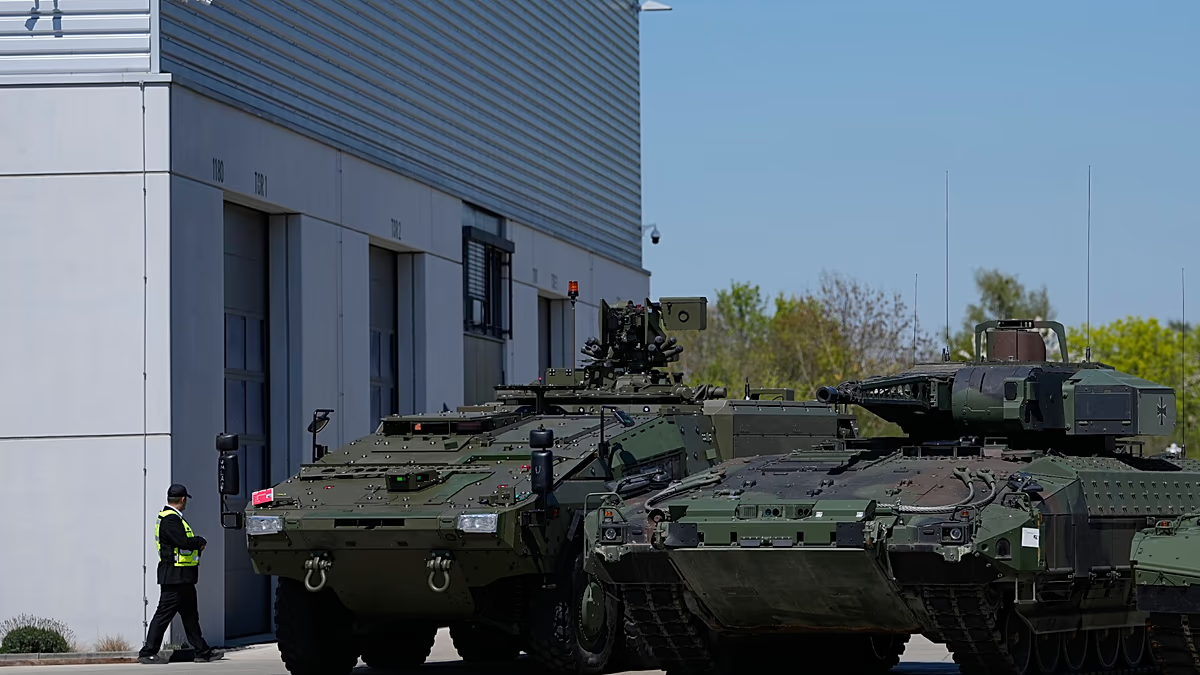
Beyond financing, SAFE exposes a critical tension in European defence: the clash between national industrial interests and the need for integrated, interoperable capability. Member states guard their prerogative to spend defence budgets on domestic suppliers, a practice SAFE does not challenge. However, this “nation-first” approach risks perpetuating a fragmented market, particularly in critical areas like drone and counter-drone technology. The European defence industry faces a paradoxical challenge: it lacks stable demand to justify scaling up, yet it also struggles to keep pace with the rapid, battle-tested innovations emerging from Ukraine. As one official starkly noted, Europe risks a future where “it will be Europeans buying from Ukraine’s defence industry.” This reality pushes the EU towards considering joint ventures with Ukrainian firms to absorb their technological edge.
Ukraine itself plays a pivotal and complicating role in this recalibration. A significant portion of a separate €90 billion EU loan to Kyiv is earmarked for military purchases. While encouraged to “buy European,” Ukrainian officials have been clear that EU production often does not meet their specific, urgent needs, especially for systems like anti-ballistic missiles where the U.S.-made Patriot remains essential. In practice, Ukraine is likely to reinvest much of this EU-borrowed money into its own battle-hardened defence sector. This creates a dual dynamic: it offers a potential bridge for European industry to access cutting-edge technology through partnerships, but also fuels fears in some capitals that their “national champions” could be overshadowed or absorbed by a mobilized Ukrainian industry.
Looking ahead, the design of any future SAFE instrument is hampered by profound strategic uncertainty. Officials are forced to plan for an unknown conflict: “For what war are we preparing?” The battlefield in Ukraine has evolved dramatically since 2022, and the landscape of 2030 is unpredictable. Compounding this is the staggering cost of potential U.S. disengagement. Replacing American “strategic enablers”—the vital logistical backbone like airlift and command systems—could cost up to €500 billion, a sum unthinkable for member states to shoulder alone. The central challenge for SAFE II, therefore, is not just shifting from loans to grants, but designing a financial tool flexible enough to incentivise capabilities for a future war whose shape is still a mystery, all while navigating the delicate politics of European solidarity and industrial sovereignty. The EU’s journey into common defence borrowing has begun, but its most difficult tests still lie ahead.