

Here is a humanized and expanded summary of the content, structured into six paragraphs as requested.
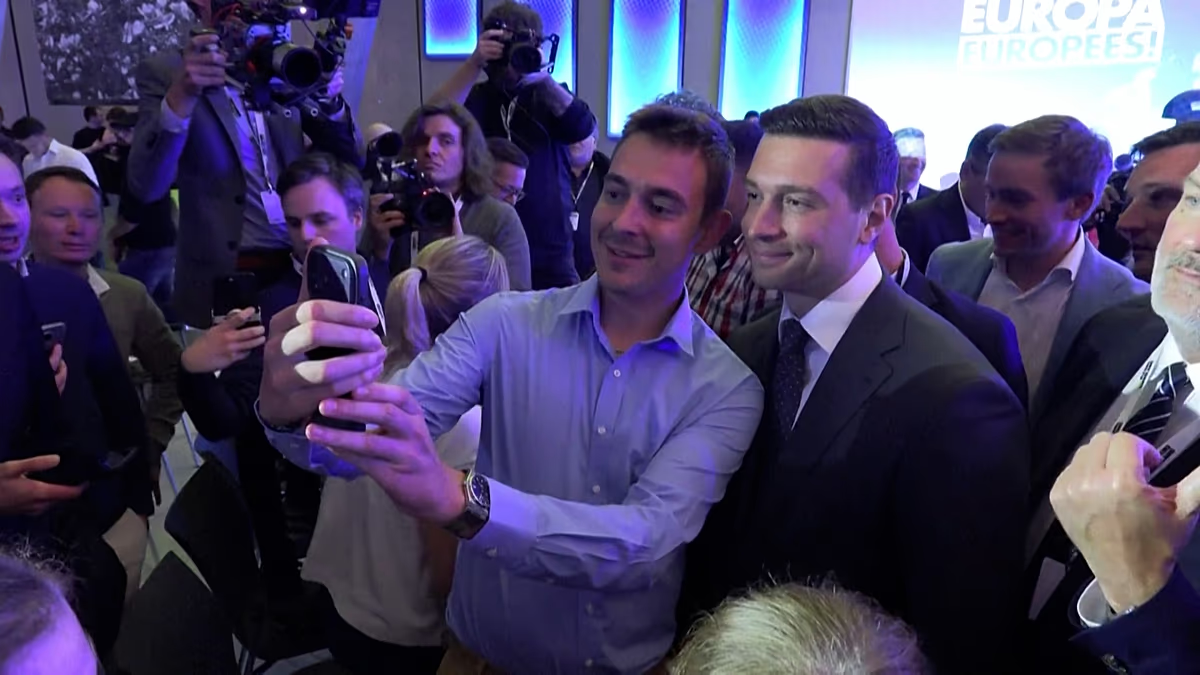
In the heart of Brussels, a city that symbolizes the complex political project of the European Union, French National Rally leader Jordan Bardella recently stepped onto a stage far from home. His destination was not the European Parliament, but the Flemish Parliament, where he sought to strengthen a strategic alliance with the Flemish nationalist party Vlaams Belang. This was more than a routine political visit; it was a calculated diplomatic mission aimed at weaving a tighter network among Europe’s rising nationalist and right-wing factions. Bardella’s core message was one of unity in purpose, arguing that fragmented national parties could achieve little, but a coordinated bloc could fundamentally reshape EU decision-making, particularly on the emotionally charged issues of migration and asylum. This visit, therefore, represented a practical step in building a counter-power structure within the very institutions these parties often criticize.
The context for this outreach cannot be separated from the political horizon in France itself. All eyes are gradually turning toward the 2027 French presidential election, and Bardella, as the fresh-faced leader of the National Rally, is widely seen as a potential standard-bearer for his party. His legal ability to run hinges on ongoing developments within the National Rally, but his current activity is unmistakably that of a statesman-in-waiting. By traveling to Brussels, Portugal, and Italy, he is building his international profile and credibility, demonstrating that he can operate and forge alliances on the European stage. This external diplomacy serves a dual purpose: it strengthens the pan-European nationalist movement while simultaneously bolstering his domestic image as a serious, connected leader capable of projecting French influence in a new political direction.
Bardella’s speech inside the Flemish Parliament celebrated the decade-long partnership with Vlaams Belang, framing it as a successful model for cross-border cooperation. He expressed support for emerging EU proposals that represent a hardening of stance—specifically, measures that would process asylum claims outside European territory and accelerate deportations. These policies, controversial to many, are presented by Bardella and his allies as matters of common sense and sovereignty, necessary to protect European borders and cultures. His endorsement signals a shared policy platform that transcends language and national history, uniting parties from different nations under a common banner of stringent migration control and a reassertion of national prerogatives over supranational mandates.
However, the day was not one of unanimous approval. Outside the parliament building, several hundred demonstrators gathered, their presence a vivid reminder of the deep divisions these political movements inspire. To these protesters, Bardella’s visit and the policies he champions are not about sovereignty or security, but a threat to the egalitarian and democratic ideals they believe are foundational to modern Europe. They see the alliance between the National Rally and Vlaams Belang as a dangerous consolidation of forces that promote exclusionary nationalism. This stark dichotomy—between supporters inside seeking greater influence and protesters outside sounding alarms—perfectly encapsulates the polarizing nature of Europe’s current political debate, where visions for the continent’s future could not be more opposed.
This event in Brussels is merely one node in a much wider web of political relationship-building. Bardella’s journeys to Portugal to engage with Chega and to Italy to connect with Giorgia Meloni’s government are part of a conscious, systematic diplomatic offensive. Nationalist and right-wing parties, once marginalized and operating in isolation, are now actively seeking to learn from each other’s electoral successes, share strategy, and create a coherent force within the European Parliament. Their coordinated focus extends beyond migration to include pushing back against ambitious EU environmental regulations like the Green Deal and challenging the trajectory toward deeper federalism. They are no longer just protesting from the sidelines; they are organizing to seize the levers of power and steer the EU vessel onto a different course.
Ultimately, Bardella’s Brussels mission underscores a significant and ongoing transformation in European politics. It highlights the shift from purely national political battles to a continent-wide ideological struggle, where alliances are forged across borders based on shared populist and nationalist sentiments. Whether one views this movement with hope or with apprehension, its growing coordination makes it an undeniable factor in Europe’s future. As the 2027 French election approaches and the next European parliamentary elections loom, these aligned parties are positioning themselves not as mere disruptors, but as potential architects of a new, more fragmented, and sovereignty-centric European Union. The demonstration outside the Flemish Parliament, therefore, was not just a protest against a single speech, but a reaction to this broader, gathering political realignment.