


Summary & Humanization: Cuba’s New Economic Reforms
Paragraph 1: A Surprise Announcement Amidst Pressure
On a Friday in early December, Cuban President Miguel Díaz-Canel delivered a significant and unexpected announcement. Facing relentless US economic sanctions and a deep domestic crisis, he unveiled a sweeping package of economic reforms aimed at liberalizing key sectors of the island’s state-controlled economy. The measures specifically target tourism, foreign trade, agriculture, and the private sector. Díaz-Canel framed this move not as a surrender to external pressure, but as a necessary and intelligent adaptation to the demands of the present time. In a revealing statement, he highlighted the delicate balance Cuba must strike, noting, “We cannot spell everything out so clearly because the enemy is watching everything we do.” This acknowledgment underscores the reform’s dual purpose: to revitalize a struggling economy while navigating a geopolitical landscape he described as a “hostile environment.”
Paragraph 2: Reviving a Crippled Tourism Industry
The centerpiece of the reform package is a bold attempt to resuscitate Cuba’s crippled tourism sector, a traditional economic lifeline. The plan involves reopening the industry to “new players” and “new modalities” to manage state-owned hotel infrastructure. This move comes as a direct response to the exodus of major foreign hotel chains, which have withdrawn fully or partially to avoid entanglement in US sanctions. Since the COVID-19 pandemic, Cuban tourism has plummeted, and the situation has been exacerbated by the tightened embargo and travel restrictions from the United States. By inviting new, perhaps smaller or more regionally focused investors and exploring different management models, Cuba hopes to inject life into empty resorts and generate desperately needed foreign currency, albeit within the constraints of the ongoing US blockade.
Paragraph 3: Liberating Agriculture and Trade
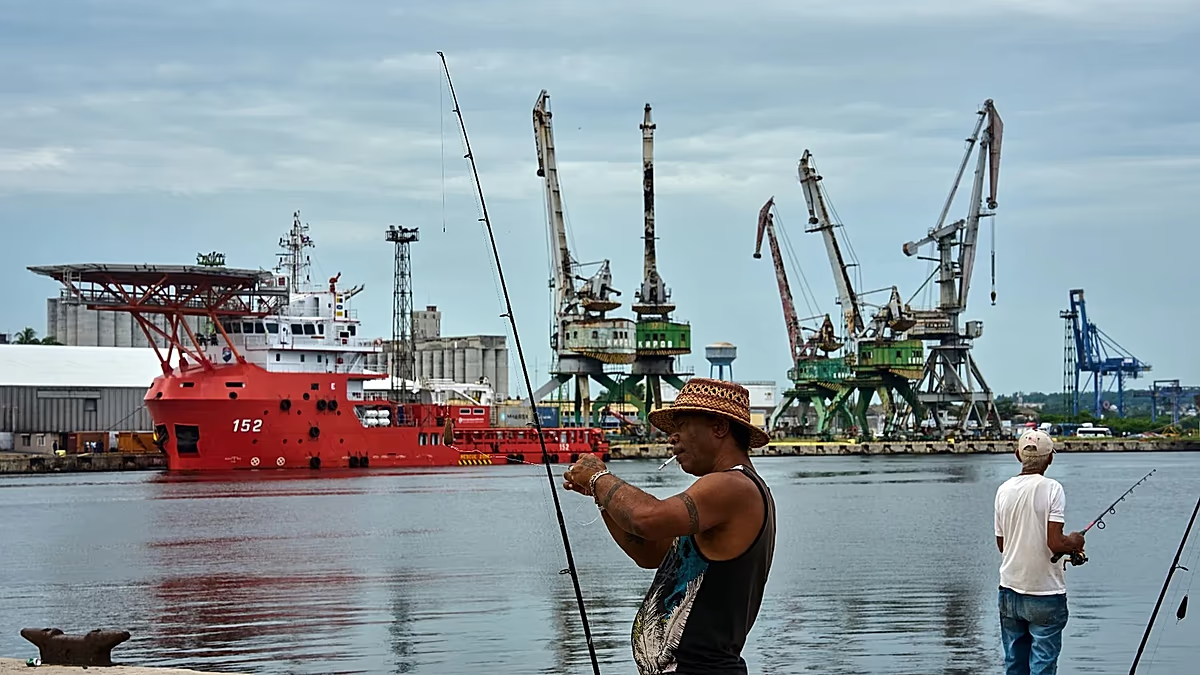
Beyond tourism, the reforms seek to untangle some of the bureaucratic knots that have long constrained Cuban productivity. The agricultural sector, crucial for both domestic food security and export, is set to gain greater autonomy. Farmers will receive direct access to essential inputs (like seeds and equipment), the ability to participate in the foreign exchange market, and a reduction in red tape. Perhaps more dramatically, the government will abolish the mandatory role of state import companies, which have historically acted as monopolistic intermediaries in all foreign trade. This change could allow businesses, including private and cooperative enterprises, to engage more directly with international markets. Furthermore, lifting restrictions on vehicle imports, while likely limited to entities with hard currency, signals a move toward normalizing commercial access to essential goods.
Paragraph 4: Streamlining the State and Targeting Aid
Díaz-Canel also addressed the cumbersome machinery of the state itself, announcing a reform aimed at consolidating and reducing the number of ministries. This points to an effort to improve bureaucratic efficiency and reduce government expenditure. In a move with profound social implications, he reiterated the intention to gradually phase out universal subsidies—a cornerstone of Cuba’s social contract—in favor of a system that “focuses them on the most vulnerable groups.” This shift from blanket support to targeted assistance acknowledges the fiscal unsustainability of the old model but risks causing anxiety among citizens accustomed to broad state guarantees. It represents a careful, and potentially painful, recalibration of Cuba’s commitment to social welfare amid severe economic constraints.
Paragraph 5: The Political Pathway and the Call for Unity
The announcement is not an immediate decree. Díaz-Canel emphasized that the package will undergo review and debate by the country’s political bodies, including the Communist Party and the National Assembly, in the coming weeks before final approval. This process ensures the reforms align with the nation’s socialist principles, even as they introduce market-oriented mechanisms. Throughout his comments, the President consistently returned to the theme of national unity. He presented the reforms as a collective, strategic response to adversity, urging cohesion in the face of external challenges. The framing is clear: these changes are a proactive, home-grown strategy for survival and development, not a concession to Washington.
Paragraph 6: Navigating a Precarious Future
In summary, Díaz-Canel’s reform package is a calculated attempt to introduce greater flexibility and efficiency into Cuba’s economic model without abandoning its political foundations. It seeks pragmatic solutions to acute problems: reviving tourism through alternative partnerships, empowering agricultural producers, simplifying foreign trade, and making the state apparatus leaner. The proposed shift in subsidies indicates a move toward more fiscally sustainable, though less universally protective, social policies. While significant, these measures unfold under the immense shadow of the US embargo, which continues to strangle the economy and will severely test the efficacy of any liberalization. The success of this bold yet cautious reform agenda will ultimately depend on its implementation, the ability to attract new foreign partners despite sanctions, and the Cuban people’s resilience during a period of difficult transition.