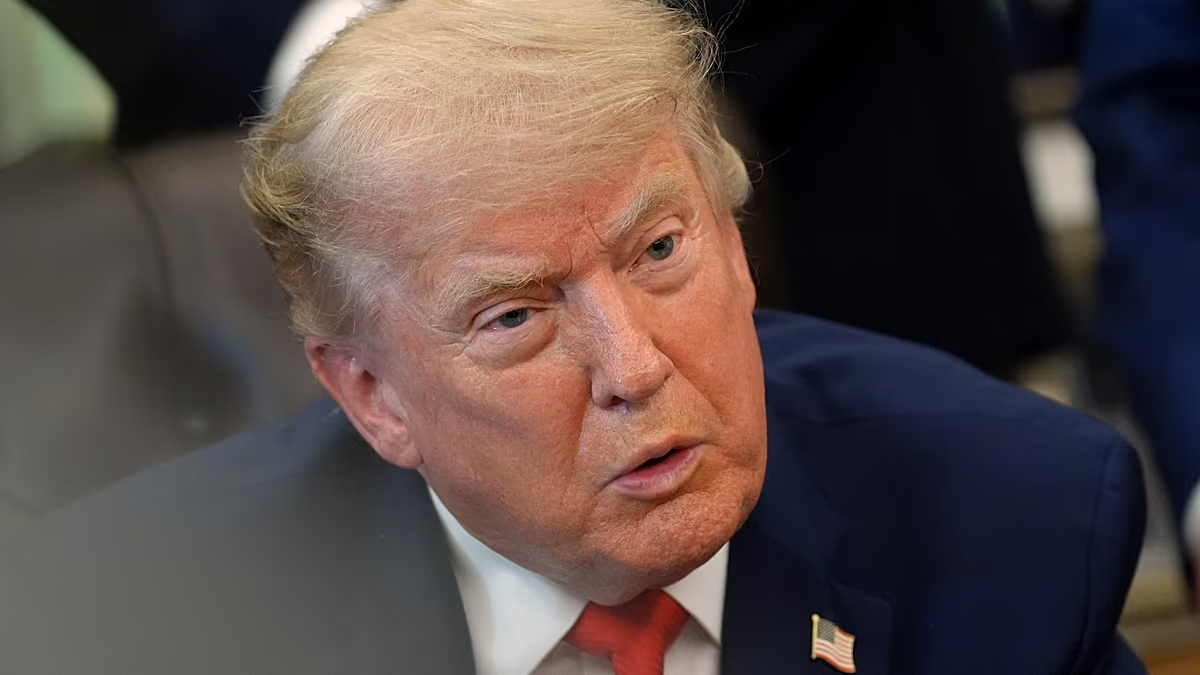


Ahead of the G7 summit in Évian, a flurry of diplomatic statements has created a dramatic, if contradictory, portrait of a potential turning point in Middle Eastern tensions. The central figure, US President Donald Trump, announced via his Truth Social platform that a long-sought peace deal with Iran could be signed imminently—as soon as Sunday—and that this would lead directly to the opening of the vital Strait of Hormuz to all navigation. His post struck a tone of both conciliation and threat, offering an olive branch by noting the US seeks a “much different and better” relationship with Iran and looks forward to future cooperation across the Middle East. Yet, it was underscored by a stark warning: should the process not proceed “quickly, easily, and smoothly,” the United States holds “the ultimate alternative, hopefully never to be used again,” a clear allusion to military force. This declaration, promising both peace and peril, immediately cast a shadow over the upcoming gathering of world leaders.
However, the path to this proclaimed deal is far from smooth, as Tehran’s official position directly contradicts the American timeline. Iran’s foreign ministry, via state media, indicated that no signing would occur on Sunday, highlighting a significant gap in public posturing between the two nations. This dissonance exists against a backdrop of longstanding Iranian demands that Trump’s statement notably omitted: any resolution addressing the war in Lebanon and Israel’s role in it, and the lifting of the US blockade on Iranian ports within the Hormuz Strait itself. Furthermore, Iran has consistently insisted on its right to enrich uranium, a point Trump addressed obliquely by stating the US would take Iran’s enriched uranium ‘dust’ once “all is calm.” The chasm between the two accounts suggests that while a diplomatic window may be open, the final steps are fraught with complexity and mutual suspicion, with core issues potentially remaining unresolved.
The international community is watching with bated breath, as signaled by Pakistan’s Prime Minister Shehbaz Sharif, who stated on social media that a deal was likely within 24 hours and that the world was “closer to a peace deal than ever before.” This external optimism underscores the global stakes of a US-Iran détente. The Strait of Hormuz, a chokepoint for roughly a fifth of the world’s oil supply, has been a theater of high tension; its opening would promise immediate stabilization for global energy markets. Consequently, the status of these negotiations will undoubtedly be a dominant concern at the G7 summit, competing for attention alongside the ongoing war in Ukraine. Leaders will be keen to discern whether Trump’s announcement is a breakthrough or a premature proclamation, and what a new US-Iran dynamic would mean for regional security architectures.
Alongside the Iran focus, President Trump’s schedule at the summit reveals a carefully orchestrated diplomatic program, though one with notable omissions. A senior administration official confirmed Trump will participate in a G7 working session with Ukrainian President Volodymyr Zelenskyy but pointedly stated no bilateral meeting between the two is scheduled. This arrangement suggests a formal, collective engagement rather than the intimate, one-on-one consultations that often signal deep strategic alignment. Trump’s attention has visibly shifted from Ukraine since US and Israeli attacks on Iran in February, making this group setting a forum to manage rather than necessarily intensify support for Kyiv. Instead, Trump’s bilateral meetings are slated with leaders from France, Qatar, the UAE, Egypt, and India—a list highlighting a clear pivot towards Middle Eastern and Global South powers, likely reflecting the immediate priorities surrounding Iran and energy security.
The symbolism of Trump’s European visit will extend beyond the summit itself. Following the G7’s conclusion, he is scheduled for a dinner with French President Emmanuel Macron at the Palace of Versailles, a site Macron’s office emphasized as a “landmark of Franco-American friendship” where the treaty establishing US independence was signed in 1783. This grand gesture, set to celebrate the 250th anniversary of that independence, aims to project an image of historic alliance and shared values. Yet, it creates a striking juxtaposition with the more transactional and turbulent diplomacy unfolding around Iran and Ukraine. The event will serve as both a photo opportunity and a reminder of the traditional alliances that now exist alongside the president’s more unconventional and unilateral foreign policy maneuvers.
In conclusion, President Trump arrives at the G7 summit having unilaterally set a high-stakes agenda with his surprise announcement on Iran. The prospect of a deal offers a vision of de-escalation and economic relief for the world, but its reality is clouded by Iranian denials and the absence of key concessions. Whether this is a masterstroke of negotiation or an instance of optimistic pressure will define the summit’s undercurrents. Simultaneously, his engagements—a group meeting with Zelenskyy, targeted bilaterals with Middle Eastern partners, and a ceremonial dinner in Versailles—paint a picture of a presidency navigating multiple geopolitical chessboards at once. The coming days will reveal if the promise of a signed deal and an open strait materializes, or if the “ultimate alternative” remains a looming specter over a region and a world yearning for stability.