

Across France, a complex and politically charged debate is unfolding as the FIFA World Cup progresses, centered on how municipalities should balance public celebration with public safety. This debate has been crystallized by the announcement of a night-time curfew for unaccompanied minors under the age of 16 in the city of Moulins, a measure that will remain in effect for the tournament’s duration. This move places the relatively small town of 19,000 inhabitants in the company of larger urban centers like Toulouse and Clermont-Ferrand, which have adopted similar restrictive policies. The underlying rationale, as cited by numerous local governments, is a direct response to recent episodes of urban violence, particularly those that erupted following PSG’s Champions League victory. Authorities are proactively seeking to prevent similar disturbances during the heightened emotions of the World Cup, framing the curfews as a necessary step to protect both the general populace and young people themselves.
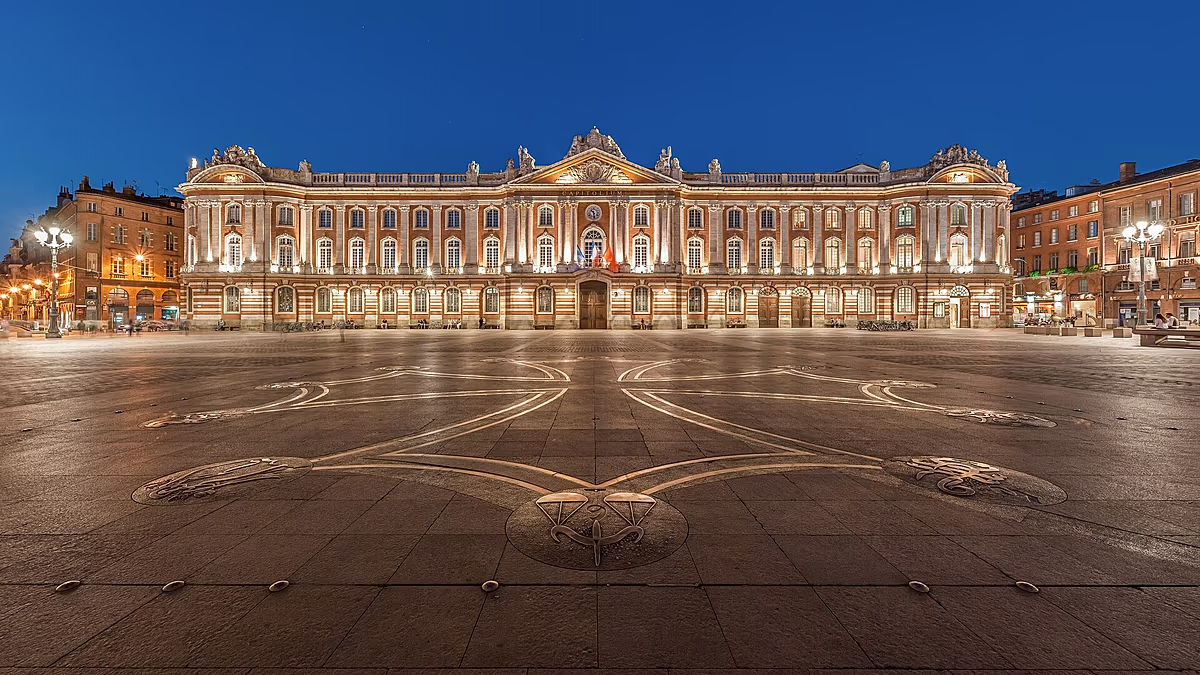
Toulouse provides a prominent example of this “stick and carrot” approach. The city, led by centre-right Mayor Jean-Luc Moudenc, has implemented a decree imposing a curfew from 10 p.m. to 5 a.m. for minors across an extended central zone, a decision made in consultation with police authorities. The “stick” is this restrictive measure, which does include exceptions for minors accompanied by adults or those facing emergencies. Simultaneously, the “carrot” is the promise of a substantial fan zone capable of hosting 18,000 supporters, but only if the French national team advances to the quarter-finals or beyond. This concession came notably after pressure from the left-wing opposition, illustrating how the management of the World Cup’s civic footprint has become a point of political negotiation. However, the curfew itself has drawn sharp criticism from figures like Left-wing MP François Piquemal, who labels it “madness” and argues it unfairly penalizes youth.
In stark contrast, the city of Clermont-Ferrand has adopted what appears to be the strictest posture in the country, demonstrating a clear lack of appetite for World Cup-related public gatherings. The city’s right-wing Mayor, Julien Bony, has announced not only a curfew—enforceable by a €150 fine—but also a definitive refusal to install any public fan zone, “even if France reach the final.” Furthermore, bars broadcasting matches have been instructed to turn their screens inward to deliberately avoid creating street crowds. This comprehensive suite of restrictions is justified by local authorities as a direct consequence of serious incidents following recent major football matches and in response to riot calls circulated on social media. Clermont-Ferrand’s strategy positions it as an outlier, almost discouraging the traditional communal celebration of football, arguably making it a destination for those wishing to escape the tournament’s atmosphere altogether.
The hesitation around large-scale public viewing events extends beyond Clermont-Ferrand to other major cities, reflecting a cautious and fragmented national response. Marseille, under Socialist leadership, has reportedly forgone a fan zone entirely, while Paris has yet to finalize its plans, only expressing a desire to create one. In Lyon, the Green-led administration has termed a fan zone a mere “possibility,” contingent on the French team’s success, and currently encourages residents to watch matches in commercial establishments. This widespread wariness stands in sharp relief to the celebratory approach of some smaller communes. For instance, Strasbourg has committed to showing matches on a giant screen, and in Vénissieux, a Left-wing mayor has promised a “great popular summer” with decentralized screenings and community barbecues, deliberately aiming to broadcast a diverse array of global teams.
Beneath these logistical decisions lies a deeper tension regarding community, control, and the perception of youth. Proponents of curfews and restrictions frame them as pragmatic and protective, necessary tools to maintain order and safeguard property and persons in a climate judged to be potentially volatile. They point to past disturbances as clear evidence of risk. Critics, however, see these measures as punitive, disproportionately targeting young people and effectively criminalizing normal social activity during a global cultural event. They argue that such policies reflect a failure to provide positive, engaging alternatives and risk deepening social divisions. The alternative model, as seen in Vénissieux, suggests that with proactive community organization and inclusive planning, the World Cup can be an opportunity for communal joy rather than a pretext for restriction.
As the current tournament heads toward its conclusion, the varied responses from French cities have set a precedent that may well influence public policy during future international events. The 2026 World Cup, to be hosted across North America, will again pose similar questions for communities worldwide about how to host a safe and inclusive global festival. The French experience of 2023 highlights that there is no one-size-fits-all answer; solutions are deeply shaped by local political leadership, recent history, and resource allocation. The divergent paths chosen—from Clermont-Ferrand’s stringent restrictions to Vénissieux’s neighborhood barbecues—reveal a nation grappling with how to foster collective identity and celebration while mitigating real and perceived risks, a balancing act that will undoubtedly continue in tournaments to come.