



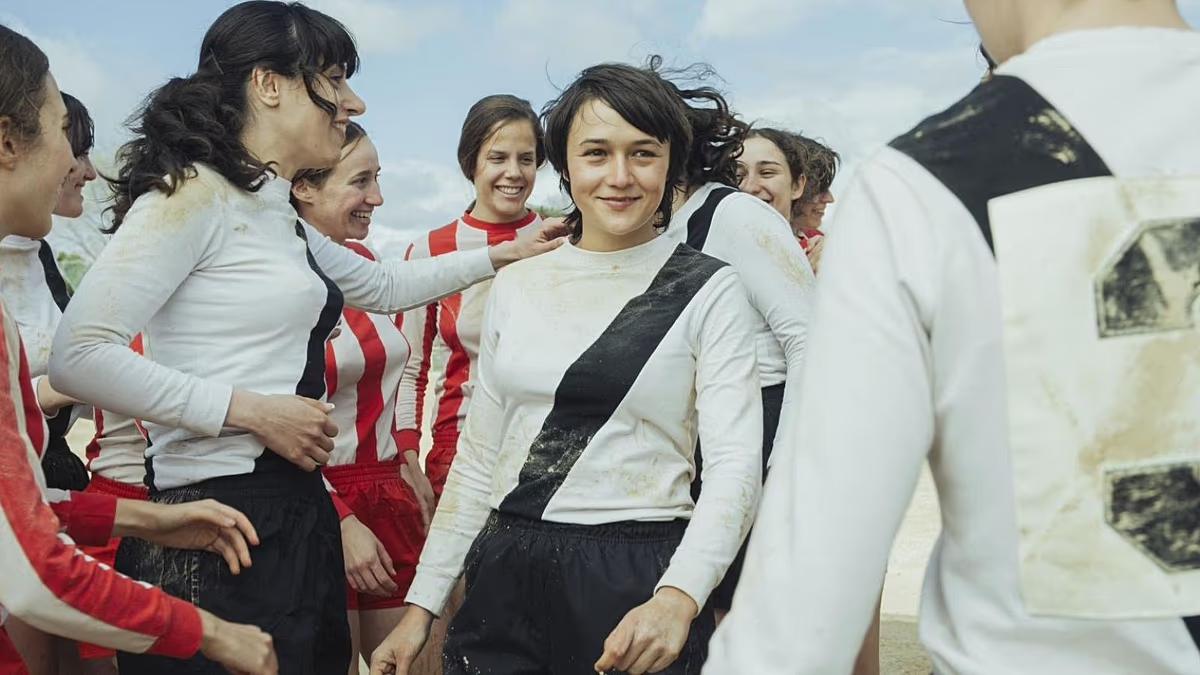
In the glittering aftermath of Spain’s 2023 Women’s World Cup victory, with stadiums now regularly filled to capacity for women’s football, it is almost impossible to imagine the clandestine, unsanctioned origins of the very same national team just over half a century ago. Long before official recognition, trophies, or professional contracts, the first Spanish women’s national team took to the field, driven not by federation support but by pure passion for the game. This is the forgotten history unearthed by filmmaker Marta Díaz de Lope Díaz in her documentary, “Pioneers. They Just Wanted to Play.” At the heart of this story is Concepción Sánchez Freire, known as Conchi Amancio, a teenage prodigy whose extraordinary talent would ignite a movement, yet whose name remains largely absent from the mainstream sporting narrative. Her journey, and that of her teammates, forms a foundational chapter not only in Spanish football, but in the nation’s social evolution.
The team that would become known as the “clandestine national team” began its journey in the early 1970s under the late Franco dictatorship, a period when women’s football was viewed with deep suspicion and institutional hostility. Organized by promoter Rafael Muga, these pioneering players traveled across Spain, promoting the sport through exhibition matches, often playing more games than they could train for. They faced Portugal and Italy in international friendlies, yet these fixtures were denied recognition by the Spanish Football Federation (RFEF), UEFA, or FIFA. As Díaz de Lope Díaz notes, the players themselves nuance the term “clandestine,” pointing out they played before crowds of thousands—they were not hiding, but they were unequivocally marginalized. The federation’s determination to sideline them was evident in symbolic slights: they were forbidden from wearing official crests, their matches were not preceded by national anthems, and even referees were barred from wearing official kit. They played for the love of football, in a vacuum of institutional support.
The legend of this pioneering generation crystallized on a single afternoon: December 8, 1970, at Madrid’s Boetticher ground. Drawn by sheer novelty, between 7,000 and 8,000 spectators witnessed a 13-year-old girl named Conchi Sánchez Freire score all five of her team’s goals. Her dazzling dribbling and clinical finishing earned her the nickname “Amancio,” after the Real Madrid legend, and she instantly became the sensation of Spanish women’s football. This moment was the spark. Conchi’s talent soon propelled her beyond Spain’s borders, as she signed for Gamma 3 Padua in Italy, becoming one of the first Spanish women to build a professional career abroad—a move significant enough to be reported on television news. Her 25-year career in Italy and England, where she won leagues and cups and scored over 500 goals, stands as a testament to the world-class talent that existed in Spain, even as it was systematically ignored at home.
Despite their foundational role, official acknowledgment from the football establishment took nearly five decades. It was not until 2019 that the RFEF finally hosted the surviving members of that early 1970s team at its Las Rozas headquarters, in an event described as paying an “unpaid debt.” The federation recognized these women as the driving force behind fundamental transformations, who had “changed history.” This long-overdue tribute, however, could not fully capture the profound social barriers they had challenged. Díaz de Lope Díaz emphasizes that her film uses football as a lens to examine a much broader struggle. These women were defying not just sporting norms, but the rigid gender ideology of the Franco regime, which promoted a domestic, submissive model of womanhood through its Women’s Section. To play football was to provoke hostility and ruffle feathers, confronting both institutional obstacles and deeply entrenched social prejudices.
The trajectory from the clandestine matches of the 1970s to the World Cup glory of 2023 illustrates a dramatic societal shift. As the director argues, the talent was always present; what was missing was the structure, the project, and the spotlight. The pioneers played for the simple right to compete, with no expectation of fame or legacy. Today, new generations have visible, celebrated role models like Alexia Putellas and Ona Batlle—a reality those first players could scarcely have imagined. This evolution mirrors Spain’s own journey from dictatorship to a more modern and equitable democracy. The film, therefore, is less a straightforward sports documentary and more a record of a “social feat,” painting a picture of the constrained lives of women in that era and the incremental freedoms won, on and off the pitch.
In essence, the story of Conchi Amancio and her teammates is a crucial origin story for contemporary Spain. It is a narrative of resilience and quiet revolution, where the act of playing a game became a profound statement of identity and autonomy. By bringing their history to the screen, Díaz de Lope Díaz does more than honor forgotten athletes; she traces the lineage of current success and contextualizes the hard-won place women now hold in Spanish public life. Their story is a powerful reminder that before the stadiums roared, there were dusty pitches and determined pioneers who, against all odds, just wanted to play. Understanding their journey is to understand not only the roots of a champion team, but the very trajectory of a nation.