


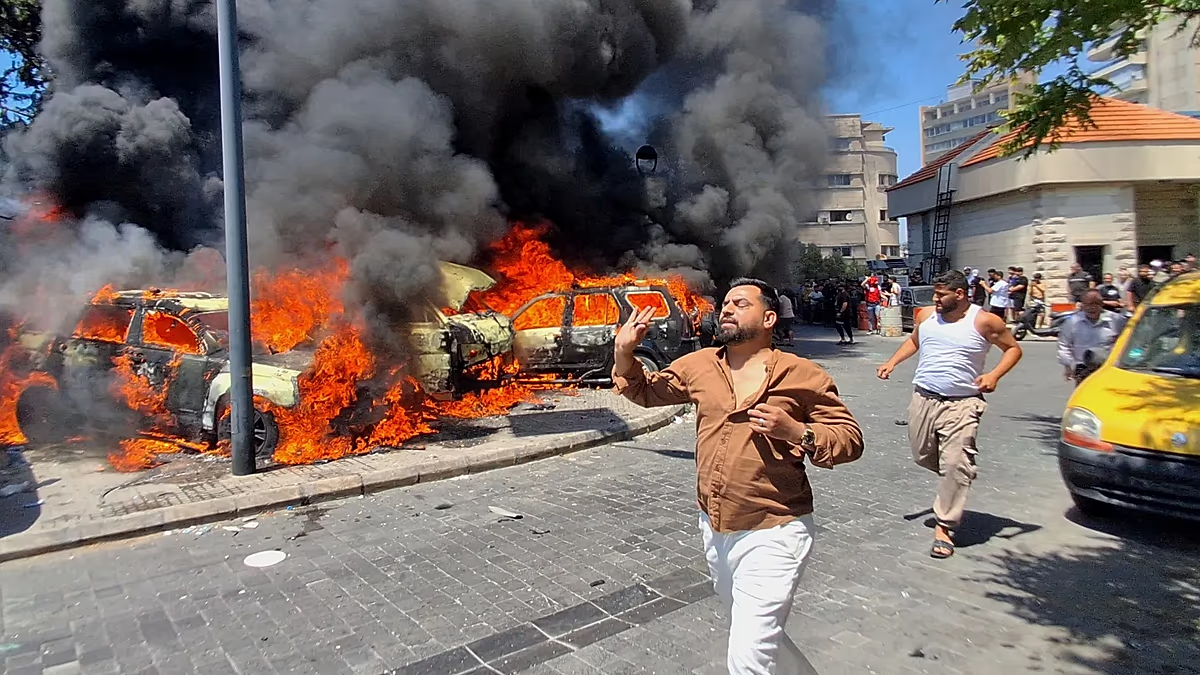
The conflict along the Israel-Lebanon border has entered a devastating new phase of intensity, marked by a relentless series of Israeli airstrikes that are deepening a humanitarian crisis. On a recent Friday morning, residents in southern Lebanon’s Nabatiyeh area witnessed yet another attack, as warplanes struck the region, sending a large plume of smoke billowing into the sky. This strike was not an isolated event but part of a brutal continuum of violence that has left towns like Marjayoun and Qlayaa shells of their former selves. Streets that should be bustling with daily life are now eerily deserted, punctuated only by the occasional passing vehicle or a terrified resident darting outside. The scars of war are visible on every corner: shops that remain open do so amidst the rubble of destroyed buildings and the husks of burned-out cars. For the Christian families and others who have chosen, or been forced, to remain in these border areas, existence is now defined by a constant, paralyzing fear, with many too afraid to even step outside to buy food or necessities.
The human cost of this military surge is staggering and indiscriminate, with civilian infrastructure repeatedly in the crosshairs. In a particularly alarming development, medical facilities, which should be sanctuaries, have become targets. On the Thursday preceding the Friday strike, an Israeli attack wounded ten staff members at a hospital in the coastal city of Tyre. This incident is part of a pattern that has seen all three major hospitals in the region damaged since the war reignited in early March. The violence has sprawled far beyond the immediate border zone, reaching the eastern Baalbek region. The wave of lethal strikes intensified mid-week after Israeli warnings for residents to evacuate, with attacks in villages like Houmin and areas east of Tyre claiming numerous lives. In one strike, at least six people were killed, while in the southern city of Sidon, an Israeli drone targeted a car, killing two more. These operations, which Israel states are aimed at Hezbollah infrastructure and militants, are creating a landscape of widespread grief and trauma for Lebanese civilians caught in the middle.
The Israeli government, led by Prime Minister Benjamin Netanyahu, frames this escalation as a necessary campaign of attrition against a formidable enemy. In a recent video message, Netanyahu claimed the Israel Defence Forces (IDF) had eliminated nearly 10,000 Hezbollah militants and were “systematically clearing out” Iranian-backed forces. This rhetoric underscores a military strategy focused on degrading Hezbollah’s capabilities through sustained force. The IDF maintains that its strikes, including those in Sidon and Tyre, are precise attacks on militant sites. However, the devastating collateral damage to homes, vehicles, and vital hospitals tells a different story on the ground—one of a conflict where the line between military target and civilian space has become tragically blurred, leaving communities to bear the brunt of the violence.
This dangerous military escalation is unfolding within a vacuum of diplomacy, where all paths to negotiation appear hopelessly blocked. The broader regional tensions provide a volatile backdrop; the very same Thursday saw the United States and Iran exchange fire for a second consecutive day, following warnings from U.S. President Donald Trump. At the heart of the diplomatic stalemate is Iran’s firm condition that any comprehensive deal to end its hostilities with the U.S. and Israel must also guarantee an immediate ceasefire between Israel and Hezbollah. Israel has flatly rejected this linkage, refusing to tie its campaign in Lebanon to wider regional negotiations. This refusal to engage with intertwined ceasefire demands has effectively green-lit the continued military surge, as political solutions are abandoned in favor of aerial bombardments and artillery duels.
The consequences of this deadlocked diplomacy and sustained warfare are catastrophic for Lebanon. Since the major escalation in March, reported deaths have surpassed 3,500, a number that fails to capture the full scope of individual and collective suffering. More tangibly, the conflict has triggered a massive displacement crisis, with approximately one million people—a significant portion of the country’s population—forced to flee their homes. These individuals are now internally displaced or have sought refuge elsewhere, their lives upended and futures uncertain. The social and economic fabric of southern Lebanon is being torn apart, with livelihoods destroyed, communities scattered, and a generation of children growing up under the shadow of war and displacement.
We are left with a grim portrait of a conflict where short-term military actions are precipitating long-term human devastation. The continued airstrikes, the targeting of civilian areas and hospitals, and the mass displacement paint a picture of a war with no clear endpoint. With diplomacy stalled and demands fundamentally incompatible, the people of southern Lebanon are paying the highest price. They endure a daily reality of fear, loss, and instability, their homes and streets transformed into a battlefield. As the international community watches, the urgent need is for a renewed, credible diplomatic initiative that prioritizes human security over military posturing, before the damage becomes irreparable for another generation.