



Of course. Here is the humanized and expanded summary of the event, structured into six paragraphs.
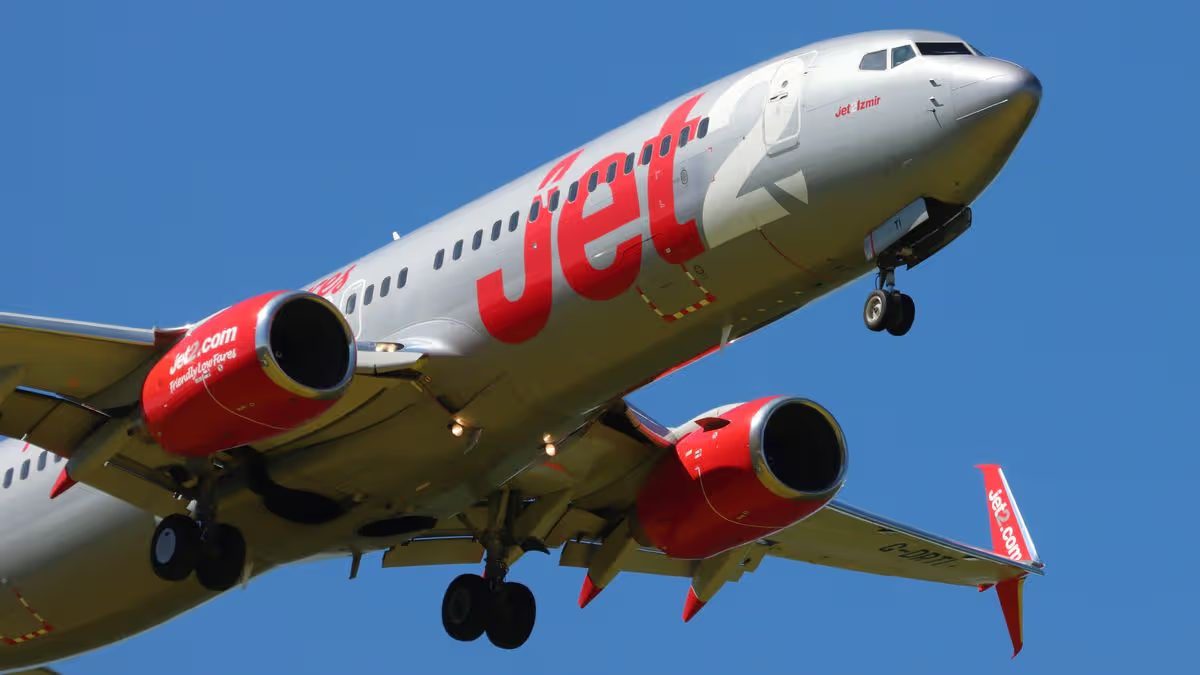
On a seemingly routine Saturday afternoon, June 13, the calm atmosphere aboard Jet2 flight LS178, en route from the sunny shores of Alicante, Spain, to Glasgow, Scotland, was suddenly transformed. High above the churning waters of the Irish Sea, the pilots made a critical decision that would set in motion a well-orchestrated sequence of events on the ground. They declared a general in-flight emergency, a move immediately communicated to air traffic control by changing their aircraft’s transponder code to the internationally recognized signal: 7700. This four-digit code, known in aviation parlance as “squawking 7700,” cuts through the radio chatter like a beacon, alerting all controllers that an aircraft requires urgent attention and priority handling. For the passengers unaware of the technical procedures unfolding in the cockpit, the flight continued its northerly path, but now under the watchful and prioritized guidance of ground control.
The declaration occurred approximately two and a half hours into the journey, as the Boeing 737-8 aircraft cruised at around 23,000 feet near the coastal town of Stranraer. Data from public flight tracking services captured its path, a digital breadcrumb trail that would later show a steady but now purpose-driven trajectory toward its destination. While the “7700” squawk signals a serious situation, it is deliberately broad in nature, covering a spectrum of potential issues from technical malfunctions with the aircraft itself to onboard medical crises. Its brilliance lies in its simplicity; it immediately clears the operational decks, prompting air traffic controllers to provide the aircraft with a clear, expedited path and alerting airport emergency services to stand by, without needing to know the specific details in the crucial first moments.
As the flight proceeded over Dumfries and Galloway and then Ayrshire, the seamless coordination between the cockpit and the ground began in earnest. Declaring the emergency allowed the pilots to request and receive a priority landing. This meant other air traffic could be redirected or held, ensuring LS178 had an unobstructed approach into Glasgow International Airport. On the ground, the airport’s emergency protocols quietly activated. Fire and rescue services, ambulances, and medical teams were placed on standby, preparing for any scenario as the aircraft made its final descent. This behind-the-scenes mobilization is the very purpose of the 7700 procedure—to translate a high-altitude alert into a swift, safe, and efficient ground response.
Shortly after 3:40 PM, the focus of all this preparation touched down smoothly on the runway at Glasgow. The safe landing marked the successful conclusion of the airborne phase of the emergency. It was only after the aircraft was on the ground and the immediate operational tension had eased that Jet2 provided clarity on the nature of the incident. The airline confirmed that the emergency declaration was not due to any mechanical fault with the aircraft, but was initiated proactively by the crew because a passenger onboard required urgent medical attention. The “squawk 7700” was used precisely as intended: to secure the fastest possible route to a place where professional medical help was available.
The spokesperson for Jet2 succinctly captured the professionalism of the moment, stating, “Our crew followed procedure and requested a priority landing due to a customer requiring medical attention.” This statement underscores a critical aspect of modern aviation: that emergencies are not solely about technical failures, but often about human needs. The training of flight crews encompasses both, enabling them to assess a medical situation, recognize the need for expedited ground access, and leverage the international protocols designed for such events. The well-being of the passenger became the central factor, and the procedures ensured the aircraft itself became the fastest possible ambulance.
This incident with flight LS178 serves as a powerful, real-world example of the invisible safety net that exists within global aviation. While the phrase “mid-air emergency” can evoke scenes of drama, the reality is often one of calm, proficient execution of long-established protocols. From the pilots making the call, to the air traffic controllers creating a path, to the ground crews standing ready, the system worked in harmony to transform a potential crisis into a managed, safe outcome. It reminds us that the infrastructure of flying is built not just for efficiency, but for resilience and care, ensuring that help is never more than a code—7700—and a quick descent away.