

The Escalating Conflict in Lebanon: A Nation at a Crossroads
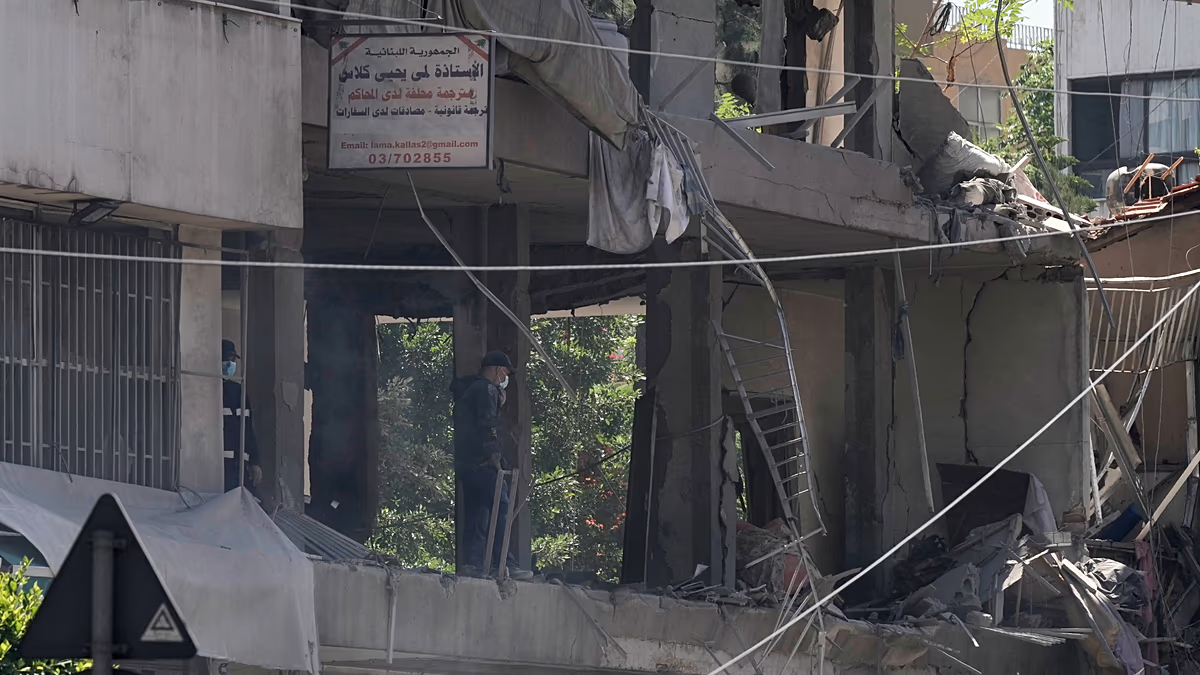
In the dense urban landscape of southern Beirut, known as Dahiyeh, smoke once again stained the sky on Sunday as the Israeli military launched fresh aerial strikes. According to Lebanon’s official National News Agency, the attack targeted the Ghobeiry neighborhood, an area with deep historical ties to the Hezbollah militant group. The Israel Defense Forces described the operation as “precise,” stating it hit a Hezbollah command center allegedly used to coordinate “terrorist attacks against Israeli civilians and IDF soldiers” operating near the border. In a communication from Prime Minister Benjamin Netanyahu’s office, Israel justified the action as a direct response to Hezbollah rocket fire, emphasizing that steps were taken to “mitigate harm to civilians.” This latest violence underscores a perilous cycle of retaliation, where projectile attacks from Lebanon toward Israeli towns like Shomera and Shlomi are met with forceful airstrikes, trapping civilian populations on both sides in a relentless exchange of fire.
A Weekend of Violence and Mourning
This recent strike marks the second major escalation in just one weekend, following a series of attacks on Saturday that left at least five Lebanese citizens dead. The human cost was felt across southern Lebanon: one life was lost in an airstrike on Maarakeh in the Tyre district, municipal mayor Ali Badie was killed in the Jezzine district, and three others perished in the towns of Deir al-Zahrani and Kafr Reman. Prior to these attacks, the Israeli military issued stark warnings, urging residents of 24 towns and villages to evacuate immediately—a directive that sows fear and dislocation but cannot erase the tragedy for those who are hit. Each casualty represents a family shattered, a community in mourning, and a deeper entrenchment of hatred, illustrating how military actions, even when labeled as precise, inevitably weave a tapestry of personal and collective grief.
A Presidential Plea for National Unity
Amid the rubble and rising tension, Lebanese President Joseph Aoun delivered a sobering address on Saturday, framing the crisis as a “fateful juncture” for his fractured nation. Speaking on the anniversary of a past political assassination, he challenged Lebanon to choose between becoming “a sovereign state that monopolises arms and upholds the rule of law” or remaining “hostage to the logic of militias and the culture of exclusion.” His words highlighted a fundamental internal struggle: the presence of armed groups like Hezbollah, which operates independently of the state army, continually undermines national cohesion and sovereignty. Aoun’s appeal for unity as an “existential necessity” is a poignant reminder that beyond the cross-border conflict, Lebanon faces a profound identity crisis, where sectarian divisions and external allegiances threaten to tear the very fabric of the country apart.
The Regional Domino Effect and International Stakes
The clashes between Israel and Hezbollah extend far beyond their bilateral border, risking the fragile tapestry of regional diplomacy. At the heart of this wider confrontation is Iran, Hezbollah’s principal benefactor, which has explicitly linked any potential ceasefire deal with the United States to a cessation of Israeli strikes in Lebanon. This interconnection was starkly demonstrated just a week prior, when Israeli attacks on Beirut suburbs prompted direct Iranian retaliation against Israel. Hezbollah’s entry into the current conflict in March, following the killing of Iran’s supreme leader, has effectively turned a localized skirmish into a broader regional proxy war. Consequently, every missile launched and every airstrike called in not only deepens the suffering in Lebanon but also jeopardizes delicate international negotiations, illustrating how local conflicts can rapidly escalate into global flashpoints.
A Glimmer of Diplomatic Hope
Despite the escalating violence, a fragile thread of diplomatic hope persists. Mediator Pakistan and U.S. President Donald Trump have indicated that Iran and the United States are closer than ever to finalizing a deal, with a potential signing imminent. Although this anticipated agreement does not resolve core, long-standing issues such as Iran’s nuclear ambitions or its frozen financial assets, it proposes a critical 60-day framework for technical discussions. This breathing space could, in theory, create a pathway to de-escalation, potentially calming the tensions in Lebanon. The deal represents a complex gamble: a chance to wind down a region-wide crisis, but one that remains vulnerable to being shattered by the next explosion on the ground, proving that the distance between the negotiating table and the battlefield is perilously short.
The Human Cost and an Uncertain Future
As smoke clears over Beirut and families bury their loved ones, the human narrative at the core of this conflict remains one of profound uncertainty and anguish. Civilians in southern Lebanon and northern Israel live in a state of perpetual anxiety, their daily lives dictated by air raid sirens and evacuation orders. The strategic calculations of governments and militant groups often overshadow these individual stories of loss, displacement, and fear. Lebanon stands at a precipice, caught between internal fragmentation and external aggression, while the international community watches, hoping diplomacy can prevail. The coming days will reveal whether leaders can seize the fragile opportunity for a deal or if the region will spiral further into a cycle of violence where the greatest cost is measured not in political statements, but in innocent lives forever altered.