



(Paragraph 1)
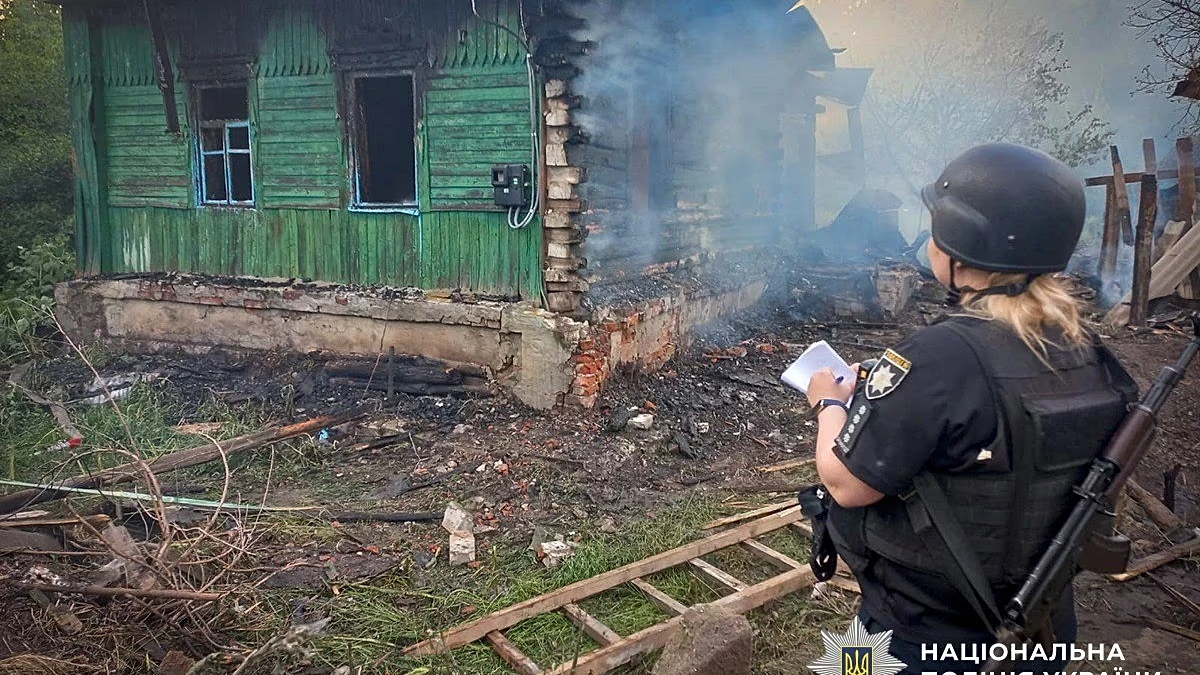
The early summer days in Ukraine and Russia carry a grim and familiar rhythm, marked not by sunshine but by the distant thud of explosions. On June 14, 2026, this violence manifested in the northern Ukrainian region of Sumy. Police reports detailed a day of terror for its residents, where Russian forces employed a devastating array of weapons—guided aerial bombs, attack drones, artillery, and mortars—against 17 different communities. The human cost was immediate and intimate: a 64-year-old woman killed by drone strikes in Bilopol, a 57-year-old woman dead in Seredino-Budsk, and several men wounded. These are not abstract statistics; they are neighbors, grandparents, and community members, whose lives were abruptly ended or altered by shells falling on their homes and streets. The war, far from the frontlines, continues to claim lives in the most ordinary places.
(Paragraph 2)
Meanwhile, deep inside Russia, the night sky brought a different kind of fire. Ukrainian forces struck a series of industrial and logistical targets hundreds of kilometres from the border, a strategic effort to diminish Russia’s war-making capacity. In Novomoskovsk, a city just 200 kilometres south of Moscow, the massive Azot chemical plant—a key producer of ammonia and fertilizers—was reportedly set ablaze. Even farther north, near Rybinsk, some 700 kilometres from Ukraine, an oil depot erupted in flames. Russian authorities acknowledged an attack on Novomoskovsk but framed it cautiously, stating only that debris from downed drones had fallen on an industrial site, avoiding confirmation of the specific damage to the vital chemical facility.
(Paragraph 3)
These long-range strikes represent a sustained Ukrainian campaign to target the engine of the Russian war effort. They are not isolated events but part of a deliberate pattern. Just days prior, Ukraine had confirmed hitting the Afipsky Oil Refinery in the Krasnodar region and, according to President Volodymyr Zelensky, a military factory in Cheboksary that produces components for drones and missiles. The goal is clear: to disrupt the production of fuel, weapons, and other critical supplies. Additionally, reports noted a strike on railway infrastructure and a residential building in the Russian city of Oryal, highlighting the complex and sometimes collateral nature of these deep strikes, which can affect both military logistics and civilian areas.
(Paragraph 4)
The contrasting narratives from each side paint a picture of a war being fought on multiple planes. In Ukraine, the reporting focuses on the immediate civilian toll—the names, ages, and communities of those killed and wounded by attacks directly on populated areas. The language is of “enemy drone strikes” and casualties in “communities.” In Russia, the official statements often emphasize the defensive “repulsion” of attacks and speak of industrial “enterprises,” downplaying the scale and success of the strikes. Independent monitoring channels, however, fill in the gaps, reporting the fires at the chemical plant and oil depot that official sources omit.
(Paragraph 5)
This day, like so many others in this protracted conflict, illustrates its sprawling geography and its relentless, grinding nature. The war is no longer confined to a defined battlefield. It extends from frontline villages in Sumy Oblast to factories deep in the Russian heartland. It is a war of drones flying over borders and bombs guided from afar. For Ukrainians, it is a daily struggle for survival against attacks on their homes. For the Ukrainian military, it is a strategic campaign to reach behind enemy lines and strike at the sources of its opponent’s strength, despite the vast distances involved.
(Paragraph 6)
Ultimately, the raw data of attacks—the lists of communities shelled, the names of factories hit—translates into a simple, human reality of profound loss and disruption. A woman in Sumy loses her life in her community. A worker in Novomoskovsk finds their industrial plant on fire. The war’s machinery interrupts and destroys the fundamental patterns of life: safety at home, continuity at work. These reports from a single day underscore that the conflict is a persistent, wide-reaching force, exacting a price from civilians and economies on both sides of the border, with no end yet in sight. The fires in Sumy and in Tula Oblast, though separated by hundreds of kilometres, are connected by the same bleak conflict.