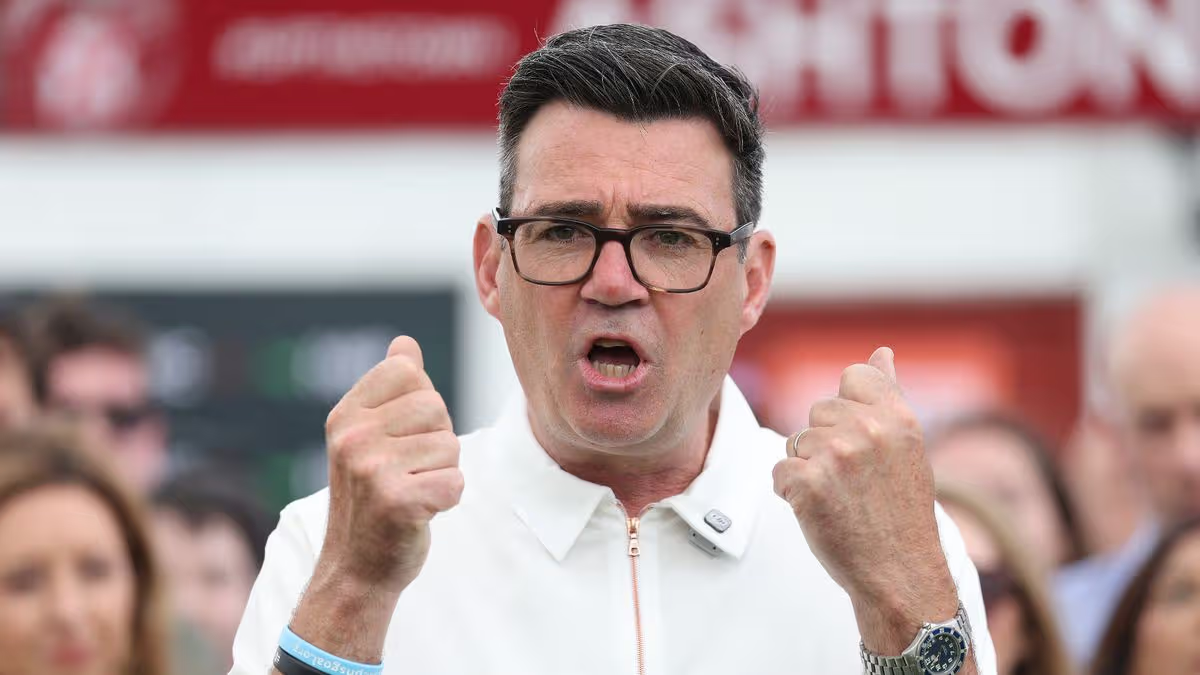


The transition to a new political era is underway, with Andy Burnham poised to assume the role of Prime Minister. His path to Downing Street appears to be built on a unique, perhaps instinctive, political charisma. American strategists who have observed his rise point to his broad, almost universal, appeal as his greatest asset. This is encapsulated in the old joke about a Blairite, Brownite, and Corbynite walking into a pub, only for the landlord to greet them all with a single, familiar “Hello, Andy.” While critics might see this as a sign of a lack of fixed convictions, his supporters interpret it as a strength—the ability to connect with disparate factions within Labour and the wider electorate. His stunning victory in Makerfield, securing 55% of the vote and outpolling all rivals combined, demonstrates this broad base, attracting tactical voters from across the spectrum. However, the coming weeks will test this persona. As Keir Starmer departs, Burnham must refine and clearly convey what his “Manchesterism” means for the entire nation. There is no hiding in Downing Street; travelling ideologically light could backfire if all those factions feel neglected rather than represented.
Burnham’s immediate challenge will be to establish stability and a clear trajectory for his premiership. A prominent ally has suggested he should immediately rule out a snap general election, instead fixing the next poll for July 5, 2029. This would, they argue, end destabilising speculation and provide a clear three-year window to transform the country and Labour’s own prospects. While this gives opponents like Kemi Badenoch and Nigel Farage a fixed target, it would also reassure MPs in marginal seats and allow Burnham to avoid the historic mistakes of Gordon Brown, who was battered by dithering over an early election, or Theresa May, who never recovered from losing her majority after calling one. This approach aligns with Burnham’s proclamation that he wants to “do politics differently.” How he walks that talk will define the early days of his tenure.
A fundamental issue awaiting his attention is the legacy of Brexit. On the eve of the referendum’s tenth anniversary, the consensus is that it was an act of unprecedented national self-harm, with most voters now wishing to rejoin the EU. Studies project a staggering cost—perhaps 6% of national income, nearing £200 billion—money that could have rejuvenated public services without further cuts or tax hikes. The damage extends beyond economics to societal division, a project championed, unsurprisingly, by Britain’s adversaries like Trump and Putin. Burnham’s own victory in Makerfield, a 2016 Leave-voting area, electing a Remainer, signals a shifting landscape where pro-Europeans need no longer fear a backlash. This offers Burnham an opportunity to be bold. “British Europeans” can be out and proud, whereas a defensive “Little Britain” stance is losing popularity. Addressing this costly legacy will be a central task of his government.
Meanwhile, a disconnect persists between the nation’s elite and the public it serves. The revelation that Prince William will send his son, George, to £63,000-per-year Eton College, rather than a state school, is a stark example of an elite hiding in plain sight. This privileged family, which uses public services like police motorcyclists to speed their limousines through traffic—a service denied to the paying public—continues a gilded PR racket pretending to be in touch with the masses. King Charles’s recent efforts to polish the crown by being more open about paying tax ring hollow when considered alongside the £200 million inheritance tax avoided on the £500 million bequeathed by his mother under a sweetheart deal. These actions underscore a deep-seated inequity that any government claiming to represent the people must acknowledge.
This inequity extends to how society responds to violence and hate. The contrasting reactions to two recent attacks cannot go unobserved. Following a stabbing in Edinburgh that was a suspected anti-Muslim rampage, public, political, and media reaction was notably muted compared to the intense focus on an assault in Belfast where a migrant faces charges. Voices like Green Party leader Zack Polanski, himself Jewish, noted that while anti-Semitic incidents are rightly called out, attacks against Muslims are too often ignored or downplayed. It is a painful reminder that all lives do not matter equally in the eyes of far-right racists, some politicians, and parts of the media. British Muslims could learn from the effective advocacy of British Jews in calling out hate, and the decent majority remains grateful that extremist thugs did not set Edinburgh ablaze as they did in Belfast. Addressing this imbalance in empathy and protection is a moral imperative.
Ultimately, Andy Burnham enters office at a moment of profound transition, carrying the hopes of a broad coalition but facing deep-seated challenges. His perceived strength—being whoever a voter wants him to be—must evolve into a clear, compelling vision for the country. He must stabilise the political timeline, courageously address the costly legacy of Brexit, confront the visible inequities of an entrenched elite, and ensure that the nation’s response to hate crimes is consistent and just. The joke in the pub may have opened the door to Number 10, but the work inside will require conviction, clarity, and a commitment to truly doing politics differently. The test begins now.