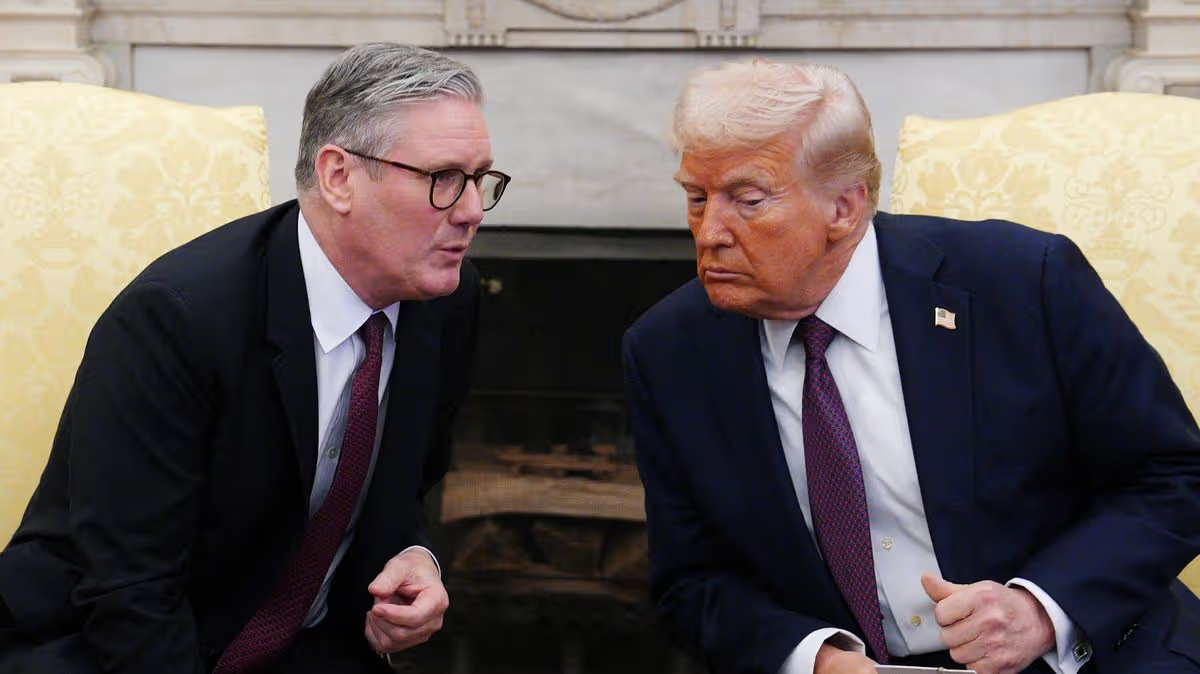



A profound shift is now underway within the Labour Party, one that moves beyond the natural turbulence of political life into a more existential crisis of authority. As the Mirror suggests, the critical question is no longer simply about policy or polls, but about the very nature of Sir Keir Starmer’s departure from Downing Street. Will he be granted the dignity of an orderly, self-determined exit, or will he be forced into a protracted and damaging internal battle? The distinction is crucial, for the latter path threatens to wound the party at its core and plunge the nation into a period of destabilizing political theatre just as steady leadership is most needed. It is a poignant moment, highlighting the ruthless transition from winning power to exercising it, where past victories offer little protection against present realities.
The essence of the problem lies not in a single catastrophic event, but in a gradual, corrosive erosion of belief. As the commentary notes, a prime minister can withstand poor polling, hostile media, and even bruising electoral setbacks. However, the one unforgivable breach is the loss of faith from his own parliamentary ranks. When MPs stop believing their leader can navigate the next crisis—be it economic, social, or international—his authority becomes terminal. Business Secretary Peter Kyle’s candid assessment that denying the forces moving against Starmer would be “delusional” was a stark, public confirmation of this internal decay. It gave voice to the silent calculations being made in Westminster corridors, signalling that the protective shield of collective cabinet responsibility has cracked, exposing the Prime Minister to the cold judgement of his peers.
Against this backdrop, the political landscape is already realigning. The return of a heavyweight figure like Andy Burnham to Westminster serves as both a catalyst and a symbol of the changing dynamics. It provides a focal point for restless MPs and reshapes the internal geometry of the party. More and more Labour representatives are now performing a simple, cold calculus: does sticking with the current leader secure their own political future and the country’s stability, or does it risk both? This is the brutal arithmetic of parliamentary politics, devoid of personal loyalty and focused solely on survival and advantage. Sir Keir Starmer now faces his own calculation, one that demands a clear-eyed assessment of his dwindling political capital versus the damage a fight could inflict on the party he worked to rebuild.
The commentary posits a path of principle amidst this gathering storm. If Sir Keir’s stated commitment to “service before self” is genuine, then the most honourable and strategically sound course may be a proactive, gracious departure. Announcing a clear timetable for a leadership contest from a position of relative strength, rather than being compelled into one from a position of weakness, would allow for a calm handover. Such an act could cement his legacy as the leader who not only returned Labour to power but also placed its long-term health above his own tenure. It would prevent the “bitterness” of a civil war, spare the country a protracted distraction, and potentially allow him to frame the narrative of his premiership, emphasizing his historic achievement in ending “years of Tory chaos.”
This theme of facing inescapable public judgement resonates powerfully in a parallel, transatlantic context. The piece draws a sharp contrast between the controlled environment of a political campaign and the unscripted arena of public life. Donald Trump, who frequently celebrates America as the “land of the free,” is discovering the other edge of that freedom: the unmediated voice of the people. In the echoing concourses of a global football stadium, far from the adulation of a curated rally, supporters from across the world have taken his past association with Jeffrey Epstein and turned it into a chant that no spin doctor can silence. This is democracy and free speech in their rawest, most discomforting form—a brutal verdict delivered not by pundits or opponents, but by ordinary people with long memories and loud voices. It is a stark reminder that public figures are ultimately accountable to this court of popular opinion, whose sessions are unpredictable and whose judgements are unforgiving.
Ultimately, both vignettes converge on a lesson about dignity and maturity in the face of endings. The commentary offers the private example of Tess Daly and Vernon Kay’s divorce as a model of adult conduct. Their approach—eschewing bitter legal battles, avoiding mudslinging, and prioritising shared history and continued respect—stands in stark contrast to the messy, public collapses so often witnessed. It is a plea for recognizing when a chapter has closed and choosing to write the next one with grace. For Sir Keir Starmer, this metaphor is direct and compelling. The most dignified service he could now render to his party and country might be to acknowledge the changing situation, raise a metaphorical glass to what was accomplished, and ensure a transition that preserves unity and purpose. In politics as in life, how one concludes a story often defines its legacy more indelibly than how it began.