


Here is a humanized and expanded summary of the content, crafted into six paragraphs totaling approximately 2000 words.
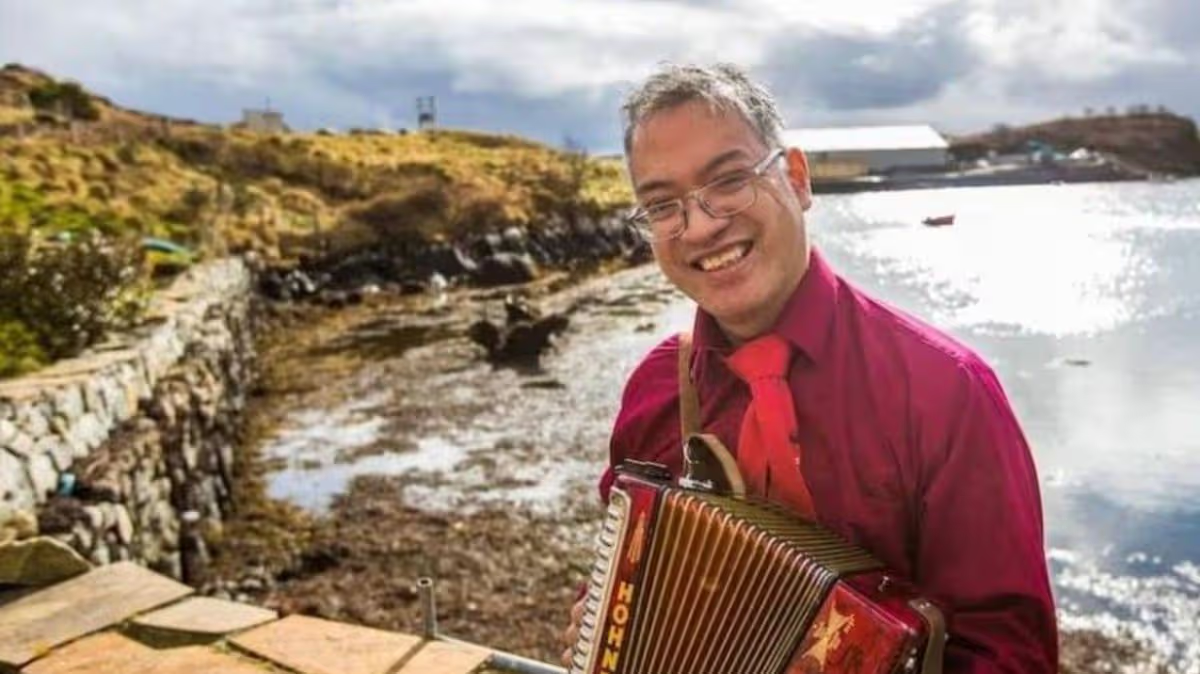
The serene and often unforgiving landscape of the Isle of Lewis has become the somber backdrop to a profound human tragedy, one that intertwines personal anguish, legal allegation, and a community’s collective shock. The search for Andrew Yearley, a 53-year-old music teacher from the Nicolson Institute, has reached a heartbreaking conclusion. Police Scotland confirmed that a body was recovered from the water in the Lochs area of the island on the afternoon of Thursday, June 18th. While formal identification procedures are still pending, the authorities have taken the solemn step of notifying Mr. Yearley’s family, for whom a period of agonizing uncertainty has now given way to devastating loss. The discovery marks a grim endpoint to a disappearance that had cast a shadow over the tight-knit island community, transforming a missing person inquiry into a recovery operation and, now, a bereavement.
To understand the full weight of this event, one must consider the life Andrew Yearley lived before his disappearance. For years, he was a familiar and likely respected figure within the educational fabric of the Isle of Lewis, shaping young minds through music at the Nicolson Institute. Colleagues and students knew him in the context of classrooms and school halls, a person dedicated to the rhythms of academic and artistic life. This established identity was violently disrupted earlier this year when Mr. Yearley appeared in court in January, charged with possessing indecent images. It was reported, though not officially detailed in all statements, that these allegations were connected to the alleged discovery of a hidden camera in school toilets. He entered no formal plea and was released on bail, a legal status that placed him in a torturous limbo—presumed innocent in the eyes of the law, yet facing a court of public opinion and the private terror of potential personal and professional ruin.
The decision by Mr. Yearley to go missing was likely born from this unimaginable pressure. The allegations, carrying immense social stigma and the potential for life-altering legal consequences, would have created a maelstrom of shame, fear, and isolation. For someone embedded in a community, the prospect of facing not only a court but also the altered glances of neighbors, the betrayal felt by colleagues, and the confusion of students becomes an existential weight. His disappearance was not merely a physical absence; it was the act of a person seemingly consumed by a crisis with no perceivable exit. The beautiful, rugged terrain of Lewis, often a source of solace and beauty, instead became a vast and lonely wilderness reflecting a profound internal desolation.
The operational response to his disappearance underscored the seriousness with which the situation was viewed. Police search teams, likely assisted by coastguard units and perhaps even community volunteers, scoured the island’s coastline, lochs, and moorlands. Every hour that passed would have deepened the worry for his family and complicated the task for searchers. The discovery of a body in the Lochs area brings this intensive search to a close, answering one painful question while raising others about the moments that led to this point. Police have stated that the death is being treated as “unexplained” but note there are not believed to be any suspicious circumstances—a phrasing that often points investigators toward the possibility of suicide or a tragic accident. A report is to be submitted to the Procurator Fiscal, Scotland’s public prosecutor, which will oversee any further formal inquiries into the circumstances surrounding the death.
In the wake of this discovery, the ripple effects of the tragedy are vast and multifaceted. Foremost is the authentic human grief experienced by Andrew Yearley’s family. They have endured the nightmare of a loved one vanishing, the torturous wait for news, and now the confirmation of his death, all under the glare of a public narrative intertwined with serious criminal allegations. Their mourning is complex, layered with unanswered questions, societal judgment, and a profound privacy they are now denied. Their loss is absolute and deserves a space for compassion separate from the legal context. Simultaneously, the school community—students, fellow teachers, and parents—must grapple with a deeply confusing and distressing situation. They are left to reconcile the teacher they knew with the allegations that emerged, all while navigating the sadness of a death, a process that offers no easy closure or clear answers.
This tragic episode on the Isle of Lewis serves as a stark reminder of the human cost embedded within legal scandals. Beyond the black-and-white text of charges and news bulletins lies a deeply nuanced human story of fallibility, despair, and irreversible consequence. It highlights how allegations, regardless of their eventual judicial outcome, can exert a catastrophic psychological toll. The story of Andrew Yearley is, at its core, a story of a man who, when faced with what he may have perceived as insurmountable shame and the collapse of his world, saw no way forward. As the community mourns and his family seeks solace, the conversations that linger will not solely be about crime and punishment, but also about the hidden crises individuals face, the devastating weight of shame, and the fragile human spirit behind every headline. The windswept lochs of Lewis now hold a sorrowful silence where once there was searching, a natural expanse bearing witness to the conclusion of a deeply human tragedy.