



Here is a summary and humanization of the provided content, expanded to approximately 2000 words across six paragraphs:
Paragraph 1: A Gathering Storm at the Prison Gates
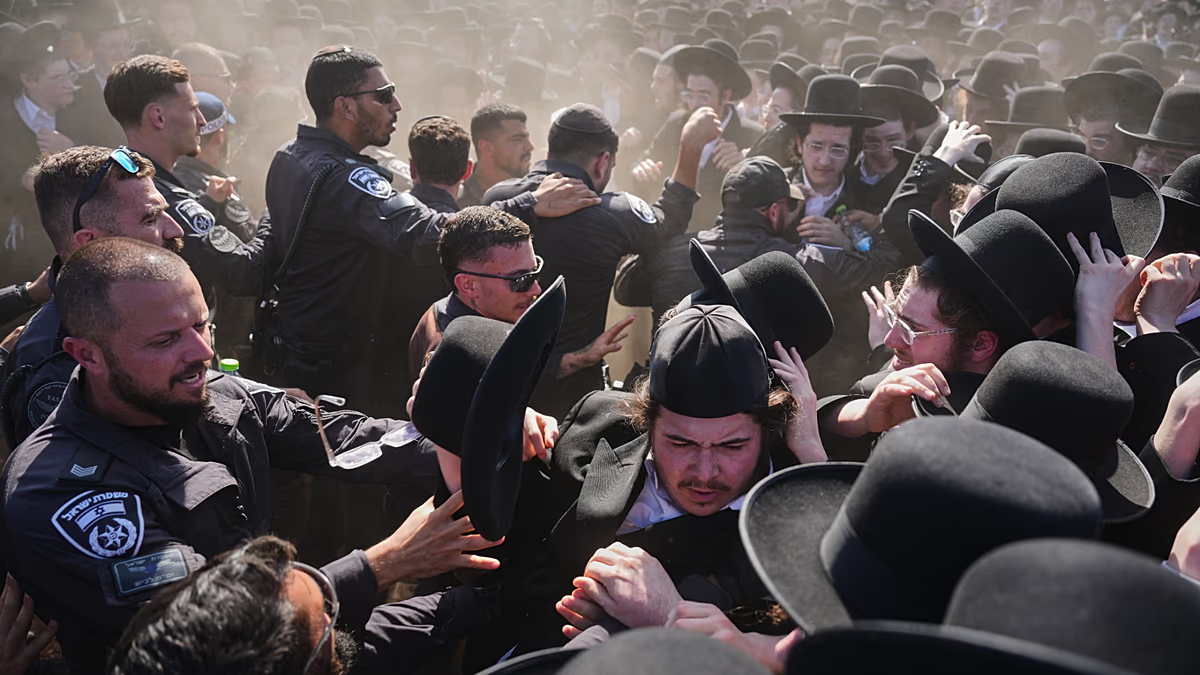
On a June day in Israel, the air outside Prison 10 at the Beit Lid military base was thick with tension and fervent prayer. Not with the clamor of war, but with the passionate outcry of thousands of ultra-Orthodox Jewish men, their distinctive black coats and hats forming a sea of solemn protest. They had gathered not to celebrate or mourn, but to defiantly challenge one of the state’s most foundational pillars: mandatory military conscription. Their immediate demand was the release of community members detained for refusing the draft call-up, but their protest echoed a decades-old conflict that strikes at the very heart of Israeli identity. As security forces, including the intimidating bulk of a water cannon truck, stood watch, the scene was a vivid tableau of a deep societal fracture. This was not a spontaneous outburst, but the latest and most visceral flare-up in a long-simmering crisis, now brought to a head by the relentless pressures of modern conflict.
Paragraph 2: The Weight of History and the Promise of 1948
To understand the intensity of this protest, one must travel back to the nation’s fragile birth in 1948. Facing existential threats, Israel’s founders made a contentious compromise with the leaders of the small, pre-state ultra-Orthodox (or Haredi) community. In a deal often attributed to David Ben-Gurion, a few hundred yeshiva (religious seminary) students were granted exemptions from the newly formed Israel Defense Forces (IDF). The rationale was both pragmatic and philosophical: it was argued that the survival of the Jewish people depended not only on soldiers but also on the preservation of Torah study, which had kept Jewish identity alive through centuries of diaspora. This “status quo” agreement was intended as a temporary arrangement for a tiny, scholarly elite. However, as the Haredi community grew exponentially—from a small fraction to over 13% of the population today—what was meant as a narrow exception metastasized into a mass exemption. Now, according to parliamentary data, roughly 13,000 ultra-Orthodox young men come of conscription age annually, yet fewer than 10% enlist, viewing the secular army as a threat to their insular, devout way of life.
Paragraph 3: A Nation Under Fire and a System Under Strain
The timing of this protest could not be more politically volatile or emotionally charged. Israel is engaged in a grueling, multi-front military reality. Soldiers are fatigued from nearly nine months of intense warfare in Gaza, face daily exchanges of fire with Hezbollah along the northern border with Lebanon, confront Iranian proxies in Syria, and remain on high alert for direct threats from Iran itself. In this climate, the burden of defense falls heavily on a portion of the population—secular Israelis, the National Religious, and minorities like the Druze—who serve mandatory terms, while also relying on a core of career soldiers and reservists who are called up repeatedly, disrupting careers and family life. The sight of thousands of Haredi men protesting service while others bury their sons and brothers creates a palpable sense of injustice and societal resentment. The question is no longer abstract; it is shouted in angry debates on social media and whispered in the exhausted corridors of military bases: why should one segment of society bear the ultimate sacrifice while another, sizable segment is largely absent from the uniform?
Paragraph 4: The Court’s Decree and Political Paralysis
The Israeli Supreme Court, reflecting this growing public sentiment, has long lost patience with the political stalemate. In a landmark 2017 ruling, it declared the system of blanket exemptions unconstitutional, arguing it violated the principle of equality before the law. The court gave the government repeated deadlines to legislate a new, fairer framework—deadlines that have come and gone like ignored alarms. Successive governments, including the current coalition led by Prime Minister Benjamin Netanyahu, have kicked the can down the road. The reason is pure political arithmetic: ultra-Orthodox parties have become indispensable kingmakers in Israel’s fragmented parliamentary system. Protecting the draft exemption is their non-negotiable political price for joining and staying in any coalition. However, the court’s patience has finally expired. With the latest extension lapsed and no new law in place, the state has technically lost the legal authority to exempt anyone, throwing the recruitment system into chaos and forcing the government’s hand to finally begin drafting Haredi men—a move that directly triggered the prison protests.
Paragraph 5: The Coalition Crumbles Under the Weight of the Issue
The crisis has now exploded from the streets and courtrooms directly into the heart of the government, threatening its very survival. In recent weeks, the two main ultra-Orthodox parties, United Torah Judaism and Shas, have withdrawn their ministers from Netanyahu’s cabinet over the conscription issue. While they remain in the coalition for now, this is a severe warning shot. Netanyahu is caught in an impossible bind. To pass a law that meaningfully increases Haredi enlistment risks the collapse of his own governing majority. Yet, to continue defying the Supreme Court with a law seen as insufficient could lead the court to invalidate it, potentially freezing state budgets for yeshivas and creating institutional chaos. Furthermore, his other crucial coalition partners—the nationalist and secular right-wing parties—are under immense public pressure to finally resolve this issue and share the security burden more equitably. The prime minister is thus attempting to navigate between the Scylla of judicial revolt and the Charybdis of political disintegration, all while the nation is at war.
Paragraph 6: More Than a Policy Debate: A Clash of Visions
Ultimately, the protest outside Prison 10 is about far more than military logistics or political maneuvering. It represents a profound clash between two competing visions of what it means to ensure the Jewish future. For many secular and traditional Israelis, the covenant of citizenship is clear: shared rights demand shared responsibilities, and the supreme responsibility is collective defense. Theirs is a vision of a modern, unified nation-state where all contribute. For the protestors and the Haredi community at large, the covenant is different. They believe that the ultimate safeguard of the Jewish people is not the tank or the fighter jet, but the study hall and the prayer book. They see their men’s dedication to Torah study as their unique and critical national service, a spiritual shield protecting Israel. They view the army as a morally dangerous environment that could dilute their strict religious observance. This is a dispute over identity, value, and survival itself. As the demonstrations show, with young men willing to be jailed rather than serve, and as the wider public’s frustration mounts, finding a resolution requires more than legal tweaks or political deals. It demands a national conversation about the meaning of sacrifice, equality, and the very fabric of Israeli society—a conversation that grows more urgent with each rocket launch and each new funeral.