

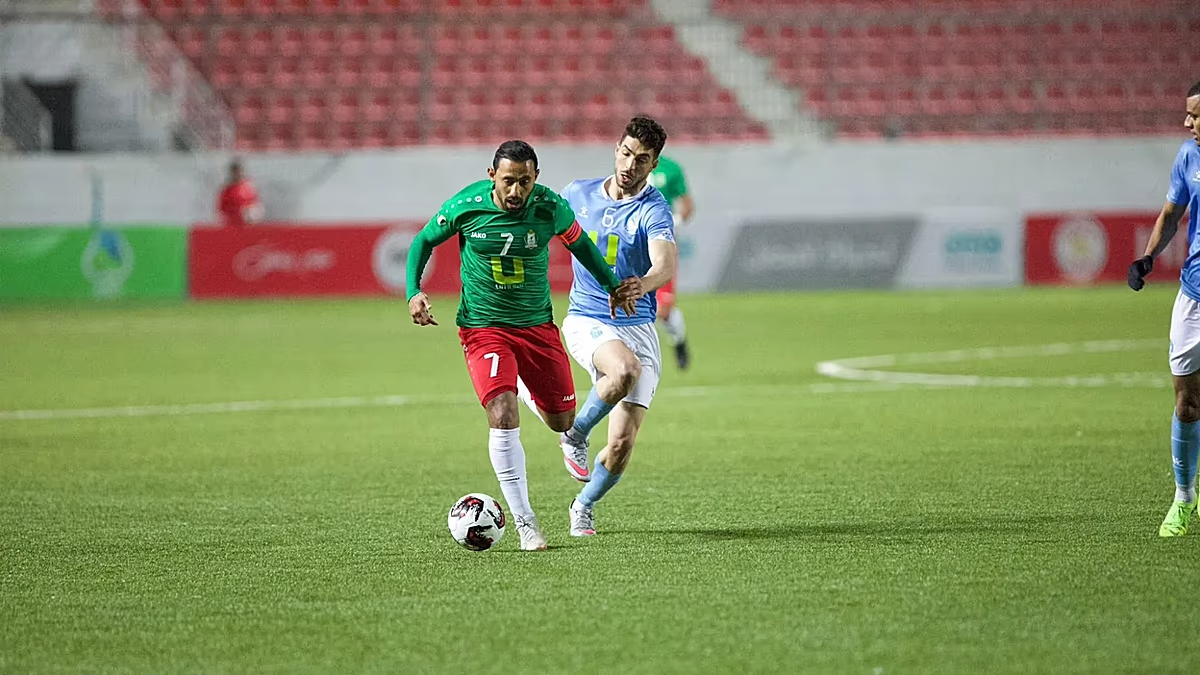
In a resolute statement issued on Thursday, the Palestine Football Association (PFA) has formally and categorically denied reports of a planned FIFA-sanctioned under-15 football match between Palestine and Israel. The denial centers on what the PFA describes as a complete lack of official communication from FIFA, the sport’s global governing body, regarding any such fixture. According to earlier media reports, FIFA was keen to schedule a match between the two nations’ youth teams as the opening event of a new annual under-15 tournament set to debut later this year. This proposed festival-style competition is envisioned to include boys’ and girls’ teams from all 211 FIFA member associations, a list that notably includes Russia, which remains suspended from most international team sports.
The PFA’s rejection, however, is rooted in far more than procedural grounds. In its statement, the association articulated a firm political and moral stance, declaring it “categorically rejects any attempt to promote or impose matches with an occupying power that systematically targets Palestinian athletes and sports infrastructure.” This position frames the potential match not as a simple sporting event, but as an inappropriate gesture of normalization amid ongoing conflict. The PFA underscored this point with stark figures, asserting that more than 1,000 Palestinian athletes have been killed in the last three years. Among those named were Sulaiman Al-Obaid, a former captain of the Palestinian national football team, and karate champion Nagham Abu Samra. For the PFA, this tragic reality forms an inescapable context that must inform any discussion of football activities involving Palestine.
The impetus behind the reported match proposal is widely attributed to FIFA President Gianni Infantino, who has positioned himself as an advocate for using football as a bridge in geopolitically tense regions. This recent initiative appears to be an extension of a previous, unsuccessful attempt at fostering dialogue. Earlier this year, at the FIFA Congress in Vancouver, Infantino endeavored to orchestrate a symbolic handshake on stage between PFA President Jibril Rajoub and Basim Sheikh Suliman, the vice president of Israel’s football association. That effort failed conspicuously; the two officials maintained a physical distance on the platform, and Rajoub voiced a protest before leaving the stage. The reported under-15 match proposal seems to be Infantino’s latest strategic effort to use youth football as a diplomatic tool, following this very public setback.
Infantino’s vision for youth football development, however, is broader than this single contested fixture. Speaking about the new global under-15 festival concept in December, he framed it as a fundamental pillar of FIFA’s mission. “We have been very active in promoting youth competitions and development, and this is a natural next step,” he stated. He further emphasized that such festivals for boys and girls are central to “FIFA’s quest to give every talent a chance all over the world,” characterizing them as another example of how the organization reinvests in the game’s grassroots. From this perspective, the inclusion of all member associations—regardless of political standing—is presented as an apolitical act of universal sportsmanship and opportunity.
Yet, the stark divergence between FIFA’s inclusive developmental rhetoric and the PFA’s grounded, tragic experience highlights a deep and painful fissure. The PFA’s statement makes clear that from its viewpoint, the “systematic targeting” of Palestinian sports infrastructure and lives creates an impossible environment for such symbolic fraternization. To engage in a match under FIFA’s banner, in this context, could be seen as ignoring or even sanitizing the ongoing violence faced by the very community the Palestinian team represents. This isn’t merely a political disagreement; it is a profound disconnect between a vision of football as a unifying world game and the lived reality of football under occupation, where stadiums have been damaged and players lost.
Ultimately, this incident reveals the extreme limitations of sport as a neutral diplomatic channel in the face of unresolved and asymmetric conflict. While FIFA leadership may see a youth match as an innocent gesture of hope and development, the Palestinian football governing body experiences it as a deeply painful proposition that overlooks a harsh daily reality. The denial from the PFA is not just a refusal to play a game; it is an assertion that for Palestinian athletes, sport cannot be separated from the struggle for basic rights and safety. Until there is a fundamental change in the circumstances they describe, attempts to bring the teams together on the pitch are likely to be met with the same firm and unchanged resistance, leaving FIFA’s bridge-building ambitions stalled at the halfway line.