


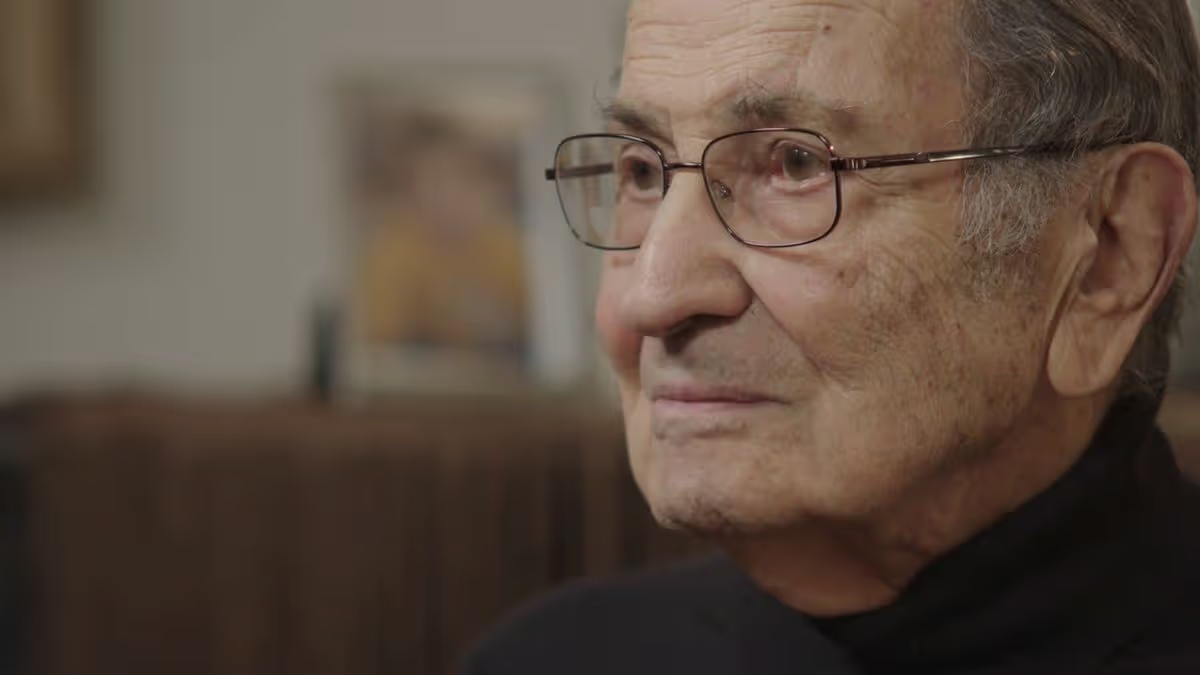
The life of Peter Sichel defies simple categorization. To call him a “vintner, prisoner, soldier, spy” only scratches the surface of his century-long journey, a tale so remarkable it has now been immortalized in the film The Last Spy. Born into a prosperous Jewish wine family in Mainz, Germany, Sichel’s early world was one of privilege and connection. Yet, the rise of the Nazis shattered that world, forcing his family to flee to Bordeaux. When war engulfed Europe, they were interned in French camps—a dire situation that became a death sentence for his cousin who refused to flee with them. Peter, demonstrating the persuasive charm and strategic nerve that would define his life, convinced the camp commander to release his family, allowing them a perilous escape to New York, a stark contrast to the cousin who remained and perished in a concentration camp.
Upon reaching America, Sichel’s path took a dramatic turn. After Pearl Harbor, he joined the U.S. Army and was swiftly recruited by the nascent Office of Strategic Services (OSS), America’s urgent answer to the established spy agencies of Britain and Russia. Trained in the dark arts of espionage—from lock-picking to silent combat—he was deployed to Algiers. His unique value became clear during preparations for the invasion of Southern France: his fluent German made him indispensable in interrogating and recruiting German prisoners of war to serve as American agents, a chapter later dramatized in the film Decision Before Dawn. By war’s end, stationed near Dachau, he existed in a strange duality: deeply involved in intelligence yet, as he confessed, unaware at his level of the systematic mechanized horror of the Holocaust, knowing only of “labor camps.”
The end of one global conflict merely ushered Sichel into the dawn of another. As a top OSS operative in post-war Berlin, he was instrumental in shifting the agency’s focus towards the emerging Soviet threat, helping to ring in the Cold War. When the OSS evolved into the CIA, Sichel rose to become its chief in Berlin and later Head of Eastern Europe Operations. His work epitomized the complex, often messy, geopolitics of the era. He believed in the necessity of interference, citing the prevention of a communist Italy as vital to stabilizing Europe, yet his operations were fraught with peril and moral ambiguity. In Hong Kong, tasked with monitoring Communist China, he orchestrated a bizarre mission to obtain a stool sample from Indonesia’s President Sukarno via a Pan Am air hostess, and supported conspirators against him—a operation that ended with a CIA plane being shot down and a pilot’s freedom purchased.
The clandestine life, however, exacted a heavy personal toll. Sichel described espionage as a “fascinating game” akin to a drug, compounded by a profound loneliness that fostered a dangerous drinking culture within the CIA. Ironically, fearing this path would lead him to alcoholism, he left the agency in 1960. His next act would, nevertheless, remain deeply intertwined with drink. He returned to the family legacy: wine. Marrying Stella Spanoudaki and raising three daughters, he channeled his intelligence, charm, and strategic brilliance into the commercial world. Taking the family’s existing Blue Nun Liebfraumilch brand, he masterfully marketed it in America through savvy radio advertising and by positioning it as a versatile “all-meal” wine. His espionage proficiency found a new outlet, transforming Blue Nun into a global phenomenon, selling 24 million bottles annually in the 1980s and becoming a staple in celebrity circles.
For his family, Sichel remained an enigmatic figure. His daughter Bettina recalls dinner-party stories of buried gold for the French Resistance and covert missions, but she had no real grasp of his towering significance within the CIA until later. He was a man who compartmentalized his life, keeping his deepest secrets even from those closest to him, yet always maintaining the warm, persuasive demeanor that made him so effective in both his professions. Despite the profound losses in his life, including the death of his daughter Alexandra and later his wife Stella, he retained a fond loyalty to his English schooling at Stowe and remained a dedicated fundraiser for the institution.
Peter Sichel passed away at 102, a man who witnessed and shaped history across two distinct realms. He understood that while tastes in wine may shift with the times, the fundamental human instinct to uncover hidden truths—to spy—is eternal. From fleeing genocide to crafting Cold War strategy, and from building a wine empire to guarding his most intimate secrets, his life was a testament to resilience, adaptation, and the enduring allure of the game. His story, now told in his own words in The Last Spy, is not just a chronicle of espionage or commerce, but a deeply human narrative about surviving chaos, leveraging talent, and navigating the shadowy lines between duty, family, and self.