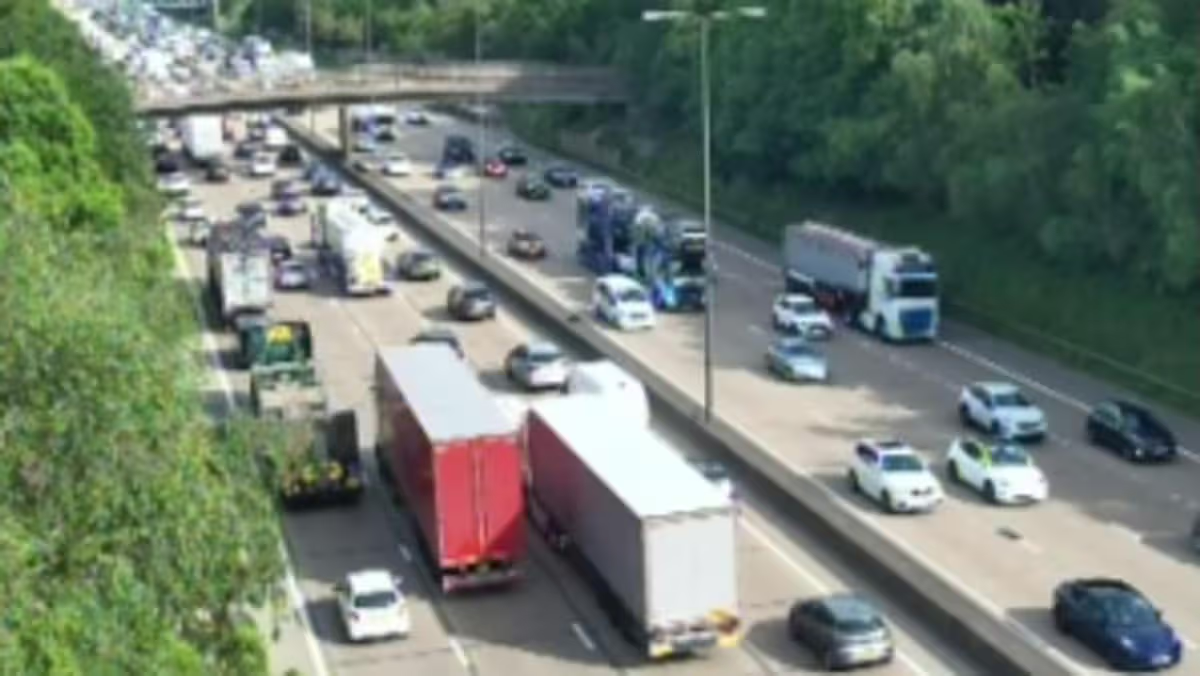


The M25 motorway, the vital orbital artery that encircles London, faced significant disruption on Thursday evening following a serious incident in Surrey. Heavy traffic began to build anticlockwise between junctions 10 and 9, near Wisley and Leatherhead, after a collision involving a motorcycle and a car necessitated the closure of two lanes. The severity of the incident prompted a full closure of that section of the motorway to allow emergency services—including police, ambulance, and likely air ambulance crews—safe and unhindered access to the scene. For hours, the typically relentless flow of commuters, freight, and travellers came to a standstill, symbolising the fragility of our interconnected transport networks and the profound human reality behind every traffic alert.
Behind the sterile terminology of “lane closures” and “incident management” lies a deeply human story of sudden crisis. The individuals involved in the collision, whose ordinary journeys were catastrophically altered in a moment, became the immediate focus of skilled first responders working under immense pressure. Meanwhile, thousands of other lives were inadvertently entangled in the aftermath. Families awaiting a parent home for dinner, truck drivers facing strict delivery deadlines, individuals racing to catch flights from Heathrow or Gatwick, and patients with hospital appointments—all found their plans dissolving into frustration as tailbacks stretched for miles. This cascade of delay underscores how a single event on one stretch of tarmac can ripple outwards, stressing schedules, economies, and tempers across the region.
National Highways, the agency responsible for England’s motorways, coordinated the response, prioritising the welfare of those injured while managing the growing traffic crisis. Their traffic officers worked alongside Surrey Police to secure the scene, divert traffic, and provide crucial updates to the public. After several hours of intensive work, all lanes were successfully re-opened by approximately 5:45 p.m., allowing the physical blockage to be cleared. However, the conclusion of the emergency phase did not magically dissolve the congestion that had built up over the afternoon. The system, like a compressed spring, needed time to release the pent-up volume of vehicles, meaning the disruption lived on long after the recovery vehicles had departed.
Consequently, the official advice from National Highways remained cautious long after the lanes reopened. Drivers were, and continued to be, strongly warned to allow considerable extra time for their journeys or to seek alternative routes if possible. The residual delays served as a lingering echo of the earlier closure, a testament to the immense challenge of recovering smooth traffic flow on Europe’s busiest bypass. For those caught in the subsequent slow crawl, the experience was a monotonous trial of patience—a landscape of brake lights and crawling progress, with the cause of the delay now invisible ahead but its consequences fully felt.
This incident on the M25 provides a stark microcosm of the delicate balance of modern infrastructure. It highlights our collective dependence on these concrete loops and the vulnerability that comes with such efficiency. The network operates at such high capacity that even a temporary partial closure creates disproportionate and long-lasting effects. It also showcases the silent, daily reliance we place on the protocols and personnel of emergency services and highway agencies, whose rapid interventions are critical in resolving both the human tragedy and the logistical gridlock.
Ultimately, while the digital traffic maps slowly returned from angry red to flowing green, the evening’s events left a tangible impact. Beyond the quantified delays and official statements, there was a shared experience of inconvenience and a sobering reminder of the human stakes inherent in road travel. The hope, as traffic finally normalized, was for a full recovery for those injured, and a moment of reflection for all on the importance of safety on roads where a single moment can alter so many journeys, reminding us that behind every traffic bulletin are human stories, interrupted plans, and a community of responders and travellers navigating the unexpected together.