

Summary and Humanized Expansion
Paragraph 1: An Unforeseen Disruption on a Vital Artery
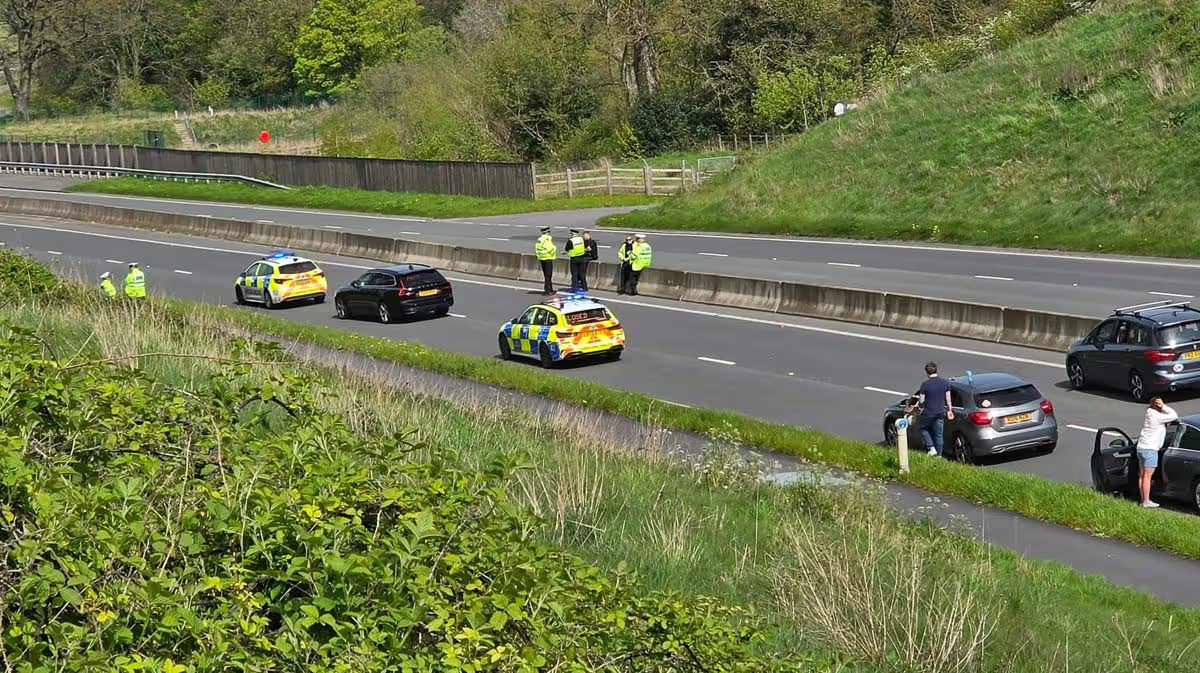
This afternoon, the rhythm of travel around Manchester Airport was abruptly disrupted as police confirmed the closure of a major thoroughfare, the A555 Manchester Airport Relief Road. In a terse statement, Greater Manchester Police alerted the public to a “serious incident” occurring between the junctions for Cheadle and Poynton. The directive was clear and urgent: both sides of this key link road are shut, and all motorists must avoid the area entirely. This road is not a minor lane; it is a purpose-built conduit designed to ease congestion around one of the UK’s busiest transport hubs, ferrying airport traffic, daily commuters, and freight between key arteries like the M56 and A6. Its sudden closure sends immediate ripples across the region’s travel network, replacing planned journeys with uncertainty and frustration for countless people.
Paragraph 2: The Ripple Effect of a Closed Road
The human impact of such a closure is immediate and widespread. For travellers, the carefully timed journey to catch a flight descends into anxiety as sat-navs flash with angry red lines and estimated arrival times balloon. Families heading for a holiday, businesspeople with tight schedules, and airport staff reporting for duty now face a stressful scramble for alternative routes. Beyond the airport bubble, the closure cripples a vital commuter route for residents of Cheshire and South Manchester, turning the evening drive home into a prolonged trial. Local roads in Cheadle, Heald Green, Handforth, and Poynton, already busy at this time of day, inevitably bear the brunt, becoming clogged with redirected traffic. This creates a secondary wave of disruption, affecting people who may not even need the airport road but whose local streets are now inundated, leading to delays for buses, deliveries, and local services.
Paragraph 3: The Weight of the Word “Serious”
In official communications, language is measured. The police’s use of the term “serious incident” is deliberately chosen and carries significant weight. It is a phrase that encompasses a range of grave possibilities but rules out minor occurrences. It tells the public this is not a simple breakdown or a spilled load that will be quickly cleared. This could indicate a major multi-vehicle collision, a significant hazard on the carriageway, or another situation requiring extensive emergency response and investigation. The declaration that the road is “likely to remain closed for some time” further underscores the gravity. It signals that scene preservation, evidence gathering, or complex recovery and cleanup operations are underway. This phrasing is a crucial tool for public safety, managing expectations and compelling people to take the warnings seriously, understanding that a swift reopening is not feasible.
Paragraph 4: The Unseen Symphony of Emergency Response
While drivers are urged to steer clear, within the closed cordon a coordinated symphony of emergency services is undoubtedly in action. The first priority is always life and limb; paramedics from the North West Ambulance Service will be providing critical care at the scene. Firefighters, equipped to deal with complex extrications, fuel spills, or fire risks, work to make the area safe. Police officers, beyond managing the closure points and traffic diversions, are beginning the meticulous work of securing the scene and investigating the cause. Highways officers are likely en route to assist with signage, barriers, and eventual road repair. This multi-agency effort is complex and cannot be rushed, as the safety of the responders and the integrity of any investigation are paramount. The prolonged closure is a testament to the scale of this operational response happening behind the scenes, invisible to the public but essential for resolution.
Paragraph 5: Navigating the Alternatives and the Human Response
For those now caught in the travel chaos, the advice is simple in theory but difficult in practice: find another way. Navigation apps will be frantically recalculating, potentially overloading less suitable country lanes or residential streets. The wise course is to check live traffic updates from local radio or trusted travel news services before setting out, allowing extra hours for any journey touching the region, and exercising great patience. Beyond the practicalities, there’s a human element to these disruptions. They breed shared experiences of inconvenience, sparking conversations and complaints on social media and in workplaces. They also, however, can prompt acts of patience and community, as locals understand their streets are busier and drivers (hopefully) show a little more courtesy under stressful circumstances. The incident becomes a collective, if unwelcome, event in the day of Greater Manchester.
Paragraph 6: A Reminder of Fragility and Resilience
Ultimately, an incident like this serves as a stark reminder of the fragility of our interconnected transport systems. A single serious event on one link can compromise the network’s efficiency for miles around, affecting thousands of lives and economic activity. It underscores the importance of heeding official warnings—not as mere suggestions but as critical safety and efficiency advice that prevents compounding the problem. As the recovery operation continues into the evening, the focus will slowly shift from response to restoration. The community’s resilience is tested in these hours of delay and detour. While the immediate situation is one of disruption and concern, the coordinated efforts of emergency services and the public’s adaptation pave the way for a return to normality, a process that, while taking “some time,” is a testament to structured response in the face of unforeseen crisis.