



Of course. Here is a humanized and expanded summary of the content, structured into six paragraphs.
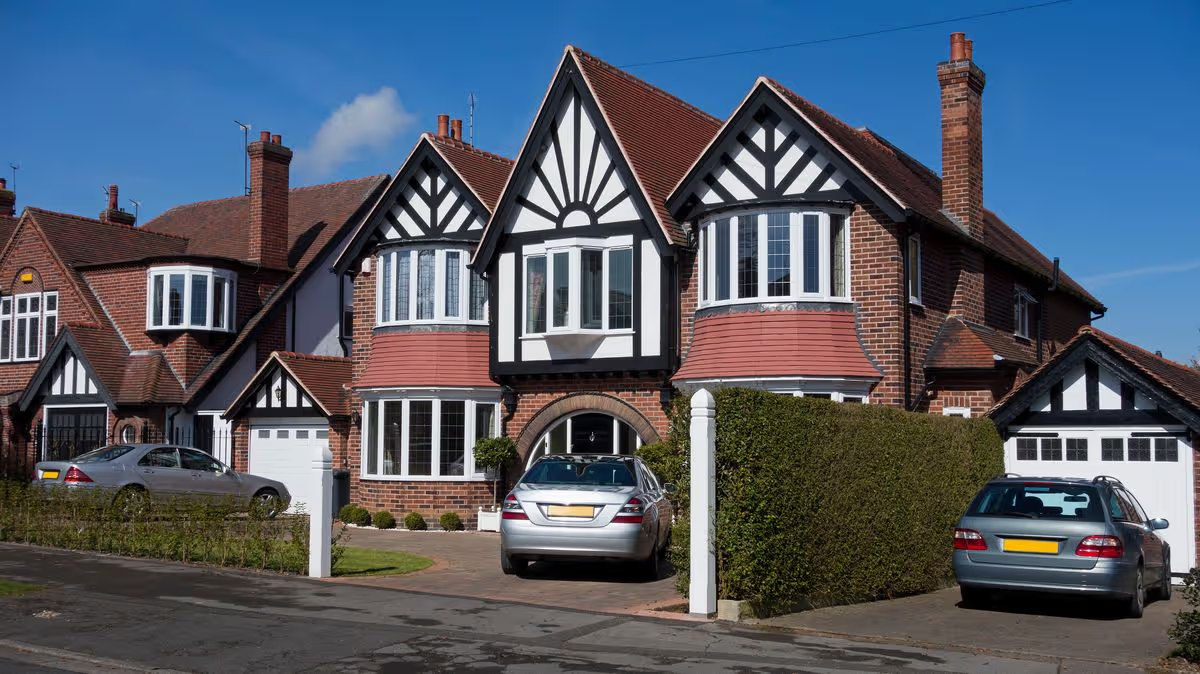
The quiet friction of suburban life often stems not from grand conflicts, but from the small, persistent intrusions into our personal spaces. This is the core of a dilemma recently shared by a homeowner on a popular social media forum. The individual, living in a semi-detached house with a single-car driveway, reached out to a community built for gauging social propriety, confessing a simmering annoyance. Their neighbour, they explained, had developed a “bothersome” habit of using their driveway during the workday. The poster only discovered this by chance while home sick, witnessing the neighbour pull in “like it was normal,” a discovery later confirmed by door-camera footage. The crux of the irritation lay not in immediate practical blockage—the neighbour always vacated the spot before the homeowner returned—but in the principle of the matter. It felt, as they aptly described, “like someone using your stuff when you’re not there,” an unsettling violation of an unspoken boundary that left them questioning their own reaction.
Feeling caught between a sense of ownership and a fear of appearing petty, the homeowner attempted a subtle, good-natured approach. In a casual conversation, they referenced seeing the car parked there, hoping a gentle “haha” would suffice as a hint. The neighbour’s response, however, only deepened the dilemma. They laughed it off with a commiseration about the area’s difficult parking, seemingly oblivious to the underlying issue and not registering the act as a problem at all. This left the poster in a social limbo: technically unharmed, yet distinctly bothered. They were now “stuck, wondering if [they] should actually say something properly or just leave it.” The post ended with a plaintive, relatable question that resonates with anyone who has ever debated confronting a neighbour: “Part of me feels petty even caring about this, but also, it’s my driveway?? idk. Am I overreacting?”
The online community’s response was a fascinating microcosm of differing social philosophies and legal understandings. Many commentators firmly sided with the homeowner, affirming that the feeling of trespass was valid. A common sentiment was astonishment that anyone would assume such a liberty, with one user stating plainly, “I can’t imagine thinking that it is okay to park on someone else’s property.” Practical, if slightly passive-aggressive, solutions were offered, like deliberately staying home one day to block the neighbour’s car in, thereby sending an unmistakable message. Others advocated for directness, advising the poster to clearly tell—not ask—the neighbour to stop, especially if their relationship was not particularly friendly.
Conversely, a significant contingent urged a more pragmatic, peace-keeping approach. Their argument hinged on the absence of tangible harm and the value of neighbourly harmony. Comments like, “if they’re always moved before you’re home, AND you have a good relationship with your neighbours, I probably wouldn’t say anything,” highlighted a calculus many engage in: is asserting a right worth the potential for ongoing awkwardness or conflict? This camp viewed the issue through a lens of communal resource-sharing, suggesting that swallowing one’s pride might be the wiser long-term investment in a peaceful living environment.
Beneath this social debate lies a clear, if cumbersome, legal framework. As organizations like the RAC clarify, parking on a private driveway without consent is fundamentally an act of trespass. However, in most jurisdictions, trespass is a civil matter, not a criminal one. This means police typically cannot arrest someone solely for this act. The pathway to legal recourse involves civil court actions, where a homeowner could seek an order for the vehicle’s removal or pursue a claim for nuisance. Yet this path is rightly acknowledged as a last resort—often lengthy, invariably expensive, and guaranteed to transform a quiet annoyance into an outright war. This legal reality underscores why the initial problem is so deeply social; the system is designed to push people toward resolution amongst themselves before considering formal litigation.
Ultimately, this story is less about driveways and more about the delicate, unwritten contracts of shared living. The homeowner’s plight illuminates the universal challenge of navigating minor transgressions that, while not catastrophic, slowly erode one’s sense of comfort and autonomy at home. It presents a choice between asserting a clear property right—with all the potential for confrontation that entails—and choosing to overlook a technical infringement for the sake of daily peace. There is no universally correct answer, as the comment section proved. The resolution depends entirely on the individuals involved, their relationship, and their personal thresholds for what constitutes a boundary worth defending. In the end, the most pressing question may not be “Am I overreacting?” but “What kind of neighbourly dynamic do I want to live with going forward?”