


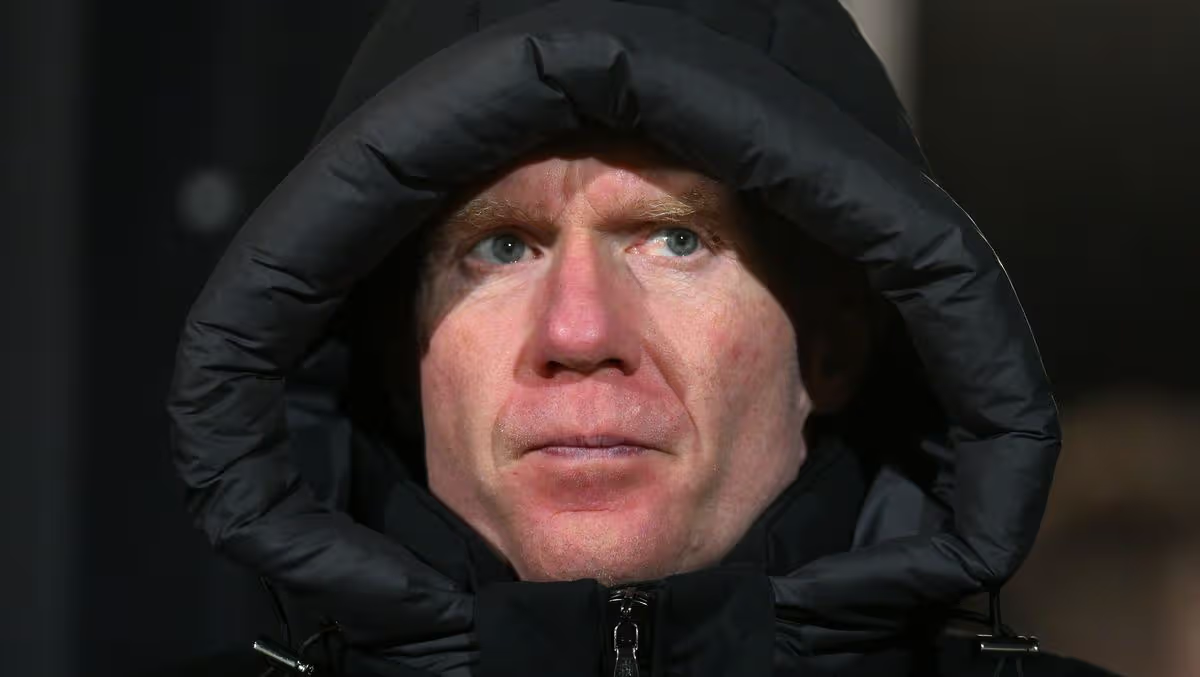
Footballing legends are no strangers to the art of pressure, precision, and spectacle, which is perhaps why a certain Premier League icon found himself drawn to the hallowed green baize of the Crucible Theatre this week. Former Manchester United midfielder Paul Scholes was spotted in a prime seat on Wednesday afternoon, a keen spectator for the second session of Ronnie O’Sullivan’s first-round World Snooker Championship match against He Guoqiang. The BBC commentary booth, manned by former champion John Parrott, quickly noted his presence, hailing “one of England’s greatest midfielders” come to watch the snooker maestro. Alongside him, analyst Ken Doherty reflected on the natural affinity between elite athletes, noting, “One great watching another… A lot of the footballers love to play snooker in their spare time.” It was a poignant moment of mutual appreciation between two titans of their respective sports, each masters of spatial awareness and tactical genius under the brightest lights.
However, Scholes’s masterclass viewing experience was, by O’Sullivan’s blistering standard, tragically brief. Having established a commanding 7-2 lead from the morning session, ‘The Rocket’ required only three more frames to seal his victory, a task he accomplished with breathtaking, back-to-back century breaks of 113 and 120. As the match concluded just after Scholes had settled in, Parrott offered a wry, apologetic nod to the football legend from the commentary box: “Paul Scholes might have enjoyed this, but he’s only going to see three frames of it. Sorry Paul, this man is just too good.” In a display of devastating efficiency, O’Sullivan had reminded everyone—celebrity guest included—of his otherworldly capacity to shorten matches and shatter expectations, even in the sport’s most gruelling and historic tournament.
With this dominant win, the 50-year-old O’Sullivan progresses to a mouth-watering second-round clash, one steeped in nostalgia and rivalry. He now faces fellow ‘Class of 92’ icon John Higgins, a contemporary with whom he has shared a stage for decades. In his post-match reflections, O’Sullivan painted a picture of two seasoned veterans clinging to their craft amidst a sea of youthful talent. “A couple of oldies,” he mused. “I feel kind of old now because everyone is 22, 23. It’s like walking into a creche! But we are still hanging around and having a go.” There was a palpable humility in his self-assessment, acknowledging a shift in his own dominance. “I am not the player I was and probably never will be… Not so much now! I have to play really good and they can play alright and still beat me.” He even positioned himself as a slight underdog, citing Higgins’s consistent tournament activity versus his own sporadic schedule, wryly referring to himself as “Rusty Ron” who must “roll a bit of a dice.”
Yet, within that candid admission lies the fascinating paradox of O’Sullivan’s current chapter. He confessed to having felt “really lost” for three years but spoke of a rediscovered joy and a “new method” that is beginning to bear fruit. This sense of renewal, however, coexists with a self-professed reliance on a dash of luck, a stark contrast to the invincible aura he once carried. His upcoming battle with Higgins is framed not just as a contest of skill, but of psychology. “John loves playing me. He really enjoys it… The pressure’s off me and more on John in this match,” O’Sullivan observed, suggesting a subtle mind game already at play. It sets the stage for a compelling narrative: can the rejuvenated but rusty genius summon one of his famed “sixes” from the dice roll, or will the ever-present Higgins, thriving on their storied rivalry, prove the favourite?
Adding another layer to his preparation was a matter of intimate, almost superstitious, detail: his cue tip. For O’Sullivan, this small piece of leather is paramount, arguably “more important than the cue.” In a revelation that speaks to his meticulous, if unorthodox, approach, he shared that he had brought a backup cue to Sheffield, having saved a good tip all year for this precise moment. “The tip wasn’t good yesterday. I did a good job considering,” he said, treating the equipment swap as a calculated gamble. This decision-making process—”crazy decisions in everyone else’s eyes”—is fundamental to understanding O’Sullivan. He operates on a unique internal logic, trusting his own instincts above all else. “It might go wrong sometimes, but overall it’s worked pretty well for me,” he stated, a testament to a career built on fearless individuality as much as peerless talent.
Thus, from the fleeting visit of a footballing great who witnessed a sublime, swift demolition, to the introspective reflections of a snooker legend navigating his veteran years with a mix of vulnerability and unwavering self-belief, the story extends far beyond a simple first-round result. Paul Scholes may have seen only three frames, but in them he saw the essence of Ronnie O’Sullivan: a breathtaking force of nature who, even while questioning his own permanence, continues to play the game at a speed and level that leaves audiences—whether die-hard fans or sporting royalty—wanting much, much more. The stage is now set for a classic encounter with Higgins, where O’Sullivan’s new method, his trusted (or new) tip, and his unique philosophy will be tested against one of the few who has shared his entire remarkable journey.