


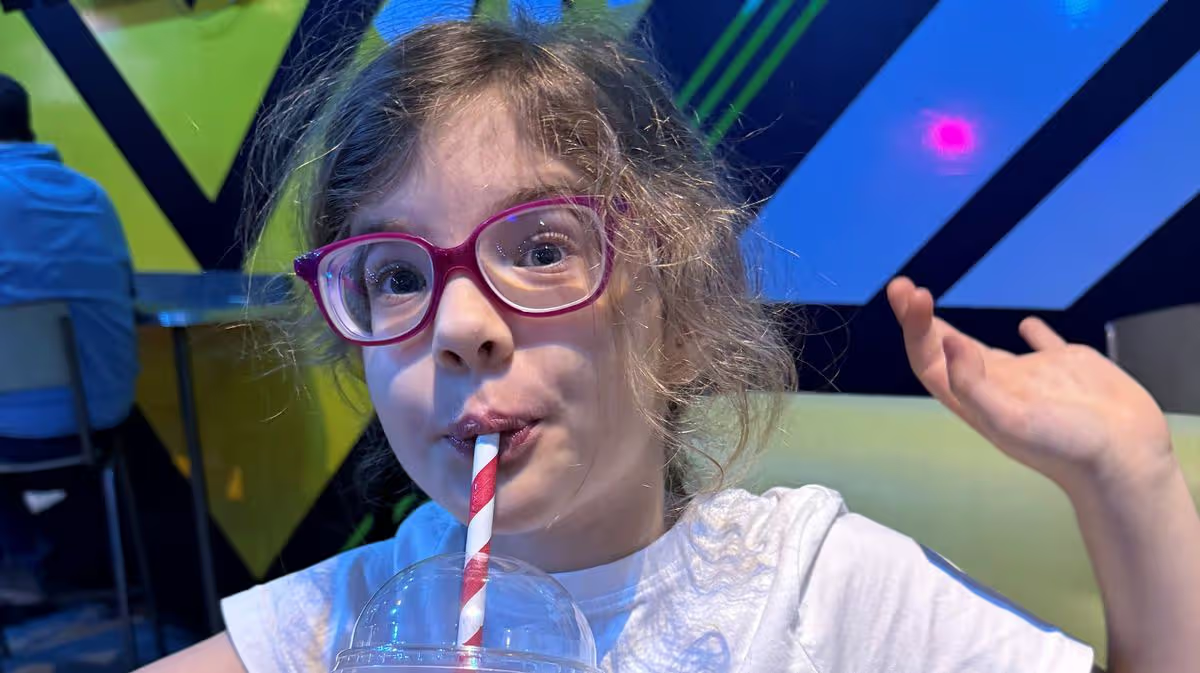
Six-year-old Saffie Sandford lives in Stevenage, Hertfordshire, and loves Spider-Man—a vibrant, joyful child whose world was nearly dimmed by a rare genetic condition. At age five, her parents, Lisa and Tam, noticed she was struggling to see in dim light and was increasingly hesitant in unfamiliar settings. Medical tests at Moorfields Eye Hospital in London revealed the heartbreaking diagnosis: Leber’s Congenital Amaurosis (LCA), an inherited retinal disease that robs cells in the eye of the ability to produce a protein essential for normal vision. Without intervention, children with LCA experience significantly limited vision in daylight and near-total blindness in low light, often progressing to complete vision loss by early adulthood. For Saffie’s family, the diagnosis was a devastating shock—one made even more profound by learning that both parents unknowingly carried the gene responsible.
Hope arrived in the form of a groundbreaking NHS treatment called Luxturna, the first gene therapy approved for certain genetic causes of LCA. Saffie was referred to Great Ormond Street Hospital (GOSH), where specialists explained that the one-time therapy works by injecting a healthy copy of the missing gene directly into retinal cells. For Lisa and Tam, the opportunity was a lifeline; they were told that without treatment, their daughter would likely be blind by the age of thirty. Saffie underwent the delicate procedure in two stages: her first eye was treated in April 2025, followed by her second eye that September. Even as a young child who had worn glasses for short-sightedness since age two, Saffie faced the process with remarkable courage.
The results, as her mother describes, have been nothing short of transformative. “It’s like someone waved a magic wand and restored her sight in the dark,” Lisa says, her voice undoubtedly filled with emotion. Before the treatment, simple evening activities—like walking through a dimly lit restaurant or going trick-or-treating at Halloween—were fraught with difficulty and anxiety. Now, Saffie can participate freely, her world suddenly illuminated. Her peripheral vision in daylight has improved, allowing her to navigate playgrounds, notice potential hazards, and engage more confidently at school. She climbs frames, plays with friends, and experiences the ordinary adventures of childhood—changes that feel extraordinary to her family.
Behind Saffie’s personal story lies pioneering scientific work. Researchers from GOSH and University College London (UCL) have recently published a study demonstrating that Luxturna does more than improve eyesight—it can strengthen the brain’s visual pathways during critical periods of development. The study followed 15 children treated between 2020 and 2023, some as young as 15 months old, and found that younger children showed more significant visual improvement, likely because their neural pathways are still highly adaptable. Using a painless test called pattern visual evoked potentials (VEPs), which measures signal transmission from the eye to the brain’s visual cortex, the team gathered objective evidence of the therapy’s impact—a vital tool for assessing outcomes in very young or non-verbal children.
While experts stop short of calling Luxturna a definitive cure, the prospects are profoundly hopeful. Rob Henderson, a consultant ophthalmologist at GOSH, emphasizes that even modest gains in vision can reshape a child’s life. He notes that this research not only validates gene therapy’s potential for inherited retinal diseases but also sets a new standard for measuring outcomes in paediatric trials worldwide. For families like Saffie’s, the therapy represents a reprieve—a chance to rewrite what was once a certain narrative of blindness into one of possibility and light.
Today, Saffie is a thriving six-year-old whose condition is no longer visibly apparent. Her parents cherish each ordinary moment—a meal out at dusk, a game in the park as daylight fades—knowing that these experiences were once beyond reach. “We are eternally grateful,” Lisa reflects. “We know it might not last forever, but every day with her sight feels like a gift.” In Saffie’s bright eyes, there is now not only the sparkle of childhood but also the reflection of medical ingenuity, familial love, and a future viewed with newfound clarity.