

The Tragic Death of Preston Davey: A Story of Trust Betrayed
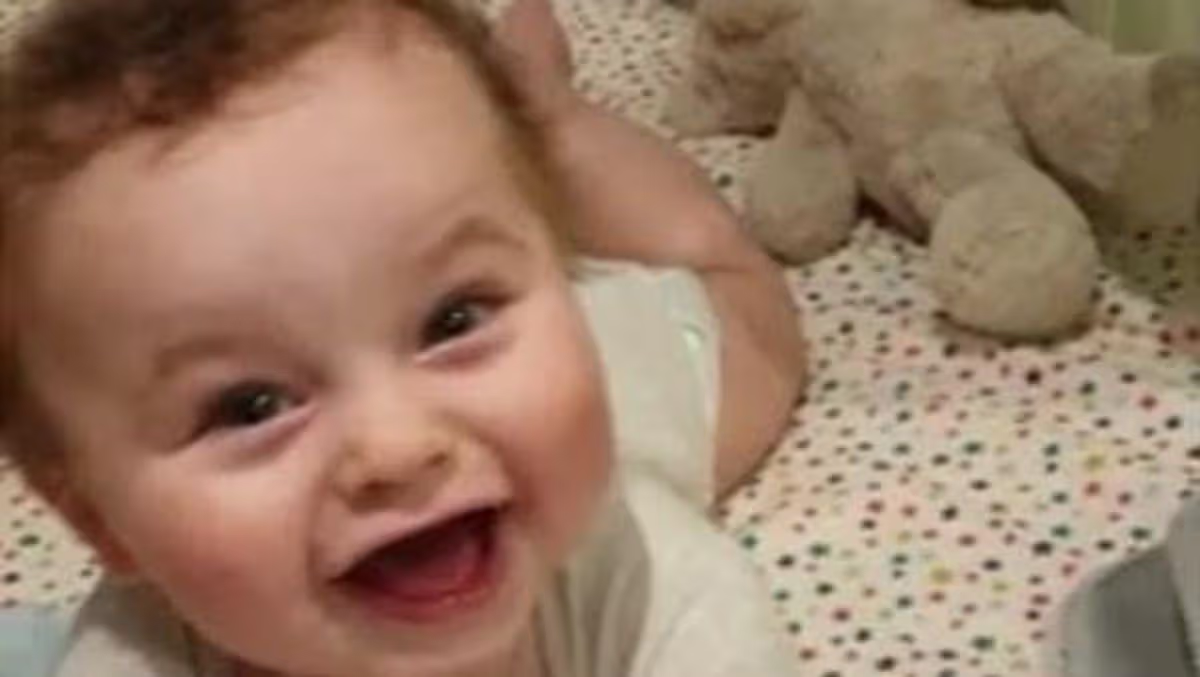
The case of Preston Davey, a 13-month-old baby boy, represents a profound and heart-rending betrayal of trust. In April 2023, Preston was placed into the care of Jamie Varley, a 37-year-old secondary school teacher, and his partner, John McGowan-Fazakerley, 32, at their home in Blackpool. The court heard that Preston was “a perfectly healthy” baby at that time, beginning a journey that was meant to lead to a permanent adoption and a loving family. Instead, less than four months later, in July 2023, he was rushed to Blackpool Victoria Hospital where he died from an acute obstruction of his upper airway. Prosecutors asserted that this fatal obstruction was caused by smothering with a hand or fabric, or by the insertion of an object into his mouth. This stark contrast between the hopeful beginning and the brutal end frames a narrative not just of a single act, but of sustained cruelty.
The trial at Preston Crown Court revealed a pattern of horrific abuse preceding Preston’s death. The child had suffered approximately 40 traumatic injuries, evidence of routine ill-treatment, physical assault, and sexual abuse. Jamie Varley faces not only a charge of murder but 25 other charges relating to this sexual and physical mistreatment. His partner, John McGowan-Fazakerley, pleaded not guilty to allowing the death of a child and four other offences. The details presented suggest a home environment of hidden violence, where a child meant to be protected was instead subjected to repeated harm. Preston’s injuries included a fractured elbow, for which his arm was in a plaster cast—an injury visible to outsiders yet explained away.
Crucially, evidence emerged that Varley himself had confessed to disturbing thoughts prior to the fatal event. In early July 2023, he visited a colleague’s house appearing “nervous and on edge.” After McGowan-Fazakerley arrived and took Preston—who the couple had renamed Elijah—away, Varley confided in his friend. He expressed struggling mentally, worrying that he was not “bonding” with the child as hoped. Most alarmingly, he disclosed having harmful thoughts towards Elijah, including thoughts of drowning or suffocating him, though he claimed he would never carry them out. The friend tried to rationalize this as a common parental anxiety about “worst-case scenarios,” but later reported the conversation to police after Preston’s death. The prosecution questioned why Varley would share such “dark thoughts” with a colleague but not with his partner, suggesting a possible attempt to unburden himself or, chillingly, to subtly signal his inner turmoil.
Preston’s deteriorating health was evidenced by multiple hospital admissions in the months before his death for breathing difficulties, seizures, nosebleeds, and the fractured elbow. On one visit in late June 2023, marks on his body were noted by medics. Varley responded by stating the baby “bruised easily,” and preemptively added, “You lot are going to think we have been abusing him or something.” This statement now stands as a haunting foreshadowing of the truth. The final day, July 27, 2023, began seemingly normally with the couple meeting a mortgage broker. McGowan-Fazakerley then left for work in Manchester, while Varley visited his mother with Preston, where photos showed the baby in apparent good health. However, upon returning home, Varley filmed a 35-second video on his phone that later proved critical. A pediatric respiratory medicine consultant concluded that Preston in the video was recovering from an episode where he had not been breathing, showing signs of respiratory failure and cyanosis—a bluish hue on his lips. Varley did not call for help or alert anyone, including his partner; instead, he proceeded to look on his phone into selling a kayak.
Less than two hours after that video, Preston was brought to the hospital in a collapsed state with obvious injuries. The prosecution case asserts that in the intervening period, Varley further sexually assaulted Preston and smothered him to death by intentionally obstructing his airways. At the hospital, Varley presented a cover story: he claimed he had left Preston unattended for a moment in a bath seat, returned to find him drowning, attempted revival, and then, as McGowan-Fazakerley returned home, rushed the deteriorating baby to the hospital by car. This account was met with immediate suspicion. Preston did not appear wet, his hair was dry, and a medical examination revealed no trauma to the lungs typical in drowning cases. Varley appeared “inconsolable,” blaming himself for the brief unsupervised moment, saying it was “all my fault.” Prosecutors argued this was a deliberate fabrication to deflect authorities from the truth of intentional assault.
The medical evidence solidified the case against an accidental explanation. Pathologist Dr. Alison Armour found multiple external and internal injuries consistent with non-accidental infliction. She concluded that the internal injuries were caused shortly before death, likely within a few hours prior. The tragic culmination of Preston’s short life lay in this expert testimony, painting a picture of a child who endured sustained abuse culminating in a violent, intentional death. The trial, continuing beyond this summary, seeks to unravel the full truth and assign accountability. The story of Preston Davey is ultimately one of a vulnerable child placed within a system of care that failed catastrophically to protect him, and of the human capacity for concealment of cruelty behind a facade of normalcy and intended parenthood.