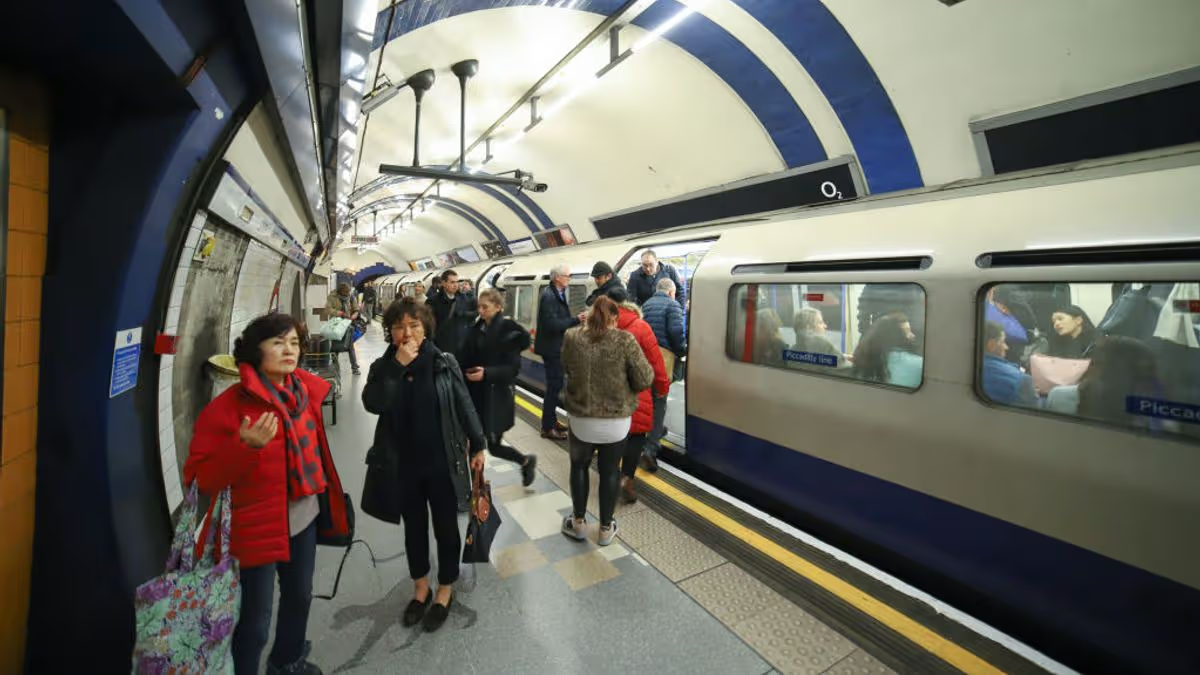



The power of a railway strike lies not merely in halted trains, but in its profound ability to ripple outward, touching the entire economic ecosystem of a city. When the RMT union orchestrates industrial action, it is deploying a tactical leverage that extends far beyond the rail network itself. The immediate disruption—commuters stranded, services cancelled—is only the visible tip of a much deeper iceberg. The true potency of such strikes is measured in their cascading impact across a wide spectrum of industries, where lost working days translate into diminished productivity, and paralyzed transport chokes the daily flow of commerce. This strategic amplification of consequences makes industrial action an exceptionally effective bargaining tool, as negotiations are not conducted in isolation but under the weight of a broader economic tremor.
Quantifying this impact reveals staggering figures. As analyzed by the Centre for Economics and Business Research (CEBR) in April, two 24-hour strikes directly cost the economy between £130 million and £250 million in forfeited working days. This sum incorporates not only the lost wages of striking RMT members but, critically, the productivity evaporating from countless commuters and professionals unable to reach their workplaces. Interestingly, the CEBR notes that the direct cost of these lost days is now higher than it would have been a few years prior, a counterintuitive shift driven by the increased adoption of remote working and cycling schemes. These adaptations, while offering some resilience, have paradoxically concentrated the economic loss; those who can work from home or cycle are insulated, meaning the remaining cohort of affected commuters represents a more essential, irreplaceable segment of the workforce, whose absence carries a heavier per-person financial toll.
Yet the financial hemorrhage extends far beyond missed salaries and office output. The strike’s secondary wave crashes forcefully into the consumer-facing heart of the city, particularly its hospitality and retail sectors. When the Tube grinds to a halt, the vibrant pulse of central London weakens. Footfall—that essential metric of urban vitality—plummets, leading to a sharp contraction in spontaneous consumer spending. Cafés, shops, and restaurants, which rely on the steady stream of workers, tourists, and daily errands, face sudden and severe desertion. The CEBR explicitly highlights this “less consumer spending” as a major hit, underscoring how a transport strike functions as a direct drain on local business revenue, transforming bustling districts into quieter, financially anxious zones.
The anticipatory dread within these sectors is palpable and quantifiable. Ahead of the April strike days, UKHospitality, the trade body, painted a stark picture. Pubs and restaurants braced for a nearly 40 percent drop in sales, while cafés and coffee shops anticipated losses of 34 percent. These are not marginal dips but existential blows for many independent businesses operating on thin margins. UKHospitality estimated the overall financial blow to the hospitality sector alone at around £600 million—a figure that dwarfs the direct lost-workday calculations and illuminates the disproportionate burden borne by these frontline service industries. This preparatory anxiety itself has a cost, as businesses cancel deliveries, reduce staff hours, and postpone marketing efforts, all in anticipation of the economic silence a strike imposes.
Therefore, the RMT’s bargaining power is intricately woven into this tapestry of interconnected vulnerability. A strike is not a singular event but a catalyst that triggers a chain reaction: halted trains lead to absent workers, which leads to empty streets, which leads to closed cash registers, which ultimately pressures a wider economic and political system. This multifaceted impact creates a powerful narrative and practical urgency for resolution. The union’s leverage is amplified because its actions resonate in boardrooms, government offices, and small business kitchens alike, creating a coalition of affected interests beyond the railway itself.
In essence, the human and economic narrative of a rail strike is one of cascading consequence and interconnected fragility. It underscores how modern urban economies are complex, interdependent organisms, where a failure in one critical artery—the transport system—can induce ischemia across many others. The calculated use of this ripple effect is a sophisticated form of economic persuasion, making the RMT’s industrial action a potent tool not just in securing conditions for its members, but in reminding society of the foundational, often invisible, role that transport workers play in the daily health and rhythm of the city itself. The true cost is a composite: lost wages, lost productivity, lost sales, and a temporary dimming of the city’s collective vitality.