


The recent escalation along the Israel-Lebanon border represents a dangerous and tragic unraveling of a fragile ceasefire, plunging communities back into a cycle of violence with devastating human cost. On a single Saturday, Israeli airstrikes across southern Lebanon killed at least thirty-nine people, according to Lebanese authorities, marking one of the deadliest days since the conflict with Hezbollah reignited. The strikes were notably widespread, extending beyond the typical front-line exchanges to target areas like the Saadiyat highway, a significant route located only about twelve miles south of Beirut and outside Hezbollah’s traditional heartlands. This geographic expansion signaled a potential intensification and broadening of the conflict, even as a nominal three-week-old truce, brokered by Washington, ostensibly remained in place. The day’s events laid bare the ceasefire’s profound limitations, demonstrating that the agreement has failed to halt the daily, lethal tit-for-tat that continues to claim lives and displace thousands.
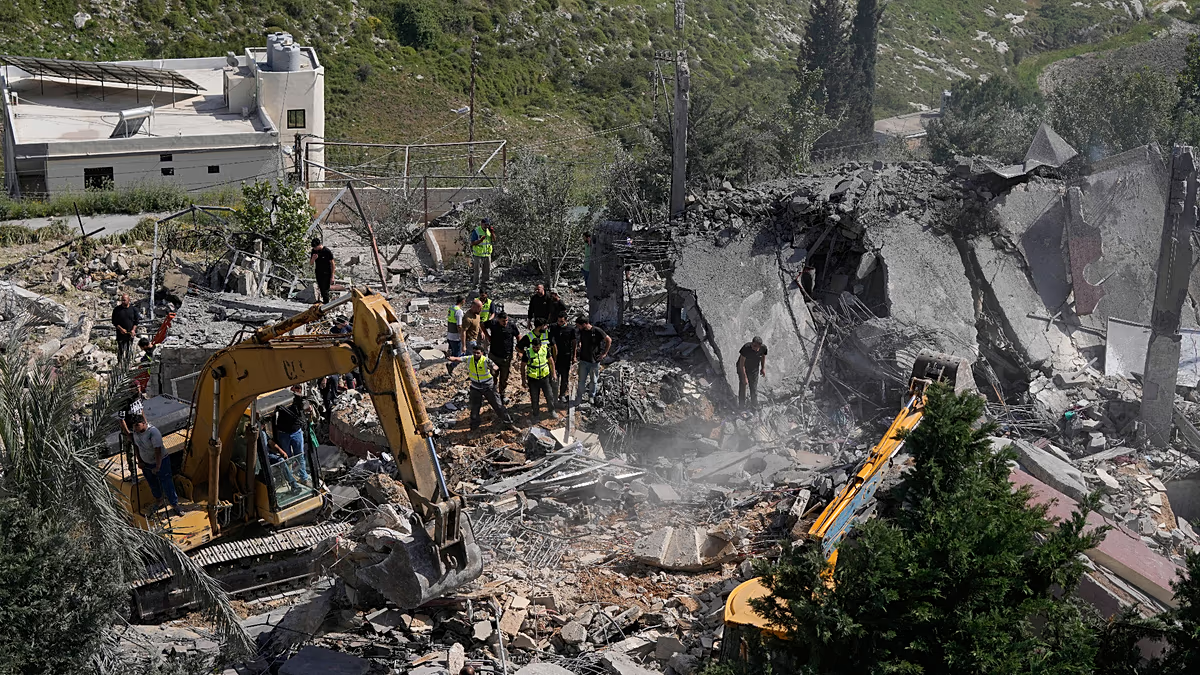
The human toll of these military operations was immediate and heartbreaking, with civilian casualties featuring prominently in the day’s reports. In the town of Saksakiyeh, a single Israeli strike hit a structure, resulting in an initial toll of seven dead, including a girl, and fifteen wounded, among them three children. While the Israeli military stated it targeted Hezbollah operatives using the building for military purposes and acknowledged reports of civilian harm, the outcome on the ground was a scene of familial devastation. Another particularly harrowing incident involved a Syrian national and his twelve-year-old daughter on a motorbike in Nabatieh. After an initial drone strike, the pair attempted to flee, only to be reportedly targeted a second time, killing the father. In a deeply disturbing detail, the Lebanese health ministry stated the drone then tracked and struck the girl directly for a third time as she lay wounded; she was said to be undergoing life-saving surgery. These narratives, alongside reports of other strikes killing and wounding families in towns like Bedias, underscore the horrific reality that civilians, including many children, are bearing the brunt of this conflict.
In response to the Israeli assaults, Hezbollah launched its own retaliatory attacks, primarily targeting northern Israel with drones and rockets. The group claimed these actions were direct responses to the continued Israeli strikes on Lebanese villages. One such drone attack severely wounded an Israeli army reservist and left two others moderately injured. Hezbollah lawmaker Hassan Fadlallah framed this exchange as the start of a “new phase,” warning that the group “will not accept a return” to the status quo before March 2nd—the date Hezbollah entered the broader regional conflict by firing rockets to avenge the killing of an Iranian commander. His statements, coupled with the group’s assertion of attacks on Israeli military positions inside Lebanon, highlighted Hezbollah’s determination to maintain a posture of active resistance, arguing that Israeli operations necessitate a direct and forceful response.
The strategic context of these exchanges is complex, rooted in a ceasefire agreement that, in practice, provides ample room for continued hostilities. The terms, as released by Washington, explicitly reserve Israel’s right to act against what it deems “planned, imminent or ongoing attacks” by Hezbollah. Israel has invoked this clause to justify extensive operations, including striking over 85 Hezbollah infrastructure sites in a 24-hour period and continuing military activities within a self-declared security zone inside Lebanese territory. Concurrently, Hezbollah views any Israeli military action within Lebanon as a breach of sovereignty and an act of aggression that mandates retaliation. This creates a perilous feedback loop where each side’s defensive or preemptive actions are perceived by the other as offensive provocations, sustaining a low-intensity war that periodically erupts into sharper, deadlier confrontations like the one witnessed that Saturday.
Amidst the violence, a diplomatic process is attempting, with immense difficulty, to find a path forward. Lebanese and Israeli representatives are scheduled for a fresh round of direct talks in Washington, following initial meetings that preceded the announcement of the ceasefire and its subsequent extension. However, these negotiations face deep skepticism and internal political resistance. Fadlallah dismissed the direct talks as a “path of concessions,” reiterating Hezbollah’s preference for indirect negotiations mediated through third parties. This political stance reflects the fundamental gap between the sides: Israel seeks durable security guarantees to prevent Hezbollah’s military entrenchment near its border, while Hezbollah and its supporters frame the conflict as a national defense against ongoing Israeli violation of Lebanese territory. The staggering casualty figures—nearly 2,800 people killed in Lebanon since March, including dozens since the truce began—cast a long shadow over these discussions, emphasizing the urgent human cost of diplomatic failure.
Ultimately, the events of that bloody Saturday serve as a grim microcosm of the wider conflict: a ceasefire in name only, shattered by escalated strikes that killed scores, including numerous children, and prompted fierce retaliation. The expansion of strikes closer to Beirut, the gruesome specifics of civilian deaths, and the defiant rhetoric from both sides all point to a conflict that is not de-escalating but potentially entering a more volatile and geographically broader phase. With civilians trapped in the middle and diplomatic talks struggling against the momentum of violence and mistrust, the risk of a full-scale war—a recurring nightmare for the region—becomes ever more palpable. The immediate aftermath leaves communities on both sides of the border mourning, terrified, and bracing for what might come next, as the cycle of action, reaction, and tragic loss continues unabated.