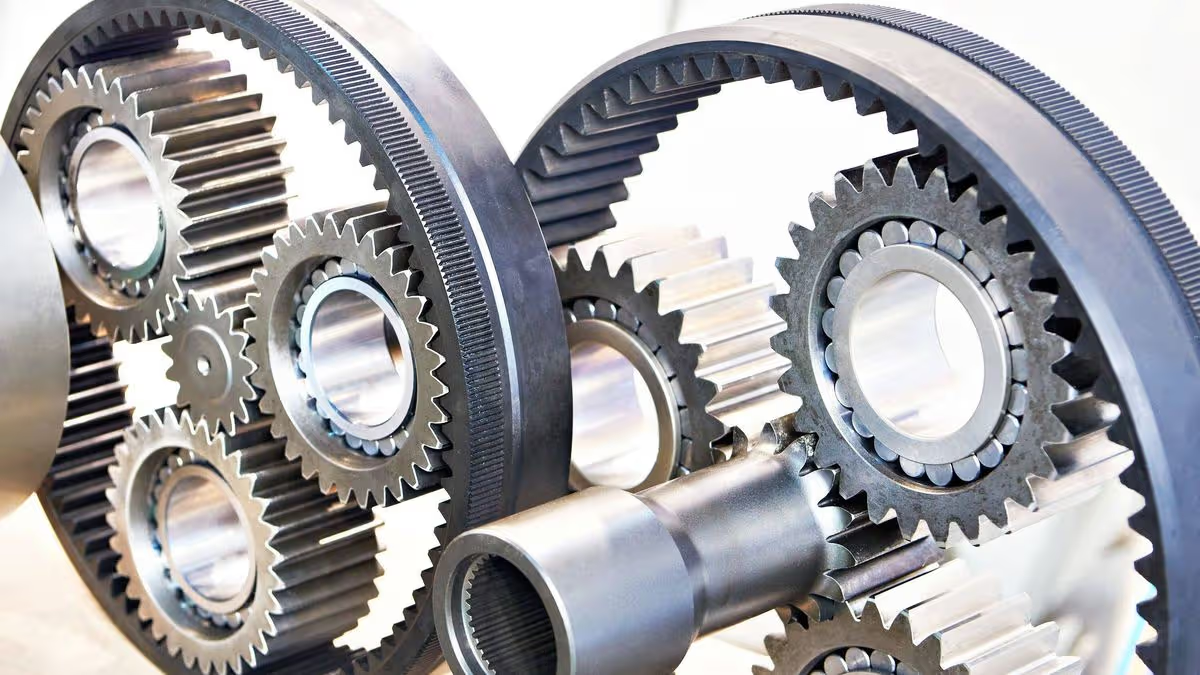



It is with a heavy sense of industrial history that we note the passing of Compact Orbital Gears Limited into administration. Founded in 1964, the Welsh firm was not just a business but a bastion of highly specialised British engineering, operating from the Brynberth Industrial Estate in Rhayader, Powys. For six decades, it carved out a reputation as a critical, if largely unseen, cog in the machinery of two of the nation’s most prestigious sectors: automotive and aerospace. The company’s expertise lay in the intricate design and manufacture of precision gearboxes and the equally vital test rigs—machines that rigorously assess the performance and durability of other equipment before it is ever deployed in the real world. Its work, though often hidden within the final product, represented the kind of advanced, practical innovation that has long underpinned the UK’s manufacturing prowess, with its remit even extending at times to components for industries like renewable energy, including wind turbines.
The formal machinery of insolvency began turning on March 13, with the appointment of Andrew Turpin and Matthew Douglas Hardy from Poppleton & Appleby as joint administrators. An official notice followed in The Gazette in May, calling for a virtual meeting of the company’s creditors on June 2. This procedural step, dry in its legal language, belies the very human and community-centric reality of the situation. For the workforce in Rhayader and the surrounding areas of Powys, this represents more than a corporate closure; it is the disruption of livelihoods and the fading of a local institution that has provided skilled employment for generations. The company’s registered office may have been in Birmingham, but its heart and its hands were firmly in Wales, making its collapse a significant blow to the regional industrial landscape and a loss of deep-seated technical knowledge.
This failure cannot be viewed in isolation, as it illuminates a period of profound strain and uncertainty rippling through the UK’s industrial supply chain. From late 2025 into 2026, the manufacturing sector has been besieged by a perfect storm of financial pressures. Soaring operational costs, from energy to raw materials, have eroded balance sheets, while persistent supply chain disruptions have made reliable production a constant challenge. Perhaps most crucially, profit margins have been relentlessly squeezed, leaving even established, technically excellent firms like Compact Orbital Gears vulnerable. When a company operating in such niche, high-value markets falters, it signals that the pressures are systemic, affecting businesses that are not merely competitors but essential partners in complex industrial ecosystems.
Indeed, Compact Orbital Gears is not a solitary casualty in this fraught environment. Its descent into administration echoes the fate of other specialised British engineering firms that have recently buckled under similar financial duress. Notably, in February of this year, the British aerospace firm Orbex also entered administration. These consecutive failures within related high-tech sectors suggest a worrying pattern, where the compounded weight of economic headwinds is overwhelming firms that are otherwise rich in expertise and heritage. Each collapse represents more than a statistic; it is a contraction of the UK’s industrial capability, a narrowing of its capacity to design and build complex components domestically, and an increased reliance on foreign supply chains for critical technology.
The human and economic ramifications of this trend are far-reaching. Beyond the immediate job losses and community impact, there is a strategic erosion of the UK’s sovereign industrial base. Companies like Compact Orbital Gears and Orbex possess intellectual property and skilled workforces that are not easily or quickly replicated. Their disappearance weakens the entire network they supported, potentially leaving major automotive and aerospace primes with fewer domestic options for precision components, which could affect project timelines, costs, and ultimately, competitiveness. This slow attrition of specialised suppliers threatens to hollow out a layer of industry that is essential for innovation and resilience, making the broader economy more fragile in the face of global shocks.
In conclusion, the story of Compact Orbital Gears Limited is a poignant microcosm of a much larger challenge. It is the tale of a venerable specialist, a quiet achiever in Welsh manufacturing, succumbing not to a failure of expertise or quality, but to the immense macroeconomic pressures currently bearing down on the entire industrial sector. Its passing, alongside that of its peers, serves as a stark warning. It underscores the urgent need for a concerted examination of the support structures and economic conditions for advanced manufacturing in the UK. Protecting and nurturing these highly specialised firms is not merely about preserving the past; it is a vital investment in the nation’s future engineering capacity, innovation potential, and economic sovereignty. The gears may have stopped turning in Rhayader, but the lessons from its closure must propel action to ensure the survival of other critical cogs in Britain’s industrial machine.