


Title: Eurovision at a Crossroads: As Slovenia Joins Boycott, Music’s Biggest Stage Confronts Politics
In a move that underscores the deepening political fractures surrounding this year’s event, Slovenia’s national broadcaster, RTV Slovenia, has formally announced it will not broadcast the 70th Eurovision Song Contest. Instead of airing the glitzy spectacle of international pop, the channel will present a curated series titled “Voices of Palestine,” featuring Palestinian documentaries and feature films. Director Ksenija Horvat confirmed the decision, framing it as a conscientious choice rooted in protest. This action places Slovenia firmly within a growing coalition of European nations, including Ireland and Spain, that are refusing to participate in or broadcast the contest. The common thread of their objection is the continued participation of Israel, which they argue is being permitted to compete by the European Broadcasting Union (EBU) despite the ongoing war in Gaza and the devastating humanitarian crisis there. For these broadcasters, the decision to step back is not a rejection of music, but a profound statement of solidarity, using their airwaves to amplify voices they feel are being marginalized on the world stage.
This unprecedented wave of boycotts is reshaping the character of Eurovision’s landmark anniversary. Spain’s RTVE declared last week it would not air the contest for the first time since 1961, while Ireland’s RTÉ stated as early as last December that it would neither send an entry nor broadcast the event. The Netherlands and Iceland, while not sending participating artists, will still broadcast the contest through their national channels, a nuanced position that highlights the varying degrees of protest. The event, scheduled for May 12-16 in Vienna, will proceed with 35 competing countries under its official slogan, “United by Music.” Yet, that ideal of unity feels increasingly strained, exposing what critics see as a glaring inconsistency in the EBU’s governance. The organization has barred Russia from competing since its full-scale invasion of Ukraine in 2022, citing the need to uphold the contest’s apolitical values. This precedent makes the inclusion of Israel, for many observers, an act of hypocrisy, suggesting that geopolitical considerations and double standards are unavoidably embedded in the fabric of an event that purports to transcend them.
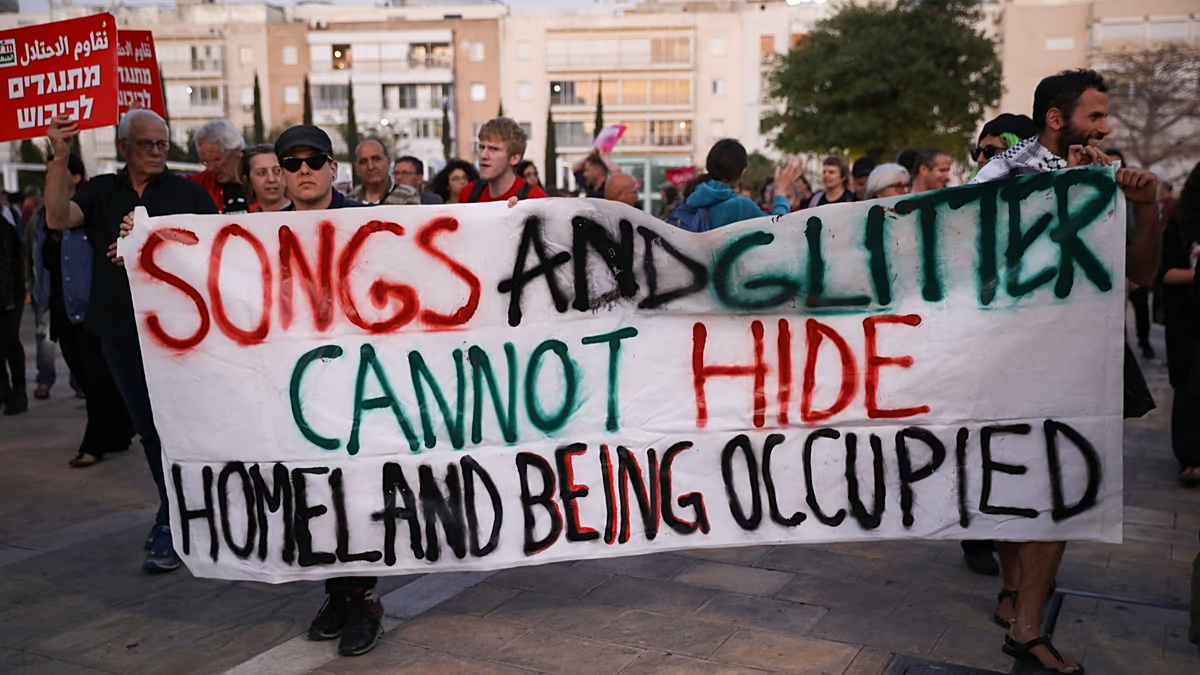
The broadcaster boycotts are powerfully reinforced by a significant groundswell of artistic dissent. Just days before Slovenia’s announcement, thousands of high-profile musicians and cultural figures—including bands like Massive Attack, Mogwai, Sigur Rós, and artists such as Brian Eno—signed an open letter organized by groups like No Music for Genocide and the Boycott, Divestment, Sanctions (BDS) movement. The letter presents a blunt and moral indictment, accusing Eurovision of being used to “whitewash and normalise Israel’s genocide, siege and brutal military occupation against Palestinians.” It calls directly on performers, crew, fans, and public broadcasters to boycott the contest until the EBU excludes the Israeli broadcaster KAN. This mobilization from within the creative community lends a potent, ethical weight to the protests, framing the issue not merely as one of political disagreement but as a matter of humanitarian conscience and artistic responsibility.
Israel vehemently rejects the accusation of genocide, presenting its military actions in Gaza as necessary self-defense against Hamas. However, a United Nations inquiry concluded in September 2025 that Israel is committing genocide, a finding that has undoubtedly fueled the intensity and moral urgency of the boycott movement. This legal and ethical chasm forms the contentious backdrop against which the EBU must operate. The union maintains that Eurovision is a non-political event for broadcasters, not governments, and that it aims to keep the competition a space for cultural exchange. Yet, by making the consequential decision to include one nation while excluding another amid international conflict, the EBU itself is entangled in the very politics it seeks to avoid. Its stance has satisfied few, drawing ire from those demanding Israel’s exclusion and from others who believe cultural platforms should remain separate from geopolitical strife.
The culmination of these forces—state broadcaster withdrawals, high-profile artistic condemnation, and fierce public debate—marks this 70th edition as arguably the most controversial in Eurovision’s long history. What is traditionally a celebration of camp, kitsch, and heartfelt balladry has become a focal point for global political anguish. The decision by RTV Slovenia to replace the live broadcast with Palestinian cinema is a symbolic act of profound significance; it redirects the audience’s attention from a contested celebration to the narratives and human experiences at the heart of the conflict. This act of substitution challenges the very premise of “United by Music,” asking whether unity can be built on a foundation that many perceive as ignoring profound injustice.
Ultimately, the 2026 Eurovision Song Contest, set to unfold before an expected global audience of hundreds of millions, finds itself at a critical juncture. It is a mirror reflecting the world’s deep divisions. The stage in Vienna will undoubtedly still dazzle, the performances will thrill, and a winner will be crowned. But the empty chairs of withdrawn nations, the silent protests of boycotting artists, and the alternative programming on channels like Slovenia’s will form a powerful counter-narrative. This Eurovision is more than a song contest; it is a vivid, messy, and painful demonstration of how culture, politics, and protest inevitably collide, forcing a beloved institution to confront the weight of the world beyond its glittering spotlight. The music will play on, but for many, the harmony has been irreparably fractured.