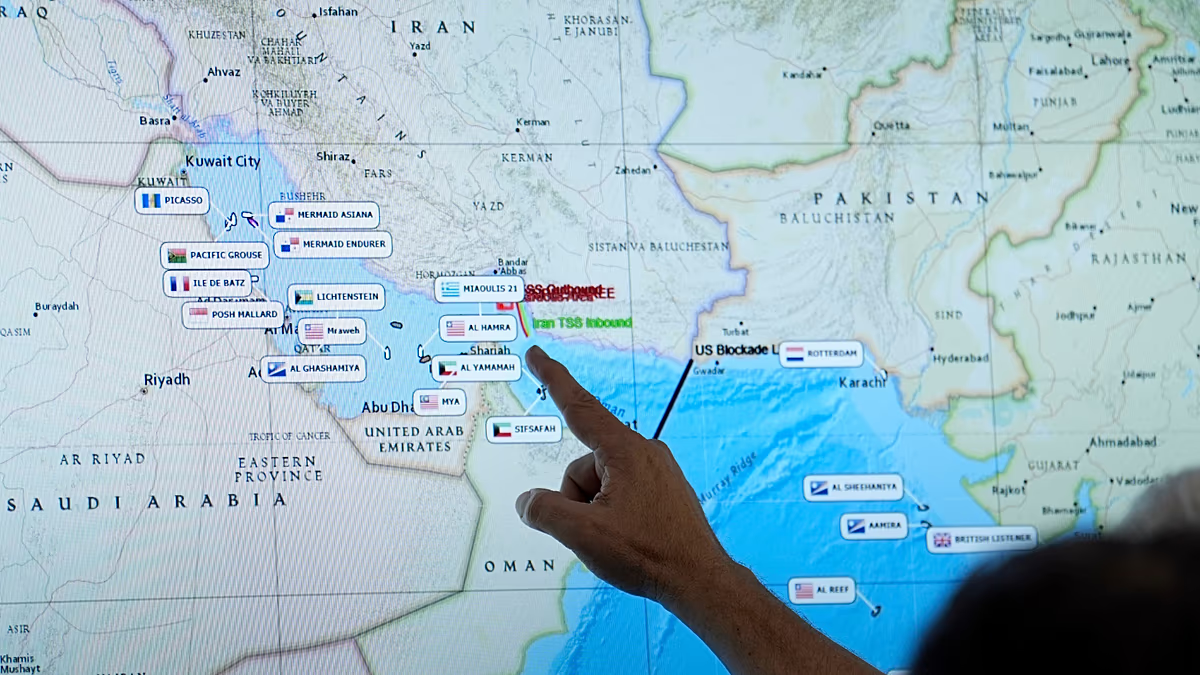


In the predawn hours before European markets opened on Monday, May 4th, 2026, the global financial landscape found itself in a tense and delicate balance. The focal point was the oil market, where crude prices registered a slight, hesitant dip. U.S. benchmark West Texas Intermediate (WTI) slipped 0.28% to $101.65 a barrel, while the international standard, Brent crude, barely moved, edging down 0.06% to $108.10. This minor retreat belied the monumental anxiety underpinning trading floors worldwide. Traders were digesting a stark announcement from U.S. President Donald Trump, who declared that a military-led “Project Freedom” would commence that very morning to escort commercial ships through the critical Strait of Hormuz. This narrow waterway, the conduit for about a fifth of the world’s oil, had become a bottleneck of global proportions due to the ongoing war with Iran. In a swift rebuttal that underscored the volatility of the situation, Iran rejected the American plan outright, setting the stage for a potentially dangerous geopolitical standoff in the heart of the world’s energy arteries.
The stakes of this confrontation could not be overstated, as the oil market had become the undeniable fulcrum upon which global economic stability teetered. As analyst Stephen Innes of SPI Asset Management noted, the situation had created a surreal maritime traffic jam, with “hundreds of tankers, bulk carriers, and cargo ships still stranded across the Gulf.” The logistical crisis had become so severe that producers were being forced to shut down wells—not due to lack of demand, but because there was simply no room left to store the unshipped oil. The U.S. plan, involving guided-missile destroyers, over a hundred aircraft, and 15,000 service members according to Central Command, was a high-risk gambit aimed at forcibly unlocking this bottleneck. Yet, the Pentagon’s silence on operational details only added to the market’s unease, leaving traders to wonder whether the move would de-escalate the situation or ignite a new, more dangerous phase of conflict.
Amid this tense backdrop, equity markets in the Asia-Pacific region presented a surprisingly mixed picture, reflecting the complex interplay of regional factors and global worries. Hong Kong’s Hang Seng Index jumped 1.4%, while markets in mainland China and Japan were subdued due to “Golden Week” holidays. The most dramatic rallies occurred in South Korea and Taiwan, where the Kospi and Taiex surged 3.8% and 4.2% respectively, fueled by robust buying in the technology sector. This regional strength echoed the record-setting momentum on Wall Street from the previous Friday. The S&P 500 had climbed to another all-time high, closing out its fifth consecutive winning week, largely propelled by a 3.3% rally in tech behemoth Apple following its better-than-expected earnings. Even as the Dow Jones dipped slightly, the Nasdaq composite soared to a record close, demonstrating a market finding reasons for optimism even in a troubled climate.
This resilience on Wall Street was fundamentally rooted in the continued strength of corporate America. Despite the dark cloud of war and soaring energy prices souring consumer confidence, U.S. companies were delivering impressive financial results for the first quarter of 2026. More than a quarter of S&P 500 firms had reported, and a robust 84% had exceeded analysts’ profit estimates. The index was on track for roughly 15% year-over-year earnings growth, a powerful testament to corporate adaptability. This dynamic highlighted a fascinating dichotomy: while Main Street households grappled with the tangible pressures of high fuel costs, Wall Street was being buoyed by strong bottom lines, with Apple’s performance serving as a prime example of how market-leading giants could dictate broader index movements even during periods of geopolitical strife.
However, the overwhelming uncertainty shadowing this corporate success story remained the trajectory of oil prices. The war had transformed the energy market; before the conflict, Brent crude traded around $70 per barrel, but fears of a prolonged closure of the Strait of Hormuz had sent prices soaring. This very surge had paradoxically boosted the latest quarterly profits for oil giants Exxon Mobil and Chevron, yet their stock prices fell as investors focused on their declining net income compared to the previous year and Friday’s slight regression in crude prices. This reaction captured the market’s schizophrenia—rewarding high prices in the short term while fearing their corrosive, inflationary impact on the global economy in the long term. Every twist in the geopolitical drama, from presidential announcements to Iranian rebuttals, sent immediate ripples through currency markets as well, with the dollar strengthening against the yen and the euro weakening in early Monday trading, a classic flight-to-safety maneuver.
Thus, the world entered the new week suspended between two powerful narratives. One was a story of remarkable economic resilience, characterized by blockbuster corporate earnings and soaring technology stocks pushing major indices to unprecedented heights. The other was a story of profound vulnerability, centered on a militarized choke point in the Persian Gulf, stranded tankers, and a cold war of words between world powers that threatened to destabilize global energy supplies. The slight dip in oil prices was not a sign of calm, but a collective holding of breath. The financial markets, for the moment, were choosing to focus on the robust earnings reports in front of them. Yet everyone understood that this fragile equilibrium depended entirely on events far from corporate boardrooms—on the tense waters of the Strait of Hormuz, where a major geopolitical gamble was just beginning, holding the power to redirect the currents of the global economy in an instant.