



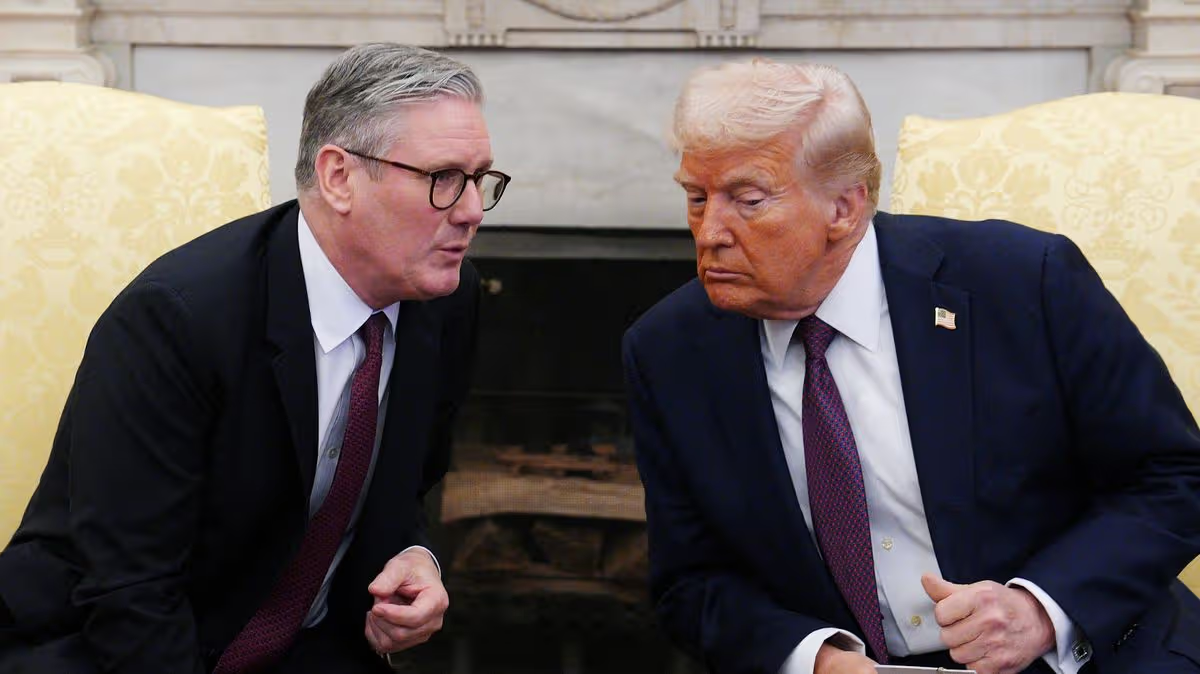
Of all the diplomatic dances a new British Prime Minister must learn, none is more unpredictable than the one with an American President, particularly when that President is Donald Trump. The relationship between Sir Keir Starmer and Trump has been a study in contrasts—a narrative of attempted warmth punctuated by inevitable friction, as their tenures as world leaders overlapped. From the outset, Starmer, as Leader of the Opposition, approached the prospect with pragmatic realism, stating he would simply “have to make it work” if both men ascended to power. This resigned acceptance set the tone for a connection that would be defined not by deep ideological alliance, but by the necessity of managing a volatile and consequential partnership between two of the world’s oldest allies.
The initial efforts were indeed made with a focus on cordiality. Following Starmer’s election and Trump’s return to the Oval Office, the two leaders held their first dinner in New York in September 2024, alongside then-Foreign Secretary David Lammy. This meeting was a feat of diplomatic stagecraft, given Lammy’s past, blistering characterization of Trump as a “woman-hating, neo-Nazi-sympathising sociopath.” The tableau of them dining together symbolized the Labour government’s immediate priority: to reset relations and build a functional, working dialogue with the new administration, regardless of past rhetoric. It was a clear signal that Starmer’s government was opting for a strategy of engagement over alienation, understanding the immense economic and security stakes involved.
However, the first signs of significant strain emerged even before Trump’s inauguration, rooted in the hyper-charged atmosphere of the American electoral process. A row erupted over British Labour Party volunteers travelling to campaign for Democrats in battleground states. Trump’s campaign team filed a formal complaint with the Federal Election Commission, accusing the UK Labour Party of “blatant foreign interference” in the US election. This allegation framed the transatlantic political kinship between Labour and the Democrats as a potentially illicit activity, injecting a dose of political poison into the relationship. Starmer dismissed the complaint as a normal occurrence, noting that party staff volunteering in US elections was a long-standing practice. Yet, the incident highlighted a fundamental tension: the natural political affinities of Starmer’s government often stood in direct opposition to the worldview and sensitivities of the Trump movement, creating a fault line that would persist.
Upon Trump’s inauguration, the British Government consciously doubled down on its strategy of warm engagement. Public statements from both sides aimed to project harmony. Trump remarked that the pair got along well and that Sir Keir had done a “very good job thus far.” This period saw the UK government carefully positioning itself to protect national interests, most critically the UK’s export economy. Anticipating the Trump administration’s protectionist impulses and fears of punitive tariffs, the government began lining up the veteran political strategist Peter Mandelson as the next US Ambassador. Mandelson, a figure renowned for his tactical acumen and deep experience, was viewed as the ultimate “trusted pair of hands” to navigate the turbulent waters of a Trump-led Washington. This move underscored the British approach: to deploy the most seasoned operators to manage a relationship too vital to be left to chance or goodwill alone.
The underlying reality, however, is that the “warm but rocky” dynamic is less a personal story between two men and more a reflection of the profound geopolitical and ideological shifts at play. Starmer’s centre-left, internationally cooperative project inherently clashes with Trump’s nationalist, transaction-oriented “America First” doctrine. Their interactions are therefore less about genuine camaraderie and more about the periodic negotiation of red lines and concessions—on trade, on climate policy, on NATO commitments, and on the approach to global conflicts. The warmth is the necessary grease for the wheels of diplomacy; the rockiness is the inevitable result when those wheels hit the hard rocks of divergent fundamental principles.
Consequently, the Starmer-Trump relationship stands as a defining case study in modern statecraft. It demonstrates how, in an era of disruptive populist leadership, traditional allied nations must operate with a blend of pragmatic outreach, strategic personnel choices, and calm management of frequent crises. The dinner in New York, the volunteer controversy, the appointment of Mandelson—each episode is a chapter in a manual on navigating an unpredictable and powerful partner. For Starmer’s government, the mission is not to forge a deep friendship, but to steadfastly protect British interests through a combination of diplomatic resilience and calculated pragmatism, ensuring that even the rockiest patches do not derail the essential journey of transatlantic partnership.