


The Academic Mirage: When Ambition Outpaced Integrity
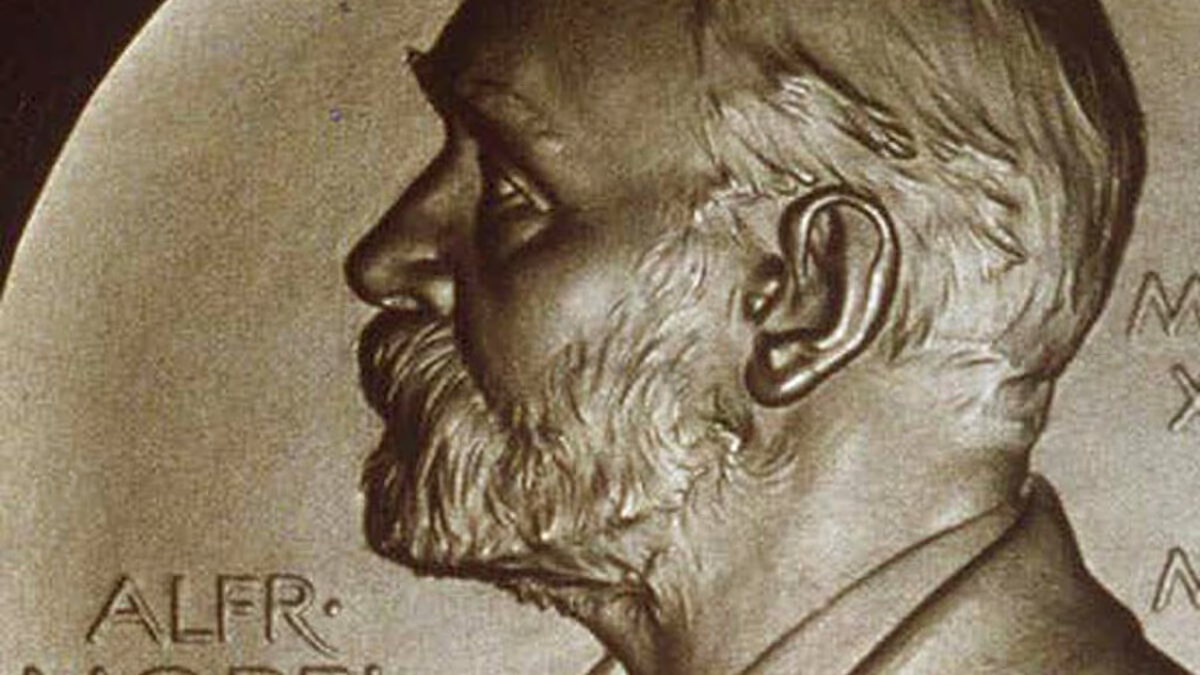
In the quiet, scholarly halls of academia, where reputation is built upon a lifetime of rigorous work, the story of Florent Montaclair unfolds as a modern parable about the perils of ego and deception. A 56-year-old professor of language science, Montaclair spent over two decades cultivating a career at the Marie & Louis Pasteur University of Franche-Comté. To the outside world, he presented the image of an accomplished researcher, his credentials seemingly bolstered by international recognition. However, this carefully constructed facade began to crumble when colleagues and journalists grew curious about a mysterious accolade adorning his curriculum vitae—a prize so prestigious it was touted as nothing less than the “Nobel of philology.” What followed was not just a professional downfall but a legal and ethical unraveling, revealing a hoax fabricated from digital threads and grandiose self-delusion.
The heart of the scandal lies in a perfectly devised stratagem, a testament to how easily illusion can be crafted in the digital age. To elevate his academic standing, Montaclair allegedly conjured an entirely fictitious organization, meticulously naming it to imply global authority and scientific esteem. Once this phantom entity was established, it became a self-sustaining engine of flattery: it would announce its “results,” and, unsurprisingly, Montaclair’s name consistently appeared among the laureates. In essence, he created a prize, defined its criteria, and then awarded it to himself. This “international” distinction was then seamlessly woven into his professional narrative, enhancing his CV and presentations, thereby projecting an image of a scholar celebrated by his peers worldwide. It served as a powerful lever of credibility, potentially unlocking new career opportunities and solidifying his position within academic circles.
However, in an era defined by instant verification and digital scrutiny, such fabrications are fraught with risk. The illusion began to dissipate when skeptical colleagues and investigative journalists attempted to trace the origins of this elusive prize. No one in specialized networks at institutions like the Sorbonne or Oxford had ever heard of it, raising immediate red flags. Their inquiries quickly uncovered a stark reality: there was no legal structure, no authentic jury, and no financial endowment associated with the award. The so-called “Nobel of philology” was exposed as a chimera—a mirage of prestige with no substance. This revelation triggered a formal investigation by the Montbéliard public prosecutor’s office, examining allegations of forgery, the use of forged documents, fraud, and the unlawful assumption of titles, casting doubt even on the legitimacy of his claimed PhD from an American university.
The consequences were swift and severe, illustrating how high the stakes are in the world of academia, where trust is the foundational currency. After more than 20 years of service, Montaclair was expelled from his university position; the institution confirmed he “no longer holds any position whatsoever.” Simultaneously, the French Ministry of Education launched a parallel process to assess the alleged misconduct, which could lead to further disciplinary actions, including the potential revocation of his professorial title. This dramatic fall from grace underscores a painful truth: the very digital tools that can be used to build a false reputation can also just as easily dismantle it, leaving behind a trail of broken trust and professional ruin.
Beyond the immediate legal and professional ramifications, this saga invites deeper reflection on the pressures within academic and research communities. In a competitive environment where publications, awards, and titles often dictate career advancement, the temptation to embellish one’s achievements can be profound. Montaclair’s case serves as a cautionary tale about the ethical boundaries that define scholarly work. It highlights the vulnerability of institutions to such deceptions and the critical importance of vigilance, peer review, and transparency in upholding the integrity of academic endeavors. When ambition overshadows integrity, the pursuit of recognition can devolve into a hollow performance, damaging not only the individual but also the collective credibility of the educational ecosystem.
Ultimately, the story of Florent Montaclair is more than a simple case of fraud; it is a human story about aspiration, vulnerability, and the consequences of losing one’s way in the quest for esteem. As the judicial and disciplinary processes unfold, it reminds us that authenticity and honest achievement remain irreplaceable. In the end, no digital stagecraft or fabricated honor can substitute for the genuine respect earned through dedicated contribution and intellectual honesty—a lesson that resonates far beyond the halls of academia, into every realm where character is ultimately judged by actions, not illusions.