


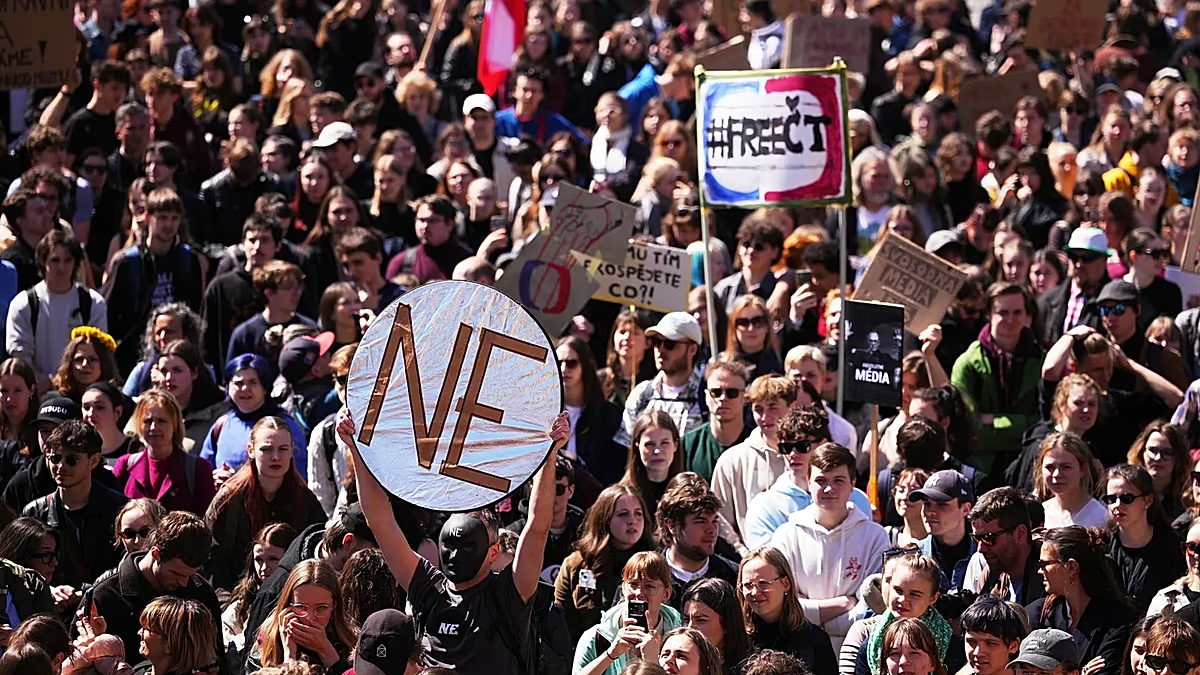
The crisp spring air of Prague was pierced not by birdsong, but by the unified voices of thousands on a recent Wednesday. Students, both from high schools and universities, flooded the streets of the Czech capital in a powerful display of civic engagement. Their protest was a direct response to a controversial new plan drafted by the coalition government of populist Prime Minister Andrej Babiš. The core of this proposal is a fundamental overhaul of how Czech public radio and television are funded. Currently, these services are financed through fees paid by individuals, households, and businesses, a model designed to create a buffer between media operations and the state. The government’s plan seeks to scrap these fees entirely, making the broadcasters fully dependent on allocations from the state budget. For the young protesters marching and chanting “We won’t let you take the media,” this shift represented an alarming threat to a cornerstone of their democracy, a sentiment echoed in smaller rallies organized across the country.
This move has ignited a firestorm of criticism from media advocates, unions, and opposition figures who see it as a direct assault on media independence. The concern is straightforward: if public broadcasters must rely solely on the government of the day for their budget, their ability to report critically on that same government is severely compromised. The financial threat is also immediate and stark; the draft plan would significantly reduce the current budgets of Czech Television and Czech Radio. Deputy Chairwoman of the Independent Unions at Czech Television, Zuzana Bancanska, gave a stark warning to staff, stating that the changes would inevitably lead to mass layoffs and cripple the outlets’ ability to perform their public service mission. She, alongside the media unions, has urged the public to rally behind media independence and has declared a readiness to call strikes if the legislation proceeds.
The anxiety extends far beyond the nation’s borders, drawing the attention of international press freedom organizations. The Vienna-based International Press Institute (IPI) expressed deep concern, suggesting the motivation behind the proposal appears to be to deliberately “weaken the broadcasters’ financial and editorial independence.” This perspective frames the funding change not as a benign administrative adjustment, but as a strategic maneuver to tame critical journalism. Opponents of the plan point to concerning parallels in Central Europe, arguing it mirrors tactics used in Slovakia and, most notably, in Hungary under the long rule of Prime Minister Viktor Orbán. The comparison is politically charged, as Orbán is an ally of Prime Minister Babiš within their “Patriots for Europe” grouping in the European Parliament. For many critics, the Czech proposal seems to follow a regional playbook where political influence over public media is a key step in consolidating power.
In defense of its proposal, the Czech government has rejected all accusations of attempting to meddle with or control media coverage. Its argument rests on an appeal to European norms, stating that having publicly funded media is a common practice across the continent. Officials contend that moving to direct state funding from the general budget is simply a modernization of an outdated license fee system, potentially streamlining operations. They present it as a pragmatic financial reform rather than a politically-driven intervention. This stance aims to normalize the proposal and deflect criticism by framing opponents as resistant to change or misrepresenting a routine administrative decision. However, this rebuttal does little to assuage fears about the specific mechanism of control that annual parliamentary budget negotiations could impose.
The stakes of this conflict are profoundly high, and the path forward is fraught with tension. The draft plan still requires formal approval from the full government and, most critically, from Parliament. This legislative journey will be a major test of the political landscape, potentially defining the relationship between the state and independent institutions for years to come. The situation remains fluid, with media unions holding the possibility of strike action as a potent countermeasure if the legislation advances. The public, mobilized by the student-led protests, is now a key actor in this drama, its support being actively courted by both sides. The outcome will signal whether the Czech Republic reinforces its public service media as an independent pillar of society or moves it closer to a model where its financial survival is subject to political winds.
Ultimately, this is more than a debate about budgets and fees; it is a struggle over the very identity of a nation’s public square. The students marching through Prague understand that a media landscape where critical inquiry is financially threatened is a democracy diminished. The protest echoes a fundamental question for modern societies: how do you fund a public good meant to hold power accountable, without making it accountable to that same power? As the Czech government and its critics brace for a protracted battle, the principles of editorial independence, the practical realities of journalism under financial strain, and the ominous regional precedents all collide. The resolution will not only shape the future of Czech television and radio but will also serve as a telling indicator of the health of democratic safeguards in the heart of Europe.